
READING FOR SEPTEMBER 10, 2024: LEVITICUS 25, ACTS 2, PSALM 94:1-11 LEVITICUS 25 God put in place a sophisticated economic system for Israel that supports the family, rewards hard work, respects the land, creates work/life balance, eliminates generational poverty and honors God. For all these reasons, it will likely never again be tried.
Verses 1-7 describe the seven-year cycle that God commanded Israel to implement immediately upon settling into the promised land. The people were to sow and reap for six years. In year seven, they were to do neither but allow the land to take a sabbatical. Hired workers and slaves also could not work on the land. Everyone was to trust God that the land would produce enough foods from the remnants of the previous year. People could go out and pick grain as needed for their daily needs, but no full-scale sowing or harvest was permitted.
God then expands this principle to a generational scale. He said after seven cycles of seven years declare a year of jubilee for year 50 starting on the Day of Atonement. It’s another sabbatical year for the land after the seventh sabbatical year. That made two straight years without sowing and reaping. It would require faith that God’s providence would meet the needs for each family, just as He did with manna in the desert.
Here’s where it really gets interesting. Eventually, Joshua will divide the promised land, giving families designated territories within the region allotted to their tribe. Note that each tribe consists of descendants from one of the sons of Jacob and the tribe retains the name of that particular son. During the 49 years in between years of jubilee, regular economic activity takes place. Some families will gain wealth and others may grow poorer. By the end of year 49, the Smith family may owe the Jones family lots of money. It is possible that poor Smith sold some or all of his land to rich Jones to pay off his debts. It is even possible that poor Smith sold himself and his family off to rich Jones as indentured slaves to work off his debts.
Now we come to the year of jubilee. Poor Smith can leave rich Jones's service and reclaim all the property he transferred to rich Jones. Poor Smith has no further debts and may start over with a clean slate financially. Now if poor Smith has a close relative he does not need to wait for the year of jubilee for his financial freedom. The relative can redeem Smith by paying Jones what Smith owes. The amount is on a sliding scale based upon the number of years until the jubilee. For example, if it is 30 years before the next jubilee, the amount would be large, say a million dollars. If it is 10 years before the jubilee, it might be around three hundred thousand.
READING FOR SEPTEMBER 10, 2024 CONTINUED: LEVITICUS 25, ACTS 2, PSALM 94:1-11 This chapter has additional interesting information on the treatment of those in challenging life situations: poverty and slavery. The overall principle is one of kindness to these individuals. Regarding poverty, this passage describes the approach: “Now in case a countrymanof yours becomes poor and his means among you falter, then you are to sustain him, like a stranger or a resident, so that he may live with you. Do not take any kind of interest from him, but fear your God, so that your countryman may live with you” (vs. 35-36).
Slavery is a topic of great sensitivity given America’s dreadful history with it. We understand- ably look back at it through the lens of those disgraceful practices. Regardless of when it occurred, slavery is objectively a bad result from the fall. The biblical context, though, is nuanced. The word for slavery/servant in Hebrew is “ebed” and is used in four ways:
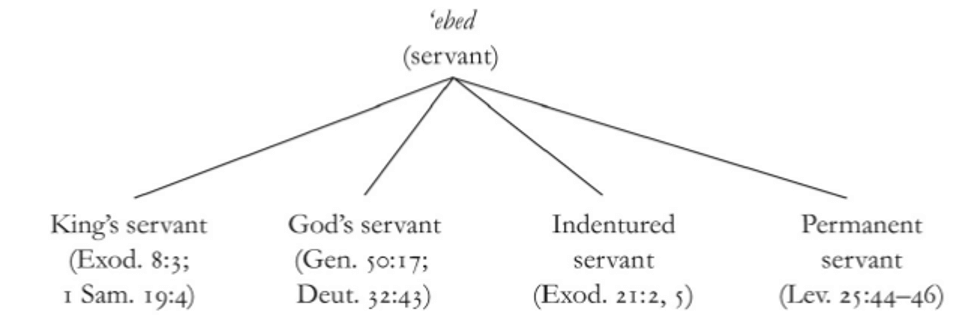
Chart from Jay Sklar
Israelites were not permitted to consider their countrymen as permanent slaves due to the year of jubilee’s literal escape clause. Regarding slaves acquired from neighboring countries, theologian Jay Sklar makes these observations: “This rationale does not apply to non-Israelites (25:44-46), who have not experienced such redemption and are not naturally covenant members. But even here, the same legal safeguards applied, and several laws presume that servants, even those from foreign lands, would be treated as household members, and thus able to partake in Israelite celebrations like the Passover (Exod. 12:44) and the feasting of Israelite festivals (Duet. 16:11-14). This is the very opposite of dehumanization.”
ACTS 2 Some of us might remember that there was a Christian rock band called the Second Chapter of Acts. This speaks to the powerful impact this chapter still has on us today. (It’s hard to imagine a group named after Leviticus). What we call Pentecost was also known as Shavuot or the Feast of Weeks (Lev. 23:15-22). It was seven Sabbaths plus one day (50 days) after the
READING FOR SEPTEMBER 10, 2024 CONTINUED: ACTS 2, PSALM 94:1-11 Feast of Firstfruits. This was a day, according to Leviticus, when all Jewish males were required to go to Jerusalem. Thus, there were lots of people in town from all over the known world. What happened next changed that world. The over one hundred disciples were together. The Holy Spirit descended from heaven sounding like a violent wind and looking like fire in the shape of human tongues. These tongues landed on each individual disciple who then spoke about God deeds in every language that was represented in the crowd of Jew. There were two reactions: one group wondered about the meaning and one group mocked this dramatic display. Perhaps that is still the reaction to any great work of the Holy Spirit. Let’s be in that first group. Jesus said what was taking place was the baptism of the Spirit (Act. 1:5).
Peter took advantage of this heavenly disruption to do a mass Bible study. Do we want to take advantage of a surprising work of the Holy Spirit? Then know the Bible well enough to communicate the appropriate passage at the appropriate moment. Having just considered slavery in Lev. 25, it’s interesting that this passage from Joel foresaw this day when the Spirit would fall even on male and female servants/slaves (doulous), enabling them to prophecy.This passage is also significant regarding the role of women in the church. Egalitarians or those who believe women can have the same role in the church as men will point to this passage as evidence. Complementarians or those who believe women and men have complementary but distinct roles would say that prophesy (prophēteusousin) does not mean a teaching and leadership role over men when the entire assembly is together (1 Tim. 2:11-12; 1 Cor. 14:33-35). What both groups agree on is what Peter’s main objective was for quoting this passage: “Everyone who calls on the name of the Lord will be saved” Consider the future of those who don’t call out to God.
Peter then explained how Jesus’s life and death were a necessary part of God’s plan for humanity: the Gospel. He again quoted from the Bible to make the point that David foresaw Jesus’s resurrection. Then he tied the resurrected Jesus to the baptism of the Holy Spirit that they had all just witnessed together. Finally, he went in for the clincher. This resurrected Jesus whom all these folks had killed is the Lord of all and the promised anointed One (Messiah) of God. This appeared to shock them as they remembered in horror what they had done. But Peter, who also once denied Jesus, had the solution: repent and be baptized. How was this rather blunt sermon received? That very day 3,000 people believed and were baptized.
READING FOR SEPTEMBER 10, 2024 CONTINUED: ACTS 2, PSALM 94:1-11 Peter’s shocking message also targets us today: “The promise is for you and your children and for all who are far away, as many as the Lord our God will call to Himself” (vs. 39).Question: Once we are saved, does our life change or continue as before? “They were continually devoting themselves to the apostles’ teaching and to fellowship, to the breaking of bread and to prayer” (vs.43). Yes, it’s true this was a once in history event, but, keeping with the slavery imagery, we are now under new ownership having received the Spirit’s baptism. Jesus says we are “born again” (John 3:3).
PSALM 94:1-11 We all know that Jesus told us to love our enemies and pray for those who persecute us (Matt. 5:44). Can we at the same time also pray to the “God of vengeance,” who is the also “judge of the world,” to pay back retribution to the proud (Psalm 94:2). Let’s take a look at these proud people as described in this Psalm. They speak arrogantly. They crush God’s people. They kill widows, strangers, and orphans. They don’t believe what the Bible says about God. Are there people who meet these criteria today? How about in recent history? For example, the Soviet Union, under Joseph Stalin, had over 100,000 Russian Orthodox pastors shot in 1937-38 as part of his five-year plan of atheism. Could Stalin be loved while asking God for retribution against him?
In verses 8-11, the Psalmist addresses these proud people, rhetorically at least. He laments that they are so clueless about God. Let’s be certain that we don’t adopt their same tendencies: believing that God doesn’t hear or see our actions, believing God won’t ever punish evildoers, and believing that God is unaware of our thoughts. These beliefs reveal a diminished view of God that will lead to problems in this life and no hope for eternity.
Back to the questions posed above about loving destructive, hateful people while praying for retribution. The key is praying to and trusting God, the judge of all the world, and not taking any vengeful action on our own. Paul, under the inspiration of the Holy Spirit, appears to have figured this out: “Never take your own revenge, beloved, but leave room for the wrath of God, for it is written: “Vengeance is Mine, I will repay,” says the Lord. “But if your enemy is hungry, feed him; if he is thirsty, give him a drink; for in so doing you will heap burning coals on his head.” Do not be overcome by evil, but overcome evil with good” (Rom. 12:19-21).