READING FOR DECEMBER 6, 2024: DEUTERONOMY 25, REVELATION 3, PSALM 119:145-152 DEUTERONOMY 25 The courts give power to the judge to decide cases in a dispute between parties. The judge chooses who is righteous and who is wicked. Then the judge determines if the wicked deserves to be beaten and how many strikes he is given based on the degree of wickedness. He can order up to 40 strikes. Anything above that would be considered excessive and degrading to the guilty person. Given the great likelihood that one of the disputed parties would be punished this way in ancient Israel, it is little wonder that Jesus advocates for settling disputes before they reach the court: "Come to good terms with your accuser quickly, while you are with him on the way to court, so that your accuser will not hand you over to the judge, and the judge to the officer, and you will not be thrown into prison" (Matt. 5:25).
Again, we see a concern for humane treatment for animals that Paul later creatively applies to reimbursing teaching elders (1 Tim. 5:18). This is followed by a bit more detail on Levirate marriages, which occur when a brother is asked to marry the wife of his deceased brother who left no heir. Here we see the shameful consequences for the brother who refuses to marry this woman. (It might have been a good idea for men in ancient Israel to get the approval of their single brothers before choosing a wife.) Speaking of wives, we learn that if wives get involved in their husbands' fights, there should be no grabbing below the belt. No doubt the penalty for unfairly intervening deterred even the most protective wives. Perhaps even today, spouses should be careful that their bias toward their husband does not lead to regrettable "overreaching." In the commands about accurate weights, we see how seriously God takes dishonest business dealings. He calls them abominations, which is what He also calls child sacrifice. Finally, Moses reminds the people to wipe out all the Amalekites due to their terrible treatment of Israel in the wilderness years before. Likewise, today, unless we confess our sins and experience Jesus's forgiveness, there is no statute of limitations on our unconfessed sins. Revelation 3: In this chapter Jesus completes his letters to 7 churches with these last three:
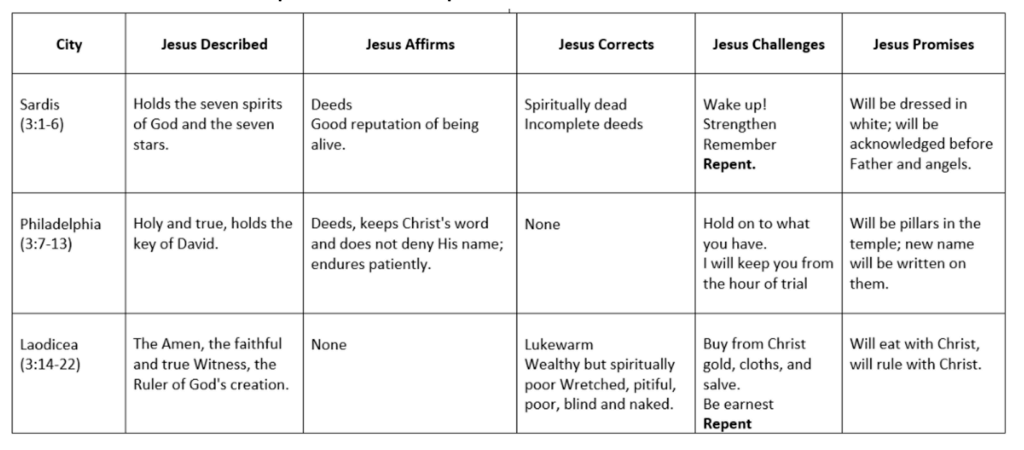
READING FOR DECEMBER 6, 2024 CONTINUED: REVELATION 3, PSALM 119:145-152 Let’s consider the church in Sardis. Their current reality didn’t match up to their past reputation. Jesus doesn’t mince words, as he declares, “You are dead!!” Not everyone who claims the name of Christ will have a living faith! A faith that is not practiced will not grow and it can die. Jesus makes it clear that it is not just being busy doing things for what they were doing was leading to death. This is because their deeds were not complete. Their deeds did not arise out of a living vibrant faith which would enable the Holy Spirit to bring their deeds to completion.
PSALM 119:145-152 On first reading it appears that the Psalmist is suggesting a deal to God: Save me and then I will obey your word. In reading the whole passage, though, it is more that the Psalmist is giving a reason for God to save him: Since I follow your word, I will continue to do so longer on earth should you save me so that I won’t die. Thus, he is not suggesting that his willingness to obey is contingent upon God answering this prayer. This should be our stance. Consider the words of the young Hebrews in the fiery furnace: “If it be so, our God whom we serve is able to rescue us from the furnace of blazing fire; and He will rescue us from your hand, O king. But even if He does not, let it be known to you, O king, that we are not going to serve your gods nor worship the golden statue that you have set up” (Dan. 3:17-18).
Notice, though, how intently the Psalmist seeks God’s answer and wisdom due to his being in a difficult spot: “I rise before dawn and cry for help; I wait for Your words. My eyes anticipate the night watches, so that I may meditate on Your word” (vs. 147-148). Isn’t being totally dependent upon God an undeniable benefit of experiencing extreme hardship? That’s just the way we are in our relationship with God. C. S. Lewis puts it this way: “Pain insists upon being attended to. God whispers to us in our pleasures, speaks in our consciences, but shouts in our pains. It is his megaphone to rouse a deaf world.” The Psalmist also clearly describes the wicked as those who “are far from Your law.” We avoid that terrible designation by considering that His“commandments are truth.” Stop rationalizing why we don’t agree with the Bible. Instead, as the song says, Trust and Obey.