
READING FOR JANUARY 3, 2024: JOSHUA 11, JOHN 1, PSALM 135 JOSHUA 11 Israel Defeats the Northern Kings
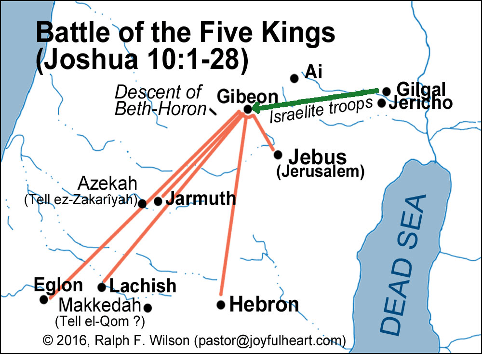
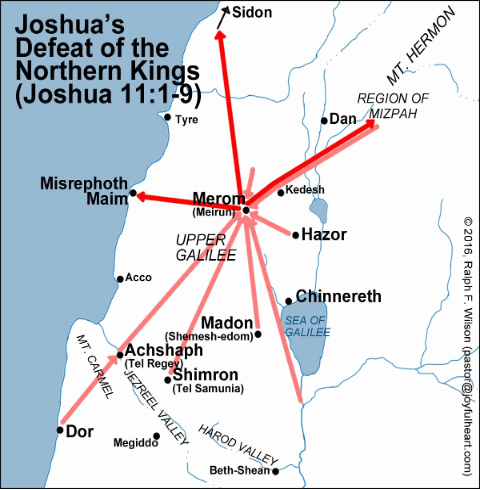
The maps at left show the battles against the five southern kings (top) at Gibeon from Joshua 10 and the allied northern kings (bottom) at Merom from Joshua 11. After the initial routing of the kings at Merom, Israel pursued the fleeing northern kings all the way to Mizpah, Misrep—hoth Maim, and Sidon. Then they turned back to Hazor to finish off that king. In both these great battles an alliance of kings first mobilized against Israel at a central location. Israel, however, initiated the battles in both cases, immediately after receiving the green light from God. In the south: “The Lord said to Joshua, ‘Do not fear them, for I have handed them over to you; not one of them will stand against you.’ So, Joshua came upon them “suddenly” (Joshua 10:8-9). In the north: “’I am going to turn all of them over to Israel as good as dead; you shall hamstring their horses and burn their chariots with fire.’ So, Joshua and all the people of war with him came upon them “suddenly” at the waters of Merom and attacked them” (Joshua 11:6-7). What green light has God given us? “Go, therefore, and make disciples of all the nations, baptizing them in the name of the Father and the Son and the Holy Spirit, teaching them to follow all that I commanded you; and behold, I am with you always, to the end of the age.” (Matt 28:19-20). As with Josh-- ua, God is with us. Like Joshua, let’s obey now.
| The maps at left show the battles against the five southern kings (top) at Gibeon from Joshua 10 and the allied northern kings (bottom) at Merom from Joshua 11. After the initial routing of the kings at Merom, Israel pursued the fleeing northern kings all the way to Mizpah, Misrep—hoth Maim, and Sidon. Then they turned back to Hazor to finish off that king. In both these great battles an alliance of kings first mobilized against Israel at a central location. Israel, however, initiated the battles in both cases, immediately | |
| after receiving the green light from God. In the south: “The Lord said to Joshua, ‘Do not fear them, for I have handed them over to you; not one of them will stand against you.’ So, Joshua came upon them “suddenly” (Joshua 10:8-9). In the north: “’I am going to turn all of them over to Israel as good as dead; you shall hamstring their horses and burn their chariots with fire.’ So, Joshua and all the people of war with him came upon them “suddenly” at the waters of Merom and attacked them” (Joshua 11:6-7). What green light has God given us? “Go, therefore, and make disciples of all the nations, baptizing them in the name of the Father and the Son and the Holy Spirit, teaching them to follow all that I commanded you; and behold, I am with you always, to the end of the age.” (Matt 28:19-20). As with Josh-- ua, God is with us. Like Joshua, let’s obey now. |
JOHN 1 The author of John is the son of Zebedee, the brother of James and the beloved disciple of Jesus.Though he was present for Jesus’ entire earthly ministry, John’s gospel is not simply a retelling of Jesus’s life. It doesn’t include every story and teaching and encounter, and it is distinctly different in arrangement and tone than the previous three gospel accounts. This is partly because it was written several decades later. By the time John wrote it, the gospels of Matthew, Mark, and Luke had been widely circulated, and the facts and accounts of Jesus’ life were well known and well established, so John could take a different focus. He wrote a much more theological account. (But don’t worry that it will be too scholarly for us; it’s like a pool that’s safe for a child to paddle in but deep enough for an elephant to swim in.) John wrote his gospel with a specific pur- pose in mind. Let’s flip to the end of the book where he explains his purpose: “These are written that you may believe that Jesus is the Messiah, the Son of God, and that by believing you may have life in his name (20:31).
John wrote so that his readers would come to believe – and continue to be strengthened in confidence – that Jesus of Nazareth was indeed the long-awaited Messiah and King of Israel and the divine Son of God, and that they would follow this Jesus into life. This is how he determined what stories and teachings to include and how he organized his gospel account. Let’s take a quick look at how John begins to achieve this purpose in Chapter 1 and get a preview of what he will write in the coming chapters. Chapter 1: Verses 1-14: John opens with an epic prologue that references both Creation and the Exodus to reveal Jesus’ eternal nature, identity, and purpose. He situates Jesus as “with God in the beginning” (creation) and tells us that he became flesh and “tabernacled” with us, the original language of verse 14 (Exodus). Verses 18, 29-35: John the Baptist testifies to Jesus’ eternal nature and divine mission in several ways, prophetically speaking of Jesus’ eternal existence (1:18, 30) and his coming sacrificial atoning death (1:29), indicating that this had been revealed to him by God. Verse 51: Jesus told Nathanael he would see “heaven opened, and the angels of God ascending and des-- cending on the Son of Man,” (referring to Jacob’s dream in Genesis 28). If these followers stayed with him, they would see what it looks like when God comes to earth, when heaven and earth are open to each other.
Seven Titles of Jesus: Already in this first chapter John gives us seven different titles for Jesus. Did you notice them? He is referred to as: Lamb of God, Son of God, Rabbi, Messiah/Christ, Jesus of Nazareth, King of Israel, and Son of Man.
Now that he has introduced us to Jesus, John will draw open the curtain and invite us to watch the drama unfold. He will allow Jesus himself to reveal his own nature and purpose in the world through what he says, what he does, and how he relates to his Father and to the people he encounters. John will allow Jesus to demonstrate for us a life lived in deep intimacy with and joyful obedience to the Father and awaken in us a longing to do the same. On one level John is the simplest of all gospels; at another level it is the most profound. No matter our level of biblical knowledge, the gospel of John promises treasures for any of us who read it seeking to know Jesus better, and through him to know the good Father and the way to light and eternal life.
PSALM 135 This Psalmist seemingly speaks to God’s people after they have arrived at the Temple in Jerusalem (those who stand in the house of the Lord-vs. 2). What should they do after traveling all those miles from their towns, ascending to the Temple? Praise the LORD (vs. 1). That seems like a long way to travel to do something so basic. Consider what those of us who are saved will be doing after our long journey through this life: “a great multitude which no one count from every nation and all tongues, standing before the throne and before the Lamb...saying, ‘Salvation to our God who sits on the throne and to the Lamb’’’ (Rev. 7:9-10). Perhaps we need to finish reading this Psalm so that we can better understand why corporate praise is so appropriate. We learn that singing praises is lovely (vs. 3). We learn that Israel then, as the church today, is chosen by God as His possession (vs. 4). We affirm our God is above all other beliefs and is totally sovereign (vs.5-6). He controls the physical creation and also has intervened in history to bring about His Kingdom purposes on earth (vs. 7-13). We learn He will judge believers with compassion (vs. 14). For those who aren’t interested in praising our God, but prefer doing their own thing, we learn that their solutions have no insight, provide no help, and lead to purposelessness (vs. 15-20). So, verses 18-21 remind believers in the God of the Bible that we need to praise Him for who He is, what He has done, and what He will do. He is worthy.