READING FOR JANUARY 14, 2025: JOSHUA 18, JOHN 8, PSALM 141 JOSHUA 18 At this point in the settlement process Joshua gathered everyone together at Shiloh, which is about 10 miles north of Bethel in the territory allotted to Ephraim. Judah, Ephraim, Manasseh, Gad, and Reuben had already received their tribal land allotments. Joshua sounds a bit miffed that the other seven tribes hadn’t taken possession of the rest of the land. (Do we ever get frustrated when church projects move ahead so slowly?) So, he tells each tribe to select three men to serve on a committee to provide descriptions of the remaining portions. Then he will cast lots in Shiloh to make the remaining assignments.
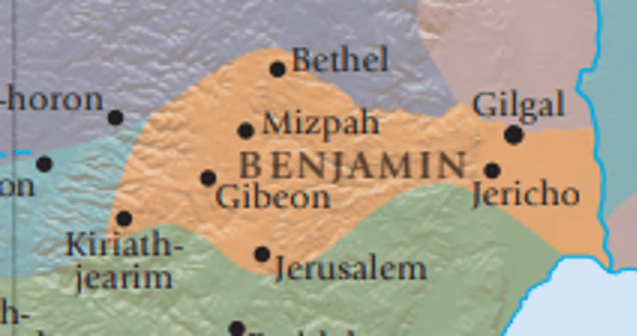
Benjamin is awarded the first allotment. As you can see, it is a smaller area with Judah on its south and Ephraim and Manasseh on its north. Its relative size is referenced when Saul is chosen king: “Am I not a Benjaminite, of the smallest of the tribes of Israel” (1 Sam. 9:21). The eastern border is the Jordan River down to the Dead Sea. The western border bends from Bethel to Beth-horon (in Ephraim) to Kiriath. The southern border snakes from there and goes south of Jerusalem and Jericho to the Dea Sea
The tribes were not only kept together, but families were awarded particular areas and cities. God seemed to want extended families to be ongoing cohesive units, unlike today’s mobility.
JOHN 8 Yesterday we read of Jesus’ fulfillment of the Water Ceremony in the Feast of Tabernacles. We saw how Jesus fulfilled in himself what had been enacted ritually for centuries: Jesus is our provision now and will become so in complete fullness when he returns to reign on earth as he does in heaven. Today we move on to Chapter 8. John 8 focuses on the second of the ceremonies that had developed over the years as a part of the Feast (or Festival) of Tabernacles: The Illumination Ceremony
The Illumination Ceremony: Celebrating God’s Presence: Four 75-foot gold oil-fed candelabras were erected in the temple courts for this ceremony. Every night for the seven nights of the festival they were lighted, illuminating the entire temple area which during the day was the scene of the Water Ceremony but at night became a different scene of celebration. The lights could be seen from the hills around Jerusalem. Righteous men would dance before the people with lighted torches in their hands, singing songs and praises. Levites with various musical instruments accompanied them on the temple steps. The lighting of the great candelabras was a celebration of the presence of God, which had accompanied the Israelites in the wilderness as a pillar of fire. Like the water, it also served a prophetic role, reminding Israel of the prophecies that one day a Messiah would come and bring light to the entire world: “It is too small a thing for you to be my servant to restore the tribes of Jacob and bring back those of Israel I have kept. I will also make you a light for the Gentiles, that you may bring my salvation to the ends of the earth” (Isaiah 49:6).
READING FOR JANUARY 14, 2025 CONTINUED: JOHN 8, PSALM 141 It is thought that John 8 takes place on the 8th day of the Feast. The great candelabras would have been extinguished, the lights put away until the next year. The festival was ending with a Sabbath’s day of rest. It is believed to be at this time that Jesus declared: I am the light of the world. (v 12). Jesus is declaring himself to be the light that guides, the light that gives life – the very presence of God among them.
Jesus’ very life on earth was a fulfillment of the Feast of Tabernacles. Just as the Jews would live in booths/tents, so, in Jesus, God took on the tent of human flesh: “The Word became flesh and made his dwelling among us.” (John 1:14). The word for dwelling literally meant to dwell in a tent – or to tabernacle among us.
We also read here in 8:1-11 the beloved story of Jesus’ mercy toward the woman caught in adultery. Your Bible may indicate that this story has been placed at different times historically in different places in Scripture. The earliest copies of John don’t have it at all – and it seems a little out of place where we find it. Chapters 7 and 8 would flow quite nicely without it. Let us allow this response from N.T. Wright guide us as we read it:
“There is something to be said for reading it here, where a lot of manuscripts do have it. John 7 has Jesus teaching in the Temple during the Festival of Tabernacles, and the crowds and authorities getting increasingly interested in asking who he is and what he’s about. John 8 has an altogether darker tone, with Jesus accusing the Judeans of willfully misunderstanding him, failing to grasp what he’s saying, and wanting to kill him, because they are following the dictates of ‘their father, the devil’. Chapter 8 records some of the harshest things Jesus is ever recorded as saying. What has happened? It is as though Jesus has come face to face with the real problem at the heart of the Judean attitude. . . The chapter fits with a change of mood brought on by something which has caught Jesus’ attention [this encounter in John 8:1-11], and has made him realize just how steeped in their own patterns of thinking his Judean contemporaries had become – and how devastatingly unlike God’s patterns of thinking they were.“ (John for Everyone)
Revealing the hardened hearts of the Jewish leaders leads us into the change of mood we see in John 8. The chapter begins with people wanting to stone a woman to death; it ends with them wanting to stone Jesus.
PSALM 141 David asks for a rapid response from God, but as we will see, his requests are not really selfish. He also asks that his prayers rise to God like incense (golden bowls full of incense, which are the prayers of the saints—Rev. 5:8) and his raised hands as an evening offering (I want the men in every place to pray, lifting up holy hands—1 Tim. 2:8). David amazingly prays in accordance with these New Testament scriptures that hadn’t been written yet. In our case, it is always good practice to pray the scriptures that are written, so that our requests are in accordance with God’s will. Verses 3-4 states he immediately wants God to keep him from speaking hurtful comments, evil desires and practices, or associate with those who do.
We need to speak these prayers. A very challenging but correct prayer is to seek correction from righteous people. We need others to hold us accountable. Ouch! This is even true if sometimes their own deeds are not perfect (vs. 5); we all fall short. Most importantly, let’s follow David’s example and set our eyes on the Lord: “Let’s run with endurance the race that is set before us, looking only at Jesus, the originator and perfecter of the faith” (Heb. 12:1-2).