READING FOR JANUARY 17, 2025: JOSHUA 21, JOHN 11, PSALM 144:1-8 JOSHUA 21 The 48 Cities Awarded to the Levites, with Surrounding Pasture Lands
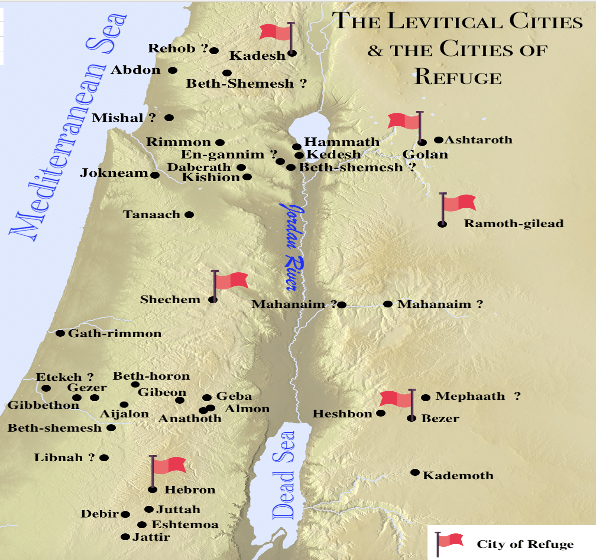
“Of these cities the priests received thirteen (Josh 21:4), and six were cities of refuge, to which men who had accidentally killed someone could go for protection. The Levitical cities were made up by taking four cities from each of the twelve tribes. The apparent purpose of thus dispersing the Levites throughout the land was to enable them, as the official representatives of the Hebrew faith, to instruct the people throughout the land in the law and in the worship of Jehovah. The Levites were not the sole possessors or occupiers of these cities. They were simply allowed to live in them and have fields for the pasture of their herds. These cities did not cease to belong to the tribes within which they were located” (Taken from the Encyclopedia of the Bible).
JOHN 11 When I am memorizing passages of Scripture, I work at it slowly, adding one sentence or phrase at a time, moving on only when I have that new line added to the previous ones I’ve learned. It’s a slow process, taking weeks or months to finish a passage, slowly layering one phrase upon another. This often provokes new insights, as I find myself stopping and staying on an idea or image when I normally would rush on in my reading. With this chapter, it was especially so. You see, I have lost a brother. So, while working on memorizing this chapter, I found myself here for a couple days as I added Martha’s first words upon meeting Jesus that day: Lord, if you had been here, my brother would not have died. My heart ached with Martha: Lord, if you had been here my brother would not have died. I felt with the sisters the sense that this death did not have to happen. You could have stopped it, Jesus, but you didn’t. Where were you? Stopping there, rather than reading straight on to the conclusion, caused me to feel the universal cry of humanity in grief: God, if you had been here my brother/mother/sister/child would not have died. If you had been here, my loved one would not have suffered.
In the days that followed, as I slowly added line by line, I read Jesus’ response to Martha, “Your brother will rise again.” In fact, in committing the passage to memory, I said the line out loud over and over. And I felt Jesus’ calm reassurance: My brother will rise again. Then I quickly found myself drawn on to Martha’s reply: I know that he will rise again in the resurrection at the last day. Can you hear the pain in her voice – perhaps even the disappointment? I know that, Lord, but I want him here. Now. And Jesus doesn’t tell her what he is planning to do. He doesn’t tell her that in just an hour or so she will indeed have her brother back. In answer to her grief, he offers only himself. “I am the resurrection and the life. . . Do you believe this?”
READING FOR JANUARY 17, 2025 CONTINUED: JOHN 11, PSALM 144:1-8 Martha affirms her belief in him. Then, still carrying the grief and the unanswered questions, she hurries back to Mary, who had been too burdened with grief to even go out to meet Jesus. Somehow the encounter – though it didn’t answer her questions or take away the pain – was enough for Martha for the time being. She hurried to get her sister, somehow certain that being with Jesus was enough.
Remember, when Jesus learned of Lazarus’ illness he was across the Jordan in a remote place. We can be sure that he was praying and listening for the Father’s direction in this matter. He remained firmly anchored in his mission to join the Father in bringing new, eternal life into the world. And in doing so, Jesus brought us the sixth sign that John recorded – the final sign before his resurrection itself, the sign that gives us ultimate confidence that we can trust him with our lives and with the life and death of those we love.
Do you, like me, have an “if only”? Most of us do, I imagine. If you had been here, Jesus, then. . . Perhaps you can do as Martha did, run to Jesus. Tell him your pain. Ask him why he didn’t come sooner or step in and prevent the pain. Listen to his response. Perhaps allow this brief exchange to be his answer to your grief. I think you will find yourself, like Martha did and like I did, resting on his love and faithfulness and coming day of restoration. Yes, Lord, I believe that you are the Messiah, the Son of God, the Resurrection and the Life, who has come and who will come again into the world to make all things new.
The key to it all, now as then, is faith. Jesus is bringing God’s new world to birth; but it doesn’t happen automatically. It doesn’t just sweep everyone along with it, willy-nilly. The key to sharing the new world is faith; believing in Jesus, trusting that he is God’s Messiah, the one coming into the world, into our world, into our pain and sorrow and death. (N.T. Wright, John for Everyone)
PSALM 144:1-8 Within the first two verses we see that David considers the Lord his trainer for battle and ultimate love of His life. We often consider God as one or the other, but the reality is more complex. If we think there is no opposition to being a Christian, perhaps that is a sign we don’t love God enough to cause the forces of evil to bother with us. The profound question David asks about the nature of man (vs.3), he asked in Psalm 8:4. The writer to the Hebrews expands upon this same question by pointing to the Gospel and to Jesus’s dual nature as God and man: “What is man, that you are mindful of him, or the son of man, that you care for him... but we see him who for a little while was made lower than the angels, namely Jesus, crowned with glory and honor be- cause of the suffering of death, so that by the grace of God he might taste death for everyone” (Heb. 2:6,9). In fact, David’s request for God to come down from heaven to deliver him (vs. 5-8) was answered in a greater sense than David could have foreseen, when Jesus became man and tasted death for everyone. Have we received this gift of grace Jesus offers?