
READING FOR MARCH 17, 2025: 1 SAMUEL 13, Romans 3, Psalm 20 1 SAMUEL 13 Saul builds up a standing army but overreaches by straying from his lane.
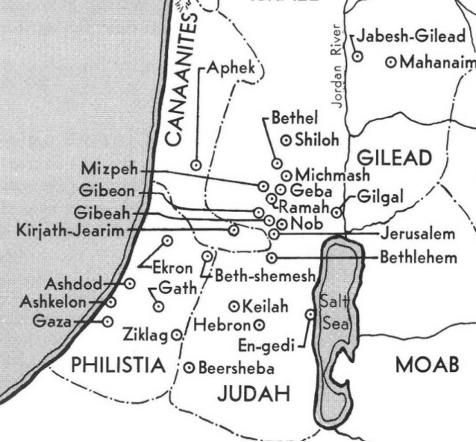
Saul continues his kingship by seemingly developing a standing army. He commands a force of 2,000 men based in Michmash and gives his son Jonathan 1,000 men stationed at Gibeah. Jonathan attacked the Philistines encamped at Geba, which appears closer to Saul’s troops. Saul announces this attack to Israel but takes credit for it himself. He also summoned the people to assemble at Gilgal. The Philistines assem-- bled an enormous force at Michmash, which caused the Israelites at Gilgal to tremble with fear. While Saul was waiting for Samuel to offer a sacrifice for the battle, the people started leaving. With Samuel being delayed, Saul decided to offer the sacrifices himself, in disobedience to the law. This angered Samuel who de- clared that, because of this sin, Saul’s descendants would not reign. A new king and line will be chosen.
As is true throughout scripture and with us today, we can only approach God on His terms as revealed in His word. Being religious and spiritual are not enough. We must be obedient. Saul went back to his troops at Gibeah, who by now were down from 2,000 to 600. Then three companies of Philistine raiders came out of Michmash, each going in different directions. If that weren’t bad enough, the Philistines had cornered the market on blacksmiths. Israel had to use Philistine blacksmiths for all their farm tools. Thus, this meant Israel had no ability to produced spears or swords. Bad industrial policy! Only Jonathan and Saul had swords. Could the situation look any bleaker?
ROMANS 3 Paul constantly finetunes his message. He just finished chapter 2 stating circum- cision must be from the heart—not the traditional spot. Now he feels compelled to say the physical descendants of Abraham still have special value because they were the recipients and trustees of God’s Word for centuries. He reminds us just because some of them rejected Jesus does not make God’s plan failed or untrue. Many today reject Jesus. Sadly, for them, they will find out one day that their rejection of Him was mistaken. Jesus is the way, the truth and the life; the only way to God. Paul again clarifies that God’s wrath doesn’t make Him unfair. He is epitome of fairness, having gone to the greatest possible extent to provide a way out of His wrath, which is His settled opposition against sin/evil as Pastor Tim Keller has stated.
Paul again finetunes his message. (He must have been frequently misunderstood and misquoted.) He writes what should be obvious: just because God’s abundant grace, which provided a way out of man’s sin problem, enhanced God’s glory (see Leibniz from March 1, 2024), sinning is never good. He will develop this concept in Rom. 6. He quotes several Old
READINGS FOR MARCH 17, 2025 CONTINUED: ROMANS 3, PSALM 20 Testament passages to support his point that everyone, both Jew and Gentile, is sinful and accountable to God (vs 19-20). The Old Testament Law provides this knowledge but can’t fix the problem. This truth isn’t communicated in many churches because it seems offensive or not loving. But it is more loving to be honest about our condition--then provide the solution: FAITH IN JESUS.
Romans 3:25 says that in God’s forbearance He passed over the sins previously committed, meaning before the cross. This is hard to interpret. We know unbelievers before the cross will not be saved; consider Jude pointing to Sodom and Gomorrah as undergoing eternal fire. On the other hand, Paul says Abraham was justified by faith (Rom.4:3). In Hebrews 3:11-14, we see the daily priestly sacrifices did not take away sins, but Jesus’s self-sacrifice “for sins for all time” perfected “for all time those sanctified.” Thus, this passing over (paresis) of sins, could mean God’s “laying aside” sins of the pre-cross believers until Jesus’s final payment for them.
PSALM 20 This Psalm is in the first-person plural (we) talking about God apparently to David. The exception is verse 6, which is in the first-person singular. Thus, a group recites how God will deliver David in an upcoming dangerous battle then another individual interjects a comment on the same topic. One could also say that this Psalm points to that greater anointed one (vs 6), Jesus, whose offering on the cross the Father accepted (vs. 3) as fulfilling God’s gospel plan (vs.4) and achieving victory (vs. 5) by defeating God’s enemy (vs. 8) of sin/death to the praise of God (vs. 7). If we pray this Psalm for our church, how should we describe our enemies and victories? Church enemies and victories found in some books of the Bible: ENEMIES OF CHURCHES:
- Jude-grumbling, lust seeking, authority rejecting, Jesus denying;
- Revelation-false teaching, lukewarm, unrepentant;
- Galatians-gospel distorting;
- Hebrews-gospel neglecting;
- 1 Corinthians-dissension, sexual immorality.
VICTORIOUS CHURCH TRAITS:
- Romans-faithful, joyful, unified;
- Ephesians-loving, thankful, prayerful, wise;
- 1 Corinthians-participatory, orderly;
- Philippians-knowledgeable, humble, contented, generous;
- Revelation-persevering, serving.