READING FOR APRIL 21, 2025: 1 CHRONICLES 2 1 CHRONICLES 2 Verses (3-17) The descendants of Judah from Judah to Jesse’s sons
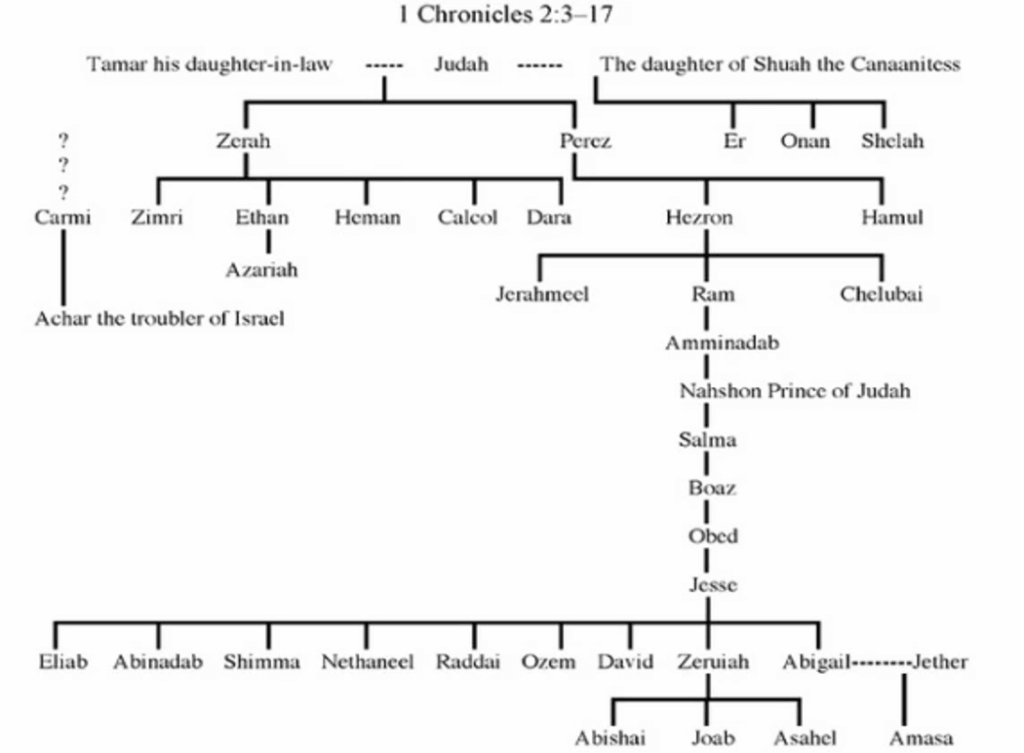
Four of David’s remarkable nephews are listed in these verses, possibly because they played important roles with David. Abishai commanded one of David’s three divisions in the battle against Absalom. In one battle, “he lifted up his spear against three hundred and slew them” (1 Sam.23:18). Joab was David longest serving commander a strong influence on David, but whose violent nature sometimes caused distress. Asahel was one of David’s 30 valiant men who died by the hand of Abner, who had backed David’s rival. Amasa briefly replaced Joab as David’s commander but was eventually killed by Joab.
Descendants of the tribe of Judah listed other than those leading to David and eventually Jesus: Verses18-24 The family of Hezron, a grandson of Judah Verses 25-41 The family of Jerahmeel, a great-grandson of Judah Verses 42-55 The family of Caleb, a great-grandson of Judah.
This listing and ones that follow include many of Jacob’s decedents, but there is a clear focus on the line that will eventually bring us Jesus, the ultimate fulfillment of God’s covenant/promise. Can some of us trace a line of faith from our grandparents to our grandchildren/great grandchildren who have put their faith in Jesus? “I thank God, whom I serve with a clear conscience the way my forefathers did...For I am mindful of the sin- cere faith within you, which first dwelled in your grandmother Lois and your mother Eunice.” (2 Tim. 1:3-5).
READINGS FOR APRIL 21, 2025: 1 CORINTHIANS 12, PSALM 33:12-22
1 CORINTHIANS 12 Chapter 12 begins a long discussion about Spiritual Gifts that will conclude in Chapter 14. There seems to be a discussion among the Corinthians about whether there is a hierarchy to the Spiritual Gifts. Is one more important than any other? Paul emphasizes three things about Spiritual Gifts:
- Spiritual Gifts are given by the Holy Spirit for the good of the community.
- The Holy Spirit has distributed the gifts as the Spirit determined.
- Everyone who has faith in Christ has been given Spiritual Gifts.
Paul lists the Spiritual Gifts of wisdom, knowledge, healing, performing miracles, prophecy, interpretation, and faith (verses 9-10.) The addition of faith to the list states that all who have confessed Jesus as their Savior have been given Spiritual Gifts
VERSES 12-26 – Paul uses the metaphor of the Body of Christ to emphasize the inter-connectedness of the Church and the Spiritual Gifts. Just as the body needs all its members (arms, legs, head, organs, etc.), the Church needs every member to function as followers of Christ. Paul reminds us in Christ we are united together. He uses the cultural distinctions of his day (Jews/Greeks – free/slave) to state these don’t matter in God’s reign through Christ. What distinctions might our culture use that we need to overcome?
In verses 15-17, Paul uses the body metaphor to address persons who believe their gifts are not important. In verses 21-24, Paul uses the metaphor for those who may think that their gift is better than others. The impor- tant thing to remember is that the Holy Spirit gives gifts to every member of the Body of Christ. We are called to use them. Honestly, we do not need everyone to prophecy. We don’t need everyone to speak in tongues.
Or, everyone to play the piano, or sing in the choir. We need you to use the gifts you have been given so that the love of Christ can be shared to the world.
The chapter ends with a hierarchy of roles and uses of the Spiritual Gifts. It is unique that Paul has spent the chapter stating that no gift is more important and now ends with a list of importance. The list is apostles, prophets, teachers, miracle workers, forms of assistance, administration, speaking in tongues. The last verse anticipates Paul discussion around love (agape) in the next Chapter. “Now eagerly desire the greater gifts. And yet I will show you the most excellent way. (1 Cor.12:31).
PSALM 33:13-22 Today’s reading is the conclusion of a praise hymn. It begins with an eight-verse section
that contains a continuation of the words of praise to God. It ends with a three-verse conclusion that offers a response to praise. King David, the writer of the psalm, calls upon the people of Israel to praise God. The
psalm affirms that God blesses the nation that places their faith in God. Those who fear God have been granted God’s blessings. The psalm then warns nations about misplaced pride. Those who think that the size of their army will bring them safety are mistaken. Those who place their trust in the number of horses sent into battle are not safe.
We currently live in a nation that has the largest military the world has ever seen. And while it is necessary for a nation to have the ability to defend itself, the psalmist tells us that our safety will come from something larger than our military. When we are in awe of God, we can rely on God’s provision. When we trust in God’s
unfailing love, we can trust in his grace alone for protection. We can pray that God will keep us alive when in darkness comes and will restore us once the troubles have past.