
READING FOR MAY 1, 2025: 1 CHRONICLES 10, 2 CORINTHIANS 4, PSALM 37:12-26 1 CHRONICLES 10 KING SAUL’S DEATH ON MT. GILBOA: HOW AND WHY
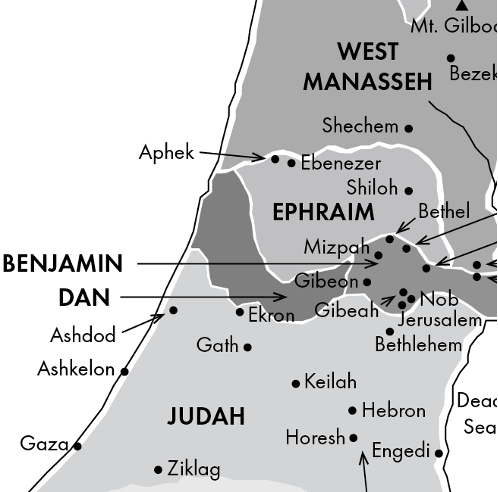
This chapter focuses on the last battle of King Saul. The Philistines, Israel’s frequent oppo- nents, were a people who also immigrated to Israel: “Have I not brought up Israel from the land of Egypt, and the Philistines from Caphtor [likely Crete]” (Amos 9:7). They had access to the superior military technology of the Greeks. Their substantial foothold in the promised land included the cities of Ekron, Gath, Ashdod, Ashkelon, and Gaza (currently much in the news). Israel fled from the battle; Saul and three of his sons died on Mt. Gilboa. The Philistines celebrated their victory by be-heading Saul and impaling it in the house of their god Dagon.
Yet even in defeat there were valiant men in Israel. The men of Jabesh-gilead (just across the Jordon east of Bezek) retrieved the bodies of Saul and his sons and gave them a proper burial. We might remember that the men of this city, in danger of having their eyes gouged out by Ammonites, were saved by forces led by Saul (1 Sam. 11). Let’s remember those who have supported us when we were in need. Unfortunately, Saul did not build on his excellent start. The text explains why he ended in disgrace: “So Saul died for his unfaithfulness which he committed against the Lord, because of the word of the Lord which he did not keep; and also because he asked counsel of a medium, making inquiry of her” (vs. 13). This writer has recently spoken to Christians who view contact with the dead as positive. Let’s learn from Saul and throughout the Bible. DON’T.
2 CORINTHIANS 4 Paul opens this chapter by affirming that the ministry he has been given helps him to stay positive in challenging times. Yes, it is true many of us cannot travel as Paul did, until he was jailed in Rome and was forced to communicate through letters. Instead of traveling to more cities, these Pauline letters have testified for Jesus in every century and country since then. Many of us at our church remember Emily’s Sear’s letter-writing. Hundreds were encouraged through her ministry. Here are a few more ministry ideas from the Bible:
- “You also must help us by prayer, so that many will give thanks on our behalf for the blessing granted us through the prayers of many” (2 Cor. 1:11);
- “I know that this will turn out for my deliverance through your prayers and the provision of the Spirit of Jesus Christ” (Phil. 1:19);
READING FOR MAY 1, 2025 CONTINUED: 2 CORINTHIANS 4, PSALM 37:12-26
- “Moreover, as for me, far be it from me that I should sin against the LORD by ceasing to pray for you” (1 Sam. 12:25);
- “Finally, brothers, pray for us, that the word of the Lord may speed ahead and be honored” (2 Thess. 3:1);
- “Simon, Simon, behold, Satan demanded to have you, that he might sift you like wheat, but I have prayed for you that your faith may not fail” (Luke 22:32).
Are we praying for spreading the Gospel, for God to be honored, for family to be saved? Paul knows his physical body is declining but believes his spirit can strengthen. That’s where he is placing his emphasis in his later years, along with anticipating eternity. THIS IS WISDOM!
PSALM 37:12-26 The first verses suggest that there are lots of smart but short-sighted people who make evil plans against the poor and needy. Is this still true? “’It’s overwhelming,’ said Attorney General Merrick B. Garland, during a[n] interview with AARP at the Department of Justice (DOJ) about what the federal government is doing to fight fraud — which is often aimed at older adults. He said that while the DOJ is dedicated to the effort, it’s challenged by the fact that these crimes are ‘innovative and constantly changing.’” Here’s another case: “Taxpayers are losing more than $100 billion a year to Medicare and Medicaid fraud, according to estimates from the National Health Care Anti-Fraud Association.”
The fact that these deceivers think they will get away with this is laughable, according to this Psalm. God will hold them accountable. Those who live honestly have an inheritance that can’t be stolen or lose value. There is no need to be envious. Instead, we should double down on being generous, especially to those who are believers. This is God’s original social safety net, so that the following will always be the case: “I have been young and now I am old, yet I have not seen the righteous forsaken or his descendants begging for bread” (Psalm 7:25).
