READING FOR MAY 16, 2025: 2 SAMUEL 8, MARK 2, PSALM 43
2 SAMUEL 8
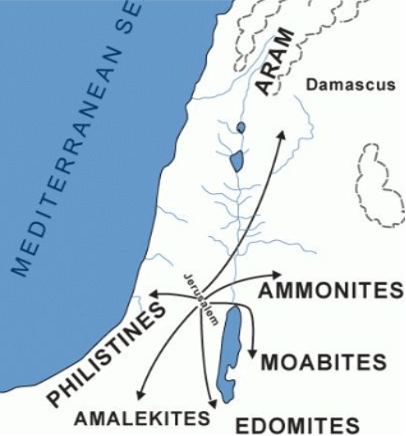
In chapter 7 God promises, “I will establish a place for My people Israel, and will plant them, so that they may live in their own place and not be disturbed again, nor will malicious people oppress them anymore as previously.” In this chapter God, using David as His instrument, defeated Moab (vs.2), Zobah (vs. 3-4), Aram (vs. 5-6), Hadadezer (vs. 6-10), and made Edom servants of Israel (vs.14). David finally had largely conquered or at least subdued the promised land. Just last night this writer participated in a conversation with a student at Ball State who is an atheist. One of his major concerns about the Bible is the way God commands what this student termed as “genocide.” That concern isn’t limited only to non-believers; it can be hard for Christians to square these military operations with Jesus’s command to love our enemies. Below are some thoughts from philosopher Paul Copan.
“To acquire land to live as a theocracy and eventually to pave the way for a coming Redeemer-Messiah, war- fare (as a form of judgment on fully ripened sin) was involved. God used Israel to neutralize Canaanite military strongholds and drive out a people who were morally and spiritually corrupt—beyond redemption. The Can- aanites had sunk below the hope of moral return, although God wouldn’t turn away those who recognized God’s justice and his power in delivering Israel from Egypt (such as Rahab and her family).”
“Some scholars have questioned whether we can hold the Canaanites morally accountable. After all, weren’t they just practicing their religion?... Shouldn’t God have enlightened them about himself and his requirements for humans? As we look at history, we see that nations and civilizations have been capable of moral reforms and improvements... After all, God reveals himself to humans through conscience, reason, human experience, and creation. This revelation opens the door for moral improvements from one generation to the next. People without the Scriptures can still have access to what is good and right: ‘That which is known about God is evi- dent within them [human beings]; for God made it evident to them. For since the creation of the world His invisible attributes, His eternal power and divine nature, have been clearly seen, being understood through what has been made, so that they are without excuse’ (Rom. 1:19—20)”
“The Old Testament’s ‘holy wars’ or, more accurately, ‘Yahweh wars’ are the most emotionally charged biblical problem raised by the New Atheists and by critics generally. Like it or not, war is a common feature of our fall- en world. Indeed, we know that warfare was a way of life - and often a matter of survival - in the ancient Near East. However, the problematic wars take place primarily during and shortly after Israel’s second historical stage under Joshua, the theocratic stage of Israel’s existence. As we’ve mentioned, this Yahweh warfare was not the standard for the other stages in Israel’s history. It wasn’t intended as a permanent fixture in Israel’s story. It was unique to Israel at a particular point in time and was not to be repeated in later history by Israel or by other nations. Without God’s explicit command...attacking the Canaanites would not have been justified.”
READING FOR MAY 16, 2025 CONTINUED: MARK 2, PSALM 43 MARK 2 We encountered the healing of the paralytic man in Capernaum before in Matthew 9:1-8. The additional information we learn here is that his friends could not bring him through the door because of the crowds. Thus, they made an opening in the roof to lower him down. How creative and persistent are we in bringing our friends to Jesus? Are we easily dissuaded, or can we think outside the box? Maybe four of us can brainstorm to find creative ways.
Here we begin to see opposition building against Jesus’s claim to be God the Son. Mark emphasizes this claim from the first verse of His Gospel. This claim becomes the reason Jewish leaders use to condemn Jesus to death and a test John uses to see if we are Christians: “Whoever confesses that Jesus is the Son of God, God remains in him, and he in God” (1 John 4:15). This is also a claim that some unbelieving biblical scholars amazingly miss: “I think it's completely implausible that Matthew, Mark and Luke would not mention that Jesus called himself God if that's what he was declaring about himself” (Bart Ehrman on NPR Apr. 7, 2014).
In Mark 1, four fishermen left their nets immediately to follow Jesus. Here we see a tax collector immediately leave his office to follow Jesus. Following Jesus’s call may mean leaving in a different sense for us than abruptly quitting our jobs, but it does mean immediately dying to self and making Jesus the highest priority in our lives. In Matthew’s case, following Jesus meant going with Him to interact with non-believers about becoming believers. It still does.
Must we keep the Sabbath as Israel did in the Old Testament? Here are some principles:
- Jesus fulfilled all sacrificial, dietary, and ceremonial laws not restated as NT commands (Matt. 5:17).
- First generation Christians changed the worship day from Saturday to Sunday (Acts 20:7, 1 Cor. 16:2).
- Paul allows for freedom and forbids judgment regarding Sabbath keeping (Rom. 14:5-6, Col. 2:16).
Regardless of how or how not the Sabbath is observed, times of rest were certainly practiced and encouraged by Jesus: “And [Jesus] said to them, ‘Come away by yourselves to a secluded place and rest a little while.’ (For there were many people coming and going, and they did not even have time to eat.) And they went away in the boat to a secluded place by themselves” (Mark 6:31-32).
PSALM 43 This Psalm is an example of working through and praying about one’s internal mindset, going from depression to praise. An ungodly nation and deceitful person can make us feel rejected by God. Here are the steps the Psalmist took, which can serve as a model for us:
- Clarify the reason for the depression by self-questioning.
- Seek truth from God as an antidote to the oppression of the enemy.
- Join with others in praising God, especially through music.
- Anticipate deliverance by praising and thanking God for His help even before we feel it.