
READING FOR MAY 19, 2025: 2 SAMUEL 9, MARK 3, PSALM 44:1-8 2 SAMUEL 9 For those in the mood for a real “feel-good” story after yesterday’s warfare, this chapter is perfect. Remember that David felt bad about living in comfort while the ark of the Lord resided in a tent? Today, apparently out of an overflow of benevolence, he wants to do something nice for one of Saul’s or Jonathan’s descendants. That’s really going the extra mile in terms of respect. One additional reason for his interest in Jonathan’s family was a commit- ment David made many years earlier to him to “never cut off your loyalty to my house, not even when the Lord cuts off every one of the enemies of David from the face of the earth” (1 Sam. 20:14). How easy and even understandable it would have been to not have followed through with that promise.
Through questioning Ziba, one of Saul’s servants, David found out about the existence of a surviving son of Jonathan named Mephibosheth. We were introduced to Mephibosheth when the news of Saul’s and Jonathan’s death in battle reached their home: “Now Jonathan, Saul’s son, had a son who was disabled in both feet. He was five years old when the news of Saul and Jonathan came from Jezreel, and his nurse picked him up and fled. But it happened that in her hurry to flee, he fell and could no longer walk. And his name was Mephibosheth” (2 Sam. 4:4).
In this chapter, as an adult with a son of his own, Mephibosheth was still disabled and likely felt in some danger by being part of a competing royal line. In fact, he expressed surprise at being summoned to the King’s presence. In a magnificent gesture of kindness, David restored to Mephibosheth all the inheritance from Saul and invited him to eat at his table with the rest of David’s sons. Ziba and his family were commanded to serve Mephibosheth, including cultivating his newly acquired land. Ziba’s response to David serves as the perfect model for us to have to God’s commands as found in the Bible: “In accordance with everything that my lord the king commands his servant, so your servant will do” (vs. 11). Is that our inner response whenever we read the Bible, or do we disclaim any obligation to obey?
MARK 3 In our discussion of Mark 2 we considered Sabbath practices for us today. Here again, we see the Pharisees continuing to be offended by how Jesus practiced the Sabbath. Notice, before Jesus healed the man, he asked the Pharisees if they thought it was lawful to do so on the Sabbath. They didn’t want to go on record but immediately began conspiring against Jesus when he healed the man. How like many of us who don’t take a stand when it matters but are quick to criticize when someone violates our way of doing things. As it says in the text, Jesus is grieved when we use unbiblical traditions as excuses not to show love to those in need.
READING FOR MAY 19, 2025 CONTINUED: MARK 3, PSALM 44:1-8
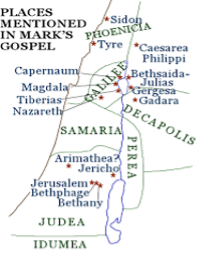
Just as did John the Baptist, Jesus’s unique ministry (in Galilee in this chapter) attracted large crowds from an enormous geographic area, from Sidon on the north seacoast to Idumea to the south of the Dead Sea. He did not use social media or any great promotional campaign. In fact, He often told people not to spread the news of his miracles. Yet, as people sensed the power of His teaching and deeds, the word spread. Can we attract people to get out of bed on Sundays to worship this loving and mighty Lord today? Jesus has not changed: “Jesus Christ is the same yesterday and today, and forever” (Heb. 13:8). Let’s worship Him as if this is true.
It’s interesting, isn’t it, that demons clearly identified Jesus as the Son of God and He did not disavow this statement of His divinity. Yet, extremely well-known Biblical scholars, such as Bart Ehrman, wrongly state on national media that Jesus did not claim to be God in the book of Mark, and they are acclaimed as “enlightened scholars.” Beware of false teachers!
Jesus chose twelve disciples, Judas Iscariot included, to receive authority to preach and cast out demons. Was Judas a believer at that point? It seems the very definition of a betrayer, say Bennedict Arnold, is someone on one side who then joins the opposing side. Thus, if Judas fits this definition, he is an example of someone who was a believer who voluntarily gave up His salvation—just as Satan gave up his place in heaven as an angel of light. Traditional Presbyterians would not explain this as losing salvation—a point of doctrinal difference.
Blaspheming the Holy Spirit is called an unforgivable sin (Mark 3:29). Since John 15:26 says the Spirit testifies about Jesus, rejecting Jesus may be the sin that can’t be forgiven. Even Jesus’s mother and brothers didn’t accept Him at this point. Jesus didn’t give them any special pass. Only believers are part of His spiritual family. This view of Mary differs with Catholic doctrine.
PSALM 44:1-8 These first verses suggest that the story of God and His people was communicated by oral tradition, specifically fathers, over an unbroken chain of multiple generations. This was enough for generations to make God their king and trust Him totally. Paul also affirms this is the duty of fathers (Ephesians 6:4). Have we noticed our younger generations continuing to walk with God or has there been a drop off? If we fathers still have children, grandchildren, or great grandchildren, it’s not too late. We don’t have to be extroverted, knowledgeable, or confident. We just need to be obedient.