READING FOR MAY 20, 2025: 1 CHRONICLES 18, MARK 4, PSALM 44:9-16 1 CHRONICLES 18
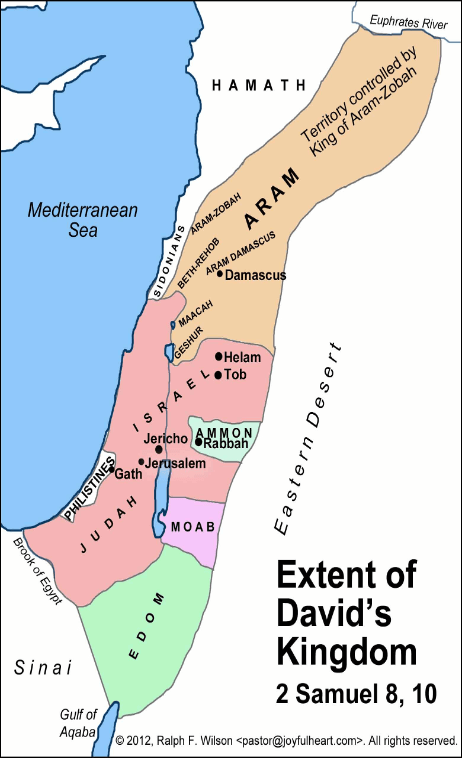
We know that David so wanted to build a Temple for God, but that wasn’t God’s will for him. But he could do all that possibly would prepare his successor for this task: raise money and secure the peace. This happens in a major way throughout this chapter. We need a scorecard to keep track of David’s efforts:David subdued the Philistines and took their towns from around Gath.David defeated Moab and made them pay taxes to IsraelDavid defeated Hadadezer near Hamath and ruled all the way to the Euphrates RiverWhen the Arameans came to help Hadadezer, David killed 22,000 and started taxing Aram.King Tou from Hamath decided it would be good to be Israel’s friend and brought David gold.In addition, David extracted gold and silver from Ammon, Edom, and Amalek. Verse 14 also states that David reigned Israel with justice and righteousness. Likely an essential aspect was the ruling team he put in place to help him govern well. Having the right people in the right places is still good practice: “An overseer, then, must be above reproach, the husband of one wife, temperate, self-controlled, respectable, hospitable, skillful in teaching, not over- indulging in wine, not a bully, but gentle, not content- ious, free from the love of money” (1 Tim. 3:2-4).
MARK 4 We studied the parable of the sower when we read Mathew 13 on February 19, 2025. There we saw that when the word of God was presented only one out of four categories of listeners responded in saving faith. Might we once have been good soil but now because of the obstacles listed such as Satan, afflictions, worries, persecution, and wealth, become un-- productive soil? We read in Revelation 2-3, for example, of the churches that lost their first love and needed to recapture it. Time for a soil inspection.
Mark’s account also repeats Jesus’s counterintuitive statement found in Matthew that His use of parables is meant to disguise the truth from those who choose to remain on the outside of total commitment. Jesus again uses the metaphor we saw first in Mathew 5 of a light not being hid under a basket but being placed on a lampstand. This is so that our lives as obedient Jesus followers will in turn lead others to become fellow followers. We are not faithful to Jesus
READING FOR MAY 20, 2025 CONTINUED: MARK 4, PSALM 44:9-16
just for His sake or just our sake, but also for those who need to know the Lord. Consider our responsibility and opportunity.
The next two parables also relate to planting seeds, not inappropriate for mid-May, although it is getting a bit late in the planting season. Some of us are also running out of time to plant spiritual seeds, but it’s certainly not too late. A reassuring aspect from parable of seed (vs. 26-29) is that we don’t need to understand the entire process to plant seeds. In verses 30-32, we learn that even planting the smallest seed of God’s word can have a super large result. In these two parables, Jesus anticipates our feelings of inadequacy about spreading the word.BUT WE CAN DO IT IN HIS POWER. In reading the account of Jesus asleep in the boat, the disciples exchanged a paralyzing fear of the storm (vs. 40), which is irrational for the faithful according to Jesus, with a fear of the One who can calm the storm (vs. 41), which is the beginning of wisdom according to Proverbs 1:7. FEAR GOD, NOT THE STORMS, AND BE WISE.
PSALM 44:9-16 The previous eight verses give us an overview of God’s heroic dealings with Israel in the past. Although secondary in importance to studying God’s word, knowing something about church history liberates us from the myth that our current culture represents the highest development of God’s people. Here the Psalmist laments Israel’s current state but is aware that it was not necessity normative. It was, by any honest evaluation, terrible. How was Israel viewed? “A laughingstock among the peoples” (vs. 14), as Christians often are today. Theologian Walter Brueggemann suggests we not minimize our discomfort: “Praise has power to transform the pain. But conversely the present pain also keeps the act of praise honest…As praise recontextualizes pain, so pain refocuses praise.” Don’t sugarcoat our prayers to God. He knows our hearts, values the truth, and desires our best interests.