
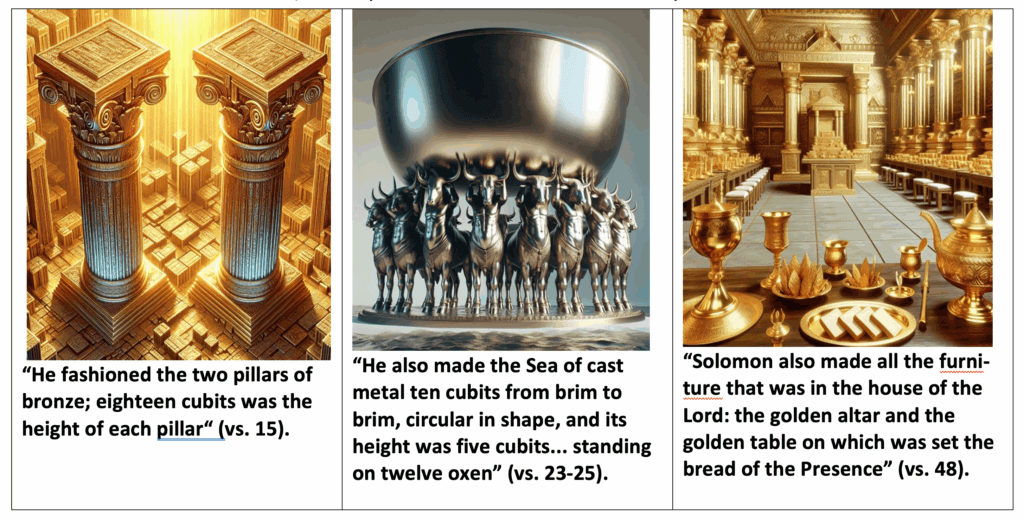
READING FOR AUGUST 22, 2025: 1 KINGS 7, LUKE 14, PSALM 86:1-7 1 KINGS 7 We know that Solomon faithfully went right to work implementing the plans his father David provided to construct the Temple. It took seven years to build and was huge: 90 feet long, 30 feet wide, and 45 feet tall. As the illustrations show in our study of 1 Kings 6, it was awesome. In reading 1 Kings 7:1-12, though, it is difficult not to be concerned with Solo- mon’s priorities. His own house took 13 years to build and was even more immense: 150 feet long, 75 feet wide, and 45 feet high. What was wrong with staying in King David’s house?
It is interesting to note that after Ezra’s extensive recounting of the Temple construction in Chronicles for the exiles returning from Babylon, he limited information about Solomon’s house to four words: “Now it came about at the end of the twenty years in which Solomon had built the house of the Lord and his own house” (2 Chron. 8:1). In their distressed economic situation, such a grand personal home could have had no place in the exiles’ thoughts. Most telling are the words of the prophet Haggai: “This is what the Lord of armies says: ‘This people says, "The time has not come, the time for the house of the Lord to be rebuilt.’’’ Then the word of the Lord came by Haggai the prophet, saying, ‘Is it time for you yourselves to live in your paneled houses while this house remains desolate?’ Now then, the Lord of armies says this: ‘Consider your ways! You have sown much, only to harvest little.”’ (Hag. 1:2-6). Each day we make decisions about our money and time. How do we prioritize our life choices? Are we sowing and reaping with Kingdom priorities in mind?
The rest of this chapter gives more details about the Temple. Hiram of Tyre is named as the skilled artisan leading the work. Is this King Hiram of Tyre? It’s likely a different person--like our small church having several Ron’s and Linda’s. Confusing, but the text says, “He was the son of a widow from the tribe of Naphtali.” (See another view tomorrow.) Below are more features:
READING FOR AUGUST 22, 2025 CONTINUED: LUKE 14, PSALM 86:1-7 LUKE 14 Doesn’t it seem suspicious that the leaders of the Pharisees, no friends of Jesus, invited Him over to eat on the Sabbath. It also says they watched him closely and positioned a man suffering from Edema directly in from of him. Edema is a condition that is highly visible and results in swelling, but likely is caused by a more serious underlying condition that is not visible. Jesus tried flush out the Pharisees with a question, but they wouldn’t go on record. He then healed the man while disarming the Pharisee by showing how their behavior was both unloving and hypocritical. The Bible still shows us those traits about ourselves. Jesus followed this up with a parable about angling for public honor, in this case the most honored seats. Of course, still a problem.

So many of us build our lives around the recognition we feel we deserve; we are terrified by the prospect of losing or not getting it. The punchline of Jesus’s parable is one of the great counter-intuitive truths of the Bible: ”Everyone who exalts himself will be humbled, and the one who humbles himself will be exalted.” The best-known positive example at Taylor University is Samuel Morris, a son of a tribal chief from West Africa: “In December 1891, Morris arrived on Taylor’s campus (then in Fort Wayne). When asked by [President] Reade which room he wanted, Morris replied, ‘If there is a room nobody wants, give that to me.’ Morris’s faith had such a profound impact on the Fort Wayne commun- ity he was frequently invited to speak at local churches. At night, he could be heard in his room praying, which he simply called ’talking to my Father."' Jesus emphasizes that our behavior in social situations reveals our real Kingdom priorities. Do we only greet the same friends in church or sit with the same crowd for fellowship times? How might we be on the lookout for those who appear to be less connected to others in the church or even to Jesus? The parable about making excuses also uses a social situation to determine if we are making God our top priority. Notices secondary priorities such as family and work can crowd out God. If that happens, Jesus implies we won’t experience heaven: ’For I tell you, none of those men who were invited shall taste of my dinner’” (vs. 24). Jesus then restates this idea using building and military illustrations. Verse 33 is extremely provocative and among the least read and taught: ”None of you can be My disciple who does not give up all his own possessions.” Big decision!
PSALM 86:1-7 David first requests God’s attention and response before he mentions individual concerns. He knows nothing good can happen unless these two conditions exist. This request before an Almighty God shows both wisdom and humility. David doesn’t express spiritual pride but rather vulnerable dependance. He isn’t looking to his other connections or assets to rescue him--only God. He highlights a characteristic about God that is not often considered: God is ready to forgive. God is poised, awaiting our reaching out to Him in confession and repent- tance. It reminds us of Jesus knocking at the door (Rev. 3:20) or weeping over Jerusalem (Matt. 23:37). He’s ready to respond to us now.
