READING FOR SEPTEMBER 1, 2025: 1 KINGS 9, LUKE 20, PSALM 89:38-52 1 KINGS 9 In this chapter, God appears to Solomon a second time. The text states His previous appearance was at Gibeon, which is recorded in 1 Kings 3. That’s when Solomon pleased God by asking for wisdom. This time, God affirms he had heard Solomon’s plea and consecrated the Temple. No mention is made of the palace Solomon spent 13 years building. What God does say is that if Solomon is faithful to the Lord as his father David was then he will always have a descendent on the throne. Notice that this is a conditional promise.
Let’s zoom ahead to the present time. Does God make conditional promises to us? Here are some New Testament promises that indicate he does:
- “Blessed is the one who endures trials, because when he has stood the test, he will receive the crown of life that God has promised to those who love him” (James 1:12).
- “Let us not get tired of doing good, for we will reap at the proper time if we don’t give up” (Gal. 6:9).
- “If we endure, we will also reign with him; if we deny him, he will also deny us” (2 Tim. 2:12).
- “You will be hated by everyone because of my name. But the one who endures to the end will be saved” (Matt. 10:22).
Those who are more Wesleyan in their theology would interpret the above verses as meaning that if folks don’t persevere in their faith, then they lose God’s salvation. A Calvinist would say, if folks don’t persevere in their faith, it means they were never saved in the first place.
In Verses 6-9, God reveals what will happen should Solomon and Israel choose not to be faithful to God:
- “I will cut Israel off from the land which I have given them" (vs. 7).
- “Israel will become a saying and an object of derision among all peoples” (vs. 7).
- “This house will become a heap of ruins” (vs. 8).
Sometimes one hears the comment that God never brings pain or problems to His people. It seems that the above represent God’s painful actions in response to His people’s disobedience.
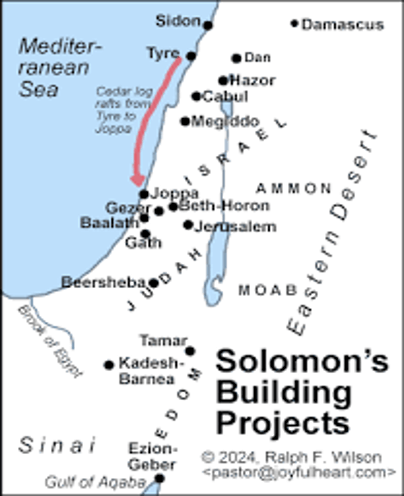
Verses 10-14 discuss the deal Solomon made with King Hiram of Tyre. Solomon gave Hiram 20 cities in Galilee (where Jesus grew up). Upon examination, Hiram thought they were worth-less. Thus, they were known as Cabul meaning “like nothing.” To Hiram’s credit, he still sent Solomon the promised gold. The rest of the chapter describes the immense additional building projects Solomon undertook. Solomon rebuilt Hazor and Megiddo (north), Gezer and Beth-horon (just northwest of Jerusalem), Baalath (due west), and Tamar (far south). He also built a fleet of ships at Ezion-geber (farthest south). The forced laborers Solomon used for these projects were those Amorites, Hittites, Perizzites, Hivites, and Jebusites whom Israel had not been able to drive out of the land but remained as residents.
READING FOR SEPTEMBER 1, 2025 CONTINUED: LUKE 20, PSALM 89:38-52 LUKE 20 Imagine the privilege of hearing Jesus teach in the temple. He is the greatest teacher of all time after all. What was His topic when He taught? Verse one said it was the Gospel. How sad it is that some churches never teach the Gospel and don’t even know what it is. Certainly, the chief priests, scribes, and elders weren’t interested in the Gospel. Threatened as they were, they asked Jesus, who gave Him the authority to teach? Whenever Christianity is attacked, the challenge will usually focus on the identity and mission of Jesus. Jesus did not answer these skeptics because they had rejected the truth already given them by John the Baptist. Let’s be certain we know Jesus is God the Son, who came to earth as a man to live a sinless life, take all our sins upon Him as the one-time sacrifice for us, died and rose again to defeat death, sin, and Satan. When we believe this and trust Him as Lord, we are saved. Parable of the Vine-Growers. In a way Jesus did answer the skeptics through this story:
- Main point—Jesus is God’s son who was rejected but will return to judge those who rejected Him.
- Who’s who—Planter is God; growers are scribes/chief priests; slaves are prophets; Son is Jesus.
- Application—God has repeatedly given us truth. We in our selfishness rejected it but will be judged.
Since Jesus claimed to have ultimate authority, these skeptics thought they might create problems for Jesus with the Roman government over taxes. Jesus replied His authority was in a different sphere and that taxes, but not one’s soul, was delegated to the government. Next the Sadducees (who didn’t believe in life after death) developed a ridiculous hypothetical question about levirate marriage. Jesus said the premise of their question was wrong because there isn’t marriage in heaven and their underlying belief was wrong because God is God of the living. Jesus gave them a brain teaser: How can the Christ be both David’s son and his Lord? Of course, it’s only possible through God’s Son becoming a man in David’s line. Finally, he gave the people and us a warning: watch out if religious folks parade their self-importance.
PSALM 89:38-52 Ethan was so positive in verse 37 about David’s throne being established forever. Now, a few words later, he claims God has repudiated the covenant He forged with David. Verses 38-48 are a litany of the different ways Ethan sees God abandoning David: You have covered him with shame ... Will Your wrath burn like fire?” (vs. 45-46). But Jesus also, “endured the cross, despising the shame... who has endured such hostility by sinners against Himself” (Heb.12:2-3). Ethan’s next to last thought is an honest lament without much hope: “How I carry in my heart the taunts of all the many peoples, with which Your enemies have taunted, Lord, with which they have taunted the footsteps of Your anointed” (vs. 50-51). Then, he just reasserts His faith in God: “Blessed be the Lordforever! Amen and Amen” (vs. 52). Yet, because of the suffering of and taunts against God’s ultimate anointed One, we have a reason to “celebrate in hope of the glory of God” (Rom. 5:2). “God demonstrates His own love toward us, in that while we were still sinners, Christ died for us. Much more then, having now been justified by His blood, we shall be saved from the wrath of God through Him” (Rom. 5: 8-9).