
READING FOR NOVEMBER 3, 2025: 2 CHRONICLES 20, HEBREWS 13, PSALM 116:1-11 2 CHRONICLES 20 Thanking God in the Valley of Beracah
Armies from Moab and Ammon with some Meunite soldiers approached Judah with hostile intent. In his fear, King Jehoshaphat called for a national time of fasting and prayer. Jehoshaphat stood and gave voice to the people, confessing to God that they were hopeless without an intervention from God. Then in the midst of the assembly the Spirit of the Lord came upon Jahaziel. This is a very good sign. How wonderful that all the people so humbled themselves and that the Holy Spirit responded through Jahaziel. Are we facing an overwhelming foe today, either individually or as a church? Is God the same today? “I the Lord do not change” (Mal.3:6)
If we are walking with the Lord and find ourselves facing an enemy that is obviously too much for us, we can turn to God as did Jehoshaphat. Then we can receive the same promise as he did: “Do not fear or be dismayed because of this great multitude, for the battle is not yours but God’s” (vs. 15). This does not mean the result will be exactly what we had in mind. This writer has a friend in prison serving an extremely long sentence. In his desperation, he also has criedout to the Lord. Will he be released? Maybe not, but he has started a nightly prayer group with 10 other inmates. He is having as much of an impact for God as anyone I know.
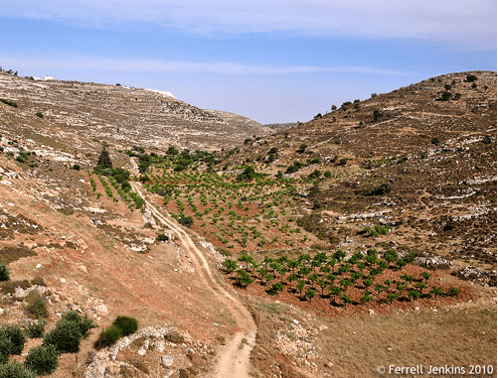
This story is also especially meaningful because of how Jehoshaphat harnessed the power of musical praise. Instead of positioning his archers and charioteers in battle formation, he placed his singers on the frontline. Then what happened? “When they began singing and praising, the Lord set ambushes against the sons of Ammon, Moab, and Mount Seir, who had come against Judah; so, they were struck down” (vs. 22). Before returning to Jerusalem, the people all assembled at the Valley for Beracah, which means blessing, (see above picture) for a time of thanksgiving to God. This is an essential step for God’s people. Maybe we could locate our own place of Beracah.
King Jehoshaphat completed a mostly successful 25-year reign because he didn’t deviate from the right ways of his father, Asa. But he still could have been more proactive for God: “The high places, however, were not removed; the people had not yet directed their hearts to the God of their fathers” (vs. 33). As we complete our time on earth, is there an additional step of faith left to take?
HEBREWS 13 This chapter includes lots of seemingly disconnected bits of guidance that flow from the reminder given in the last phrase of chapter 12: “Our God is a consuming fire.” Being aware of that truth should motivate us to certain actions, a holy checklist:
READING FOR NOVEMBER 3, 2025 CONTINUED: HEBREWS 13, PSALM 116:1-11
- Keep loving believers. They have special claim on our attention. Check out YMC’s prayer calendar.
- Show hospitality to strangers. These strangers might be angels or might need to know Jesus.
- Remember those in prison. These prisoners may have been incarcerated for their faith (Heb. 13:23).
- Reserve sexual activity for marriage. Jesus made this clear in Matthew 19: 1-12.
- Free ourselves from the love of money. Not doing so shows we don’t trust God’s word or character.
- Imitate the faith of those who teach God’s word to us. Of course, we need to verify that God’s word is being taught—not just what is trendy or some extraneous teaching that is not clearly God’s word.
- Verse nine implies strange teaching can carry us away from the truth of God grace. This seems to be connected with those preoccupied by certain foods. Perhaps the larger context refers to those advocating for a Kosher diet or food offered as sacrifices in the Mosaic law. Don’t waste time on this.
The writer of Hebrews then emphasizes that the Mosaic sacrificial system is totally fulfilled by the blood of Jesus and that we must identify with his suffering and seek the lasting city, which is still to come. Clinging to this life while ignoring the next is tragically shortsighted. Since the Levitical sacrifices are now obsolete, does that mean Christians no longer sacrifice anything? The writer of Hebrews says we offer the sacrifice of praise continually. Also, we sacrifice by doing good and sharing. A sacrifice implies that it comes at a cost to us. It should not necessar- ily be easy or unintentional. How are our continual praise, good works, and sharing costing us? Hebrews reminds us of something Americans find challenging: submitting to leaders. There is also a reminder that leaders will be accountable to God for how they lead. Leaders must be certain that their goals and means are completely in conformance with God’s word. Finally, the writer of Hebrews prays that his readers be equipped to do God’s will. May that be our prayer for us.
PSALM 116:1-11 Google the question: Why do we love? Answers pop up from psychology, philosophy, and poetry. Psalmist answers the question why he loves God. His answer may not be the main reason for others, and no doubt it is not the only reason for him. Still, it tells us a lot about the Psalmist and God. He believes God not only exists but is aware of his prayers. The Psalmist found this especially important during times of extreme trials. Consider that he could never know this experientially about God without having gone through dark times. Thus, there is great value in extreme trial because of the depth of knowledge we gain about God. Is the knowledge worth the trial? The Psalmist suggests so because it has increased his love for God. He goes on to add these experiences have taught him about God’s righteousness, compassion, and generosity. To know more about God gives us additional reasons for loving God. Let’s use each difficult experience as an opportunity to learn about God’s goodness.
