READING FOR JANUARY 9, 2026: MICAH 1, JOHN 6, PSALM 139:13-24 MICAH 1 God Punishment to His People and to the Entire World
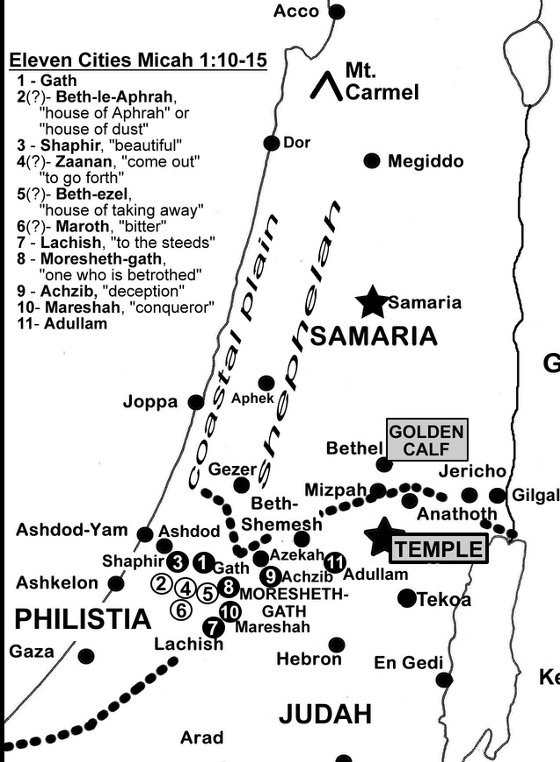
The reading plan we use is taken from Lake- wood Baptist Church in Georgia. It is chrono- logical, so often it will jump to another book in the Bible that addresses the same period of time. Here we meet the prophet Micah who was contemporary to Isaiah in the eighth cen- tury before Christ. Micah lived in Moresheth-gath (city #8). This is the word of the Lord a- gainst both Samaria and Judah but is address- ed to the whole world, which includes us. God reveals His plan to punish all the earthdue to the sins of His people Israel (vs. 5). An interesting question for us to ponder is might God punish the entire world today for the sins of His church? The New Testament does not say directly, but there is perhaps an inference of non-believers suffering due to the failure of believers to witness. Paul in Act 18:6 states he should not be punished as unbelievers pre- cisely because he shared the Gospel with them: “But when they resisted and blas- phemed, he shook out his garments and said to them, ‘Your blood is on your own heads! I am clean. From now on I will go to the Gen- tiles.’” But what about situations where peo- ple didn’t believe because he/we didn’t share the Gospel? Does he/we bear any blame?
Verses 5-7 certainly focus upon the destruction coming to the northern and southern kingdoms due to their worship of idols of the surrounding nations. As always, the application for us is our adopting (or not) the idols/ values of an increasingly non-Christian culture in 2026. Verse eight shows Micah is not a robot-like conveyer of information. He is torn apart emotionally over this situation. This should also be our attitude when speaking these kinds of judgments of God. Micah also made use of plays on words. Chapter one concludes by citing cities who names in Hebrew relate to the punishment they will be receiving.
JOHN 6 Each chapter of John is dense, packed with enough teaching to meditate on for a long time – a lifetime, I guess, of reading and rereading. But this chapter is exceptionally so! We’ll focus mainly on the theme that permeates the whole chapter: “I am the Bread of Life”. (The first of seven “I am” declarations.) This chapter takes place as the Jewish Passover Festival was near. The nation was preparing for its annual commemoration of the time when God liberated his people and led them through the wilderness to the Promised Land, providing them with manna or “bread from heaven”throughout their journey. This provides the background for Jesus’s works and teaching in our chapter. We are familiar with the feeding of the 5,000 (the 4th sign). John describes the people’s response like this: “After the people saw the sign Jesus performed, they began to say, ‘Surely this is the Prophet who is to come into the world.’” (v 14) In their excitement, they READING FOR JANUARY 9, 2026 CONTINUED: JOHN 6, PSALM 139:13-24 latched onto a promise given by Moses: “The Lord your God will raise up for you a prophet like me from among you, from your fellow Israelites.” (Deut. 18:15) This must be the one who, like Moses, would deliver them from Rome. In fact, he must be the Messiah, the king! Jesus, understanding the shallowness and worldliness of their understanding of Messiah, slipped away. He would be King on God’s terms (eternal and Cosmic) and in God’s way and God’s time. So, he patiently followed the course the Father had laid out from the beginning of time.
When the people came to him the following day, the feeding of the 5,000 was foremost in their minds. And they said, “Moses gave us manna; what sign will you do?” Jesus encouraged them not to get stuck focusing on the sign itself – free bread! – but to be curious about what the sign was pointing to. Jesus’s teaching was this: The manna in the wilderness didn’t come from Moses; it was from God. In the same way, God has now sent me to be bread for Israel (and for the whole world), but bread of a different nature: living bread. The manna was bread that sustained life temporarily, but I am bread which will sustain life for eternity for anyone who will eat it. The one who eats my bread will live; the one who will not has no life in them.
Those who heard his teaching on this day, even his closest disciples, struggled to understand it. To be honest, we still struggle with what exactly Jesus meant by “eats my flesh and drinks my blood”. We understand it to be connected with our sacrament of communion, but we sense it is also much more than that. It is helpful to meditate on words in verse 57: Just as . . . I live because of the Father, so the one who feeds on me will live because of me. While on earth, Jesus drew his very life from being immersed in relationship with the Father. We eat Jesus’ flesh by doing the same with him, abiding or remaining in life-giving relationship with him. In what way are you doing this in your everyday life? In your shared life as members of YMC?
Note throughout this chapter the many references that support what John wrote in the prologue: The Word was with God, and the Word was God. He was with God in the beginning. Jesus testified that he has come down from heaven (v 33, 38), he was sent by the Father (v 38, 44), he has seen the Father (v 46), and he is the one who will raise people up on “the last day” (v 40, 44). Finally, notice again how Jesus speaks of eternal life in the present tense (v 47, 54). The one who believes Jesus and the one who eats and drinks of him has eternal life. Jesus understands eternal life as a quality of life from the heavens, new life from God, inner life like Jesus had, that is given in the present when someone believes and continues into the future beyond death. PSALM 139:13-24 David continues to extol the capabilities of God. Although he speaks from the perspec- tive of his own personal interaction with God, this same level of Divine knowledge and involvement is possible of every person. David says God created him while he was in he womb of his mother." David adds that his body is amazingly put together. Current science continues to identify its immense complexity. He goes on to suggest that even in his prenatal state, all his days were ordained for him. This last thought might give some support that God determined his life path beforehand, or it could be read as God setting his life span. No mat- ter how it is read, the next claim about the infinite number of God’s thoughts directed personally toward him is totally mind boggling. Do we ever think no one cares about us? David says God’s thoughts towards each one of us are more than the sands in existence. Yet, David says in the face of this awesome God there are those who actively oppose Him. Social media is loaded with them, in fact. Let’s use spiritual resources, not personal attacks, to battle the powers behind these deluded people (Eph. 6). Are we bold enough to invite such a God to search our hearts for any wickedness? We should be if we truly desire not to be hurtful to God and others, and desire to follow God’s way of living, which is by far the best way.