READING FOR FEBURARY 5, 2026: ISAIAH 24, MATTHEW 4, PSALM 3 ISAIAH 24 A Description of the Last Days from a Historical Premillennial Perspective
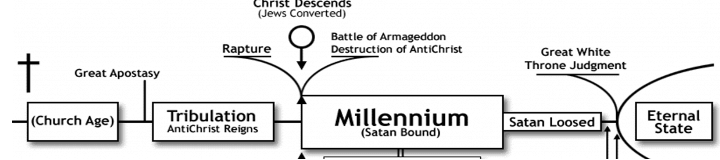
Verses 7-13 state what might appear obvious. Those living through this time of tribulation will not be happy in any way. All celebrations and musicmaking will cease. As the above chart tries to illustrate, Christians alive at this time will also be experiencing these worldwide troubles: “And unless those days were shortened, no flesh would be saved; but for the elect’s sake those days will be shortened” (Matt. 24:22).
Verses 14-16 are confusing, but based on the context and other scripture, such as Matt. 24:22, they seem to suggest that those believers living through this terrible time will still be able to praise God. Why is that? “For I am convinced that neither death, nor life, nor angels, nor principalities, nor things present, nor things to come, nor powers, nor height, nor depth, nor any other created thing will be able to separate us from the love of God that is in Christ Jesus our Lord” (Rom. 8:38-39).
The rest of this chapter focuses on God’s continuing punishment on the earth. Verses 21-22 might be interpreted as referring to those angels who fell with Satan and who might be confined with him during the 1000 millennial period (Rev. 20:2-3). The final verse could be referring to God reigning on earth with his saints during the millennium. Of course, if God chooses to fulfill these prophesies differently, He will be right and this writer all wrong!
MATTHEW 4 It seems that the Holy Spirit wanted Jesus to be tempted by Satan in the wilderness, away from other human support, and in a physically weakened state after having fasted 40 days. Partly because of this, the writer of the Hebrews makes the accurate claim that Jesus is a high priest aware of our most extreme challenges in life (Heb. 4:15). No mention is made that the Holy Spirit left Jesus during these trials. This could be significant. Notice also that in fending off each attack of Satan, Jesus fought back with what Paul describes in
READINGS FOR FEBRUARY 5, 2026 CONTINUED: MATTHEW 4, PSALM 3 Ephesians 4:17 as the sword of the Spirit: THE WORD OF GOD. That is one purpose of this Bible-reading plan—to equip us for the attacks of Satan that will certainly come our way. If Jesus depended on the Bible and, as it said in Heb.4:15, was without sin, perhaps we should follow His example.
- Temptation 1—Satan, aware of Jesus’s great physical hunger, asked Jesus to turn stone into bread. Jesus used this opportunity to declare that every Word of God (not just the parts we like) is the more necessary to our life than food.
- Temptation 2—Satan, knowing that Jesus could perform miracles, asked Jesus to jump off the top of the temple. Jesus, who later fed the thousands, healed the sick, and calmed the sea to serve others, did not do miracles just to prove Himself by recklessly placing himself in harm’s way and then expecting to be bailed out.
- Temptation 3—Satan was possibly aware of Jesus’s plan to defeat him at the cross, albeit through the most painful experience possible. He gave Jesus the option of an earthly Kingdom without the pain, if He would just worship Satan. Jesus, committed to His mission and the much greater Kingdom of God, submitted to that longer-term mission and pain because of His obedience and His joy in loving us (Heb. 12:2).
Ponder these questions: 1. Is our knowledge of the Bible sufficient to withstand a Satanic attack? 2. Do we continually put ourselves in reckless situations and expect God to bail us out? 3. Does anything, such as food, success, or personal relations, mean more to us than our relationship with God?
PSALM 4 David expressed these words while fleeing for his life from His son Absalom. The folks around David said even God could not save him this time. (Afraid we can’t always count on others to give us good advice.) Not many of us have had such a dramatic encounter with our children. We have, however, had times of loss, sadness, or fear that overwhelm us. What did David do? 1) Cried out to the Lord; 2) Sought a Word from God; 3) Trusted in God and slept well; 4) Verbalized His confidence in God; and 5) Claimed that God had already smitten his enemies. On this point, remember Ephesian 6 says our enemies now aren’t people but spiritual forces. Since the cross, our weapons and enemies are spiritual in nature. Don’t hit anyone!