READING FOR FEBRUARY 2, 2026: ISAIAH 20-21, MATTHEW 1, PSALM 1 ISAIAH 20-21 Assyrian Defeat of Egypt and Cush (Ethiopia)
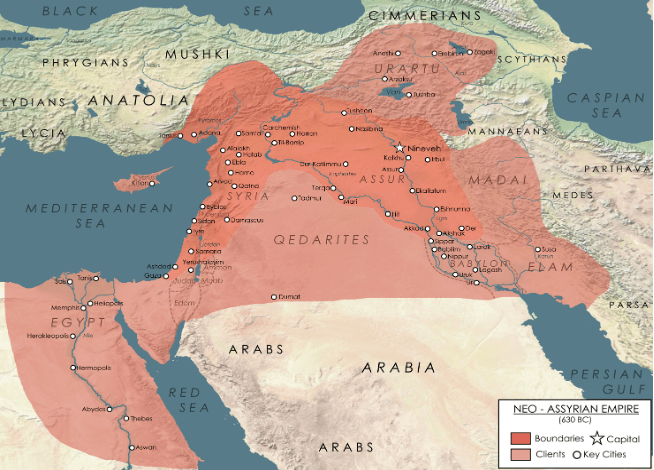
ISAIAH 20 Notice the extent of the Assyrian Empire, which reached its greatest area around 670 B.C. In this chapter, the commander of its army captured Ashdod in Philistia. No doubt, Judah might think they were next. God then told the prophet Isaiah to go naked and barefoot for three years as a sign that Assyria would soon defeat Egypt and Cush. Isaiah did and indeed history tells us Assyria was soon victorious. Certainly, this would get the attention of Judah’s people and dissuade them from seeking help against Assyria from either Egypt or Cush.
ISAIAH 21 Remember that, when Isaiah was prophesying, the major world power was Assyria. They would eventually be displaced by Babylon in the future. Here Isaiah prophesies the Persian (or Mede) victory over Babylon before Babylon even reached super-power status. The wilderness of the sea (also translated desert by the sea) represents Babylon. In verse 4, Isaiah announces God ordering Elam/Media (meaning Persia) to lay siege to Babylon because of all the pain it has caused. In verses 3-5 Isaiah vicariously feels the pain of Babylon, expressing gra- phic metaphors of a painful groin and the anguish of childbirth. Then God tells Isaiah to send a watchman to report on what is transpiring. The watchman reports that Babylon and all its gods have fallen. This entire vision is then reported to Judah (a “downtrodden people”) by Isaiah.
The pronouncement against Edom is mysterious. Someone calls from Seir (a mountainous region in Edom) asking the watchman how far gone is the night? He says morning is coming, but so is the night. This could mean that the dark reign of Assyria will soon be over, yet the morning of freedom will be brief and replaced quickly by the dark reign of Babylon.
The pronouncement against Arabia is slightly clearer. A desert caravan will spend the night in Arabia. The residents of Tema (named for a son of Ishmael the father of the Arabs) are told to provide them food and water. These travelers are in flight after their defeat in battle. God con- fides that Kedar (named for another son of Ishmael) will be decimated militarily in a year. Do we find our current world order to be chaotic? REST ASSURED. GOD IS IN CONTROL.
READING FOR FEBRUARY 2, 2026 CONTINUED: MATTHEW 1, PSALM 1 MATTHEW 1 It might be a mistake to skim over the genealogies in the Bible. Jesus says in Matt. 4:18 the smallest letter or stroke is important in God’s Word. One scholar suggests that by following all genealogies there’s a way to accept the apparent fossil and biological evi- dence for evolution while believing in a literal and direct creation of Adam and Eve.
Here is his thinking: God directly created Adam and Eve in His image from the dust in the Gar- den, perhaps as recently as 6,000 years ago, in 4,000 BC. When Adam and his family were driv- en from the Garden, they came into contact with individuals who had developed biologically through God-supervised evolution. They were outside the Garden and hypothetically not made in God’s image. This would account for the women available for Cain and Seth to marry who were not children of Adam and Eve. Through using genealogy modeling and what is known about intermarriage and migration, it can be determined that likely everyone existing in the world by the time of Jesus was a genealogical ancestor of Adam and Eve. This would make Jesus a sacrifice for all humans then living and afterwards. (Adapted from Joshua Swamidass) Of course, this is just one plausible explanation. One could hold to a young-earth view and believe that God gave the universe the appearance of age. We can see stars that are millions of light years away. Perhaps God gave those stars and their light the appearance of age. Or there may be a totally different scenario for creation that God finally reveals to us in Heaven.
This genealogy in Matthew 1, emphasizing Jesus’s human descent, is traced from Abraham. It gives importance to God’s work with His people as described in the Old Testament. We cannot really understand Jesus without paying attention to that history. Notice that this listing is unique in that it includes five women: 1) Tamar, a twice widowed woman who tricked her father-in-law into having sex outside of marriage in order to have an heir; 2) Rahab, a prostitute from Jericho, Israel’s enemy; 4) Ruth, a foreign widow; 3) Bethsheba, a woman who had an adulterous affair with David; and 5) Mary, a pregnant single girl from a small town. What do you think the significance is of these “mothers of Jesus” appearing on the list?
PSALM 1 Prayerfully reflect on these questions that are derived from this Psalm:
- Do we commit to following God’s revealed truth, or do we follow cultural norms?
- Do we really delight in God’s Word more than other hobbies or social activities?
- Do we quickly read through the Bible, or do we mediate on it and obey it?
- Do we pray for family or friends who presently do not walk in the Lord’s way and who are in danger of perishing because they are unsaved?