
READING FOR AUGUST 19, 2024: LEVITICUS 9, LUKE 10, PSALM 82 LEVITICUS 9 Obeying what God has commanded so that the glory of God appears
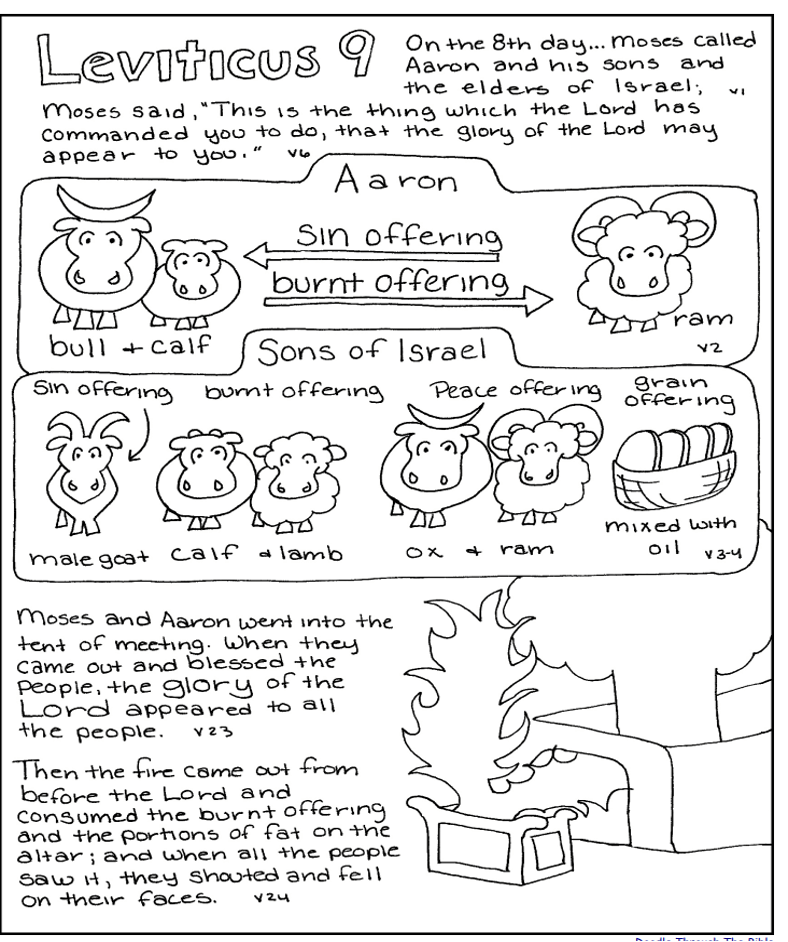
| The consecration process ends. Moses leads Aaron and the people through steps of obedience for God’s glory to appear Moses calls for Aaron to offer a bull and calf as a sin offering and a ram as a burnt offering for himself. Moses tells Aaron to offer a sin offering, a burnt offering, a peace offering and a grain offering for the Sons of Israel. Aaron lifted his hands to the people to bless them, made all the offerings, and entered the tent with Moses. They emerged and blessed the people. FIRE CAME FROM THE LORD CONSUMING THE OFFERING ON THE ALTAR. (Chart from Doodle through the Bible) |
“Since we receive a kingdom which cannot be shaken, let’s show gratitude, by which we may offer to God an acceptable service with reverence and awe; for our God is a consuming fire” (Heb. 12:28-29).
LUKE 10 Jesus had already sent His twelve disciples out to minister on their own. Now he sends out 72. They will be preparing communities for when Jesus Himself visits later. Jesus’s parting words are unusual. As He sends them, He says there are lots of folks ready to be reached, so pray for even more workers to reach them all. Often, we pray for more people to reach out to the community, but we don’t get off the couch to go ourselves. Jesus’s followers
READING FOR AUGUST 19, 2024 CONTINUED: LUKE 10, PSALM 82 who are already going seem to have much more credibility before God with their prayers. In fact, is it even legitimate for a church to pray for growth if the members themselves are not going out to the harvest?
If the harvest is so plentiful, does that mean we should expect it will be easy? Jesus said we will be like sheep among wolves. But He gives a plan: travel light; stay focused; look for and bless potential allies; don’t waste time with the uninterested; accept hospitality; minister to any needs encountered; and leave the area if rejected. That’s what it means to sow the seed, to do our part. We are not responsible for the results, but we are responsible to share. Notice that those who reject the truth will be judged and that apparently there will be levels of punishment based upon the amount of light or information received. It turns out Jesus’s plan was a good one. Are we surprised? When the 72 said that demons submitted in the name of Jesus, He casually reminded them of His eternality: He was present when Satan fell from heaven. If we act in the name of Jesus, Satan, look out! Yet, Jesus reminds us that our greatest joy is having our names recorded in Heaven. ARE WE SAVED?
Jesus gives thanks to the Father and notes the intelligent don’t often receive spiritual truth. Those who are comparatively and intellectually infants are more likely to understand. His disciples were working men. His opponents were like seminary teachers. What’s the problem? The Lord’s brother said we must humble ourselves to be exalted (James 4:10). Right after, an intelligent, but self-justifying, lawyer gives the “correct” answer about the law’s meaning. Jesus responded he now had to “do this” to gain eternal life. This led Jesus to tell the story of the “Good Samaritan,” an outsider to the Mosaic covenant, as an example to follow. A final example is the comparison between the hard-working, but perhaps also self-justifying, Martha and Mary, who developed a relationship with Jesus. We’re saved by faith in Jesus, not works.
PSALM 82 Verse 6 is quoted by Jesus in John 10:34, who adds the scripture cannot be broken. This verse is central to the Mormon position that humans can become divine. On the surface it does appear to contradict the belief in one God. Let’s see. In verse 1, God has a position of authority over this group translated as “gods.” He tells the group they are judging unjustly. (If they are gods, they are very flawed.) In verse 6, God calls them gods again. Yet this group will “die like men” and “fall like princes.” Again, we them falling and ceasing to exist, not typical characteristics of God. The word used here for gods, elohim, is translated as “judges” in Ex.21:6 and 22:8-9. These human judges represent God to the people, which fits the context in this Psalm perfectly. This is also the interpretation given by John Calvin and John Wesley. Jesus states, He alone is “whom the Father sanctified and sent into the world” (John 10:36).