READING FOR AUGUST 25, 2025: 2 CHRONICLES 4, LUKE 15, PSALM 86:8-17 2 CHRONICLES 4 Since this chapter so closely resembles chapters recently studied in 1 Kings, this writer opts to offer a perspective from his friend and former colleague Win Corduan. He lives in nearby Alexandria, and his book on Chronicles is very well researched and written.
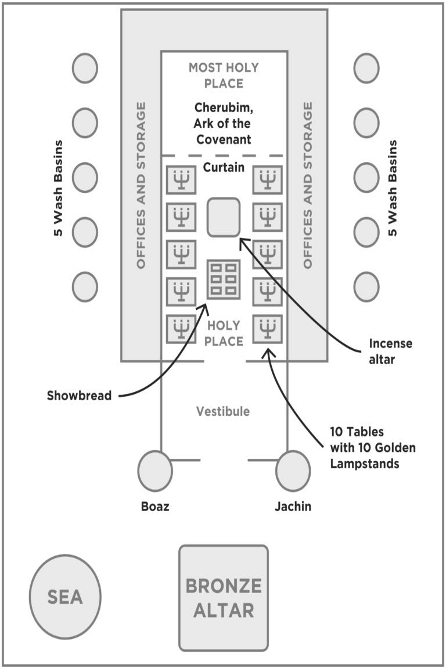
“See the diagram... [at left] for the following descriptions. One of the most important items was outside and in front of the building, the main altar for offerings. It was the same size as the inner sanctuary and 15-feet tall, so the priests and assist- ants would have needed steps to do their work.” “Then there was the ‘sea,’ a large basin made of brass. It had a circumference of about forty-five feet and a diameter of approximately fifteen feet. Its bottom was cast as two rows of gourds, and the whole piece was supported by the sculptures of a dozen oxen with four groups of three facing the cardinal directions. This huge tank was intended for the priests to wash themselves because, after performing animal sacrifices, they would most definitely be covered with blood and other animal tissue. Solomon also provided smaller portable basins for the other priests and Levites. There were five on each side.”
“Following David’s directions, he placed the required objects into the Holy Place. The sides were lined alternating with seven-branched candle holders (menorahs) and tables, ten of each. Somewhere in the center, close to the inner sanctum, was an altar for incense offerings. Every morning and every evening, the priests whose shift it was would be determined by a lottery which one of them would have the privilege of entering the temple and offering incense to God. The process has been described in detail by the medieval Jewish philosopher Moses Maimonides.”
“There also needed to be various utensils, bowls, knives, trident forks, baking equipment, and so forth. All of these were made under the supervision of Huram Abi, who carried out Solomon’s wishes. The Phoenician influence was so powerful that at one point Ezra actually mentions Hiram as the builder*(4:11). Solomon wanted to compete with other temples in the area on their rules, and it appears that he was the winner. The appearance of the temple became world-famous as we shall see shortly.” *See yesterday’s study for a different view.
READING FOR AUGUST 25, 2025 CONTINUED: LUKE 15, PSALM 86:8-17 LUKE 15 According to the Barna Group: “Today, a number of factors are curbing many Christians’ enthusiasm for faith-sharing, including the decline of religion in America, a spreading apathy toward spiritual matters and a growing cultural suspicion of people of faith.” The Pharisees and scribes also found it strange that Jesus would reach out to sinners. These parables are Jesus’s view on the matter. One danger of Jesus’s parables is that the story is often so interesting that the main point is lost. In many of His parables, as is the case in these three, the main point is plainly laid out at the very end. So, let’s work backwards: Lost Sheep Parable
- Main point—God urgently seeks people to repent and believe. Those who won’t repent are lost.
- Who’s who—Jesus is the shepherd. The tax collectors are the lost sheep. The Pharisees are the 99 sheep in the flock the shepherd left and who claim they are fine as they are.
- Application—Everyone needs to repent, and those who seek to save the lost are being like Jesus.
Lost Coin Parable
- Main point—God and all heaven rejoice when a sinner repents.
- Who’s who—The woman is Jesus or a person seeking lost sinners. The tax collectors are the lost coin.
- Application—Reaching the lost takes lots of effort, but the joy of seeing a new believer is unmatched.
Prodigal Son Parable
- Main point—God is eager to receive any lost sinner who repents and turns to Him for life eternal.
- Who’s who—The Jesus is the father. The tax collectors are the younger son. The Pharisees are the older brother.
- Application— Just living respectfully doesn’t bring joy or eternal life. All must repent before God.
PSALM 86:8-17 David determined ahead of time what he would do in a time of trouble. It is wise to settle in our minds now what we will do when in difficult circumstances rather than trust we will have the presence of mind to turn to God under stress. David affirms that the God of Abraham, Isaac, and Jacob is the superior belief system of his day, not just one pathway among many acceptable ones. This is particularly important to uphold in our time of pluralism and inclusiveness. In fact, David (and Paul) expands on this by looking forward to the day when all nations and all time periods will acknowledge this God as the only true Lord of Lords: “At the name of Jesus every knee will bow, of those who are in heaven and on earth and under the earth, and that every tongue will confess that Jesus Christ is Lord, to the glory of God the Father” (Phil. 2:10-11). It is not stated when this was written, but likely David was then a prominent person in Israel, if not king. Yet, he rightly assumes a humble position as a student before God. If because of accom- plishment or age we ever lose that attitude, God cannot use us effectively. We are too limited in our human perspective. Just because David was still learning, it didn’t mean he was unsure about all the central truths of reality. We can be certain of God’s graciousness, mercy, pa- tience, love, strength, assistance, comfort, and salvation. Those aren’t up for grabs or debate.