
READING FOR DECEMBER 2, 2025: JONAH 1, JUDE 1, PSALM 119:121-128 JONAH 1
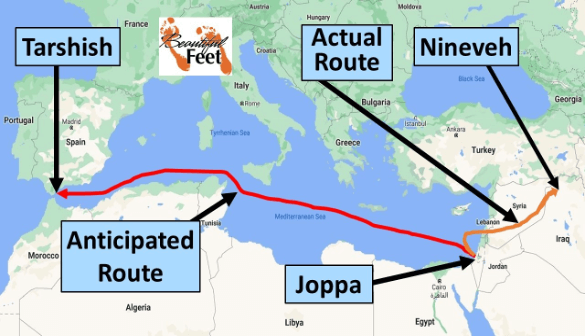
Several times this writer has heard nonbelievers, and even Christian pastors, say the events of this book are or could be fictional, only meant to convey a lesson. This was not Jesus’s view: “The men of Nineveh will stand up with this generation at the judgment and will condemn it because they repented at the preaching of Jonah; and behold, something greater than Jonah is here” (Matt. 12:41).
Why would Christian pastors hold such a position when our Lord did not? Likely, they are embarrassed by the idea of a literal fish swallowing a person and the person living for three days. But Jesus likens the historicity of this event with that of His death and resurrection: “For just as Jonah was in the stomach of the sea monster for three days and three nights, so will the Son of Man be in the heart of the earth for three days and three nights” (Matt. 12:40). This miraculous but real event of the resurrection is the basis for our salvation from sin and death, not a quaint children’s story.
Verse 1 tells us that the word of the Lord came to Jonah, son of Amittai. Jonah is also so identified in 1 Kings 14: 25: ”The word of the Lord, the God of Israel, which He spoke through His servant Jonah the son of Amittai, the prophet, who was from Gath-hepher." Jonah was given an assignment that he apparently found distasteful: cry out against the wickedness of the great city of Nineveh. Might God give us an assignment today we find distasteful? The Bible is full of assignments for all of us. Here is one from the Lord we, as did Jonah, usually seek to avoid: “Go, therefore, and make disciples of all the nations” (Matt. 28: 19).
We often cleverly refuse this assignment by saying we don’t have the gift of evangelism. Jonah, more dramatically, got on a ship to go to Tarshish, as far as possible from Nineveh. God, in His love for Jonah and for Nineveh, was not so easily thwarted. He intervened in ways we might find unloving from our tiny perspective:
- “The Lord hurled a great wind on the sea and there was a great storm on the sea, so that the ship was about to break up” (vs. 4).
- “The Lord designated a great fish to swallow Jonah, and Jonah was in the stomach of the fish for three days and three nights (vs. 17).
READING FOR DECEMBER 2, 2025 CONTINUED: JONAH 1, JUDE 1, PSALM 119:121-128 Notice that these actions were not only a result of our fallen world. The Lord took specific actions so that Jonah would turn from his sin and obey Him. Are we open to His acting this way towards us? What specific assignment from the Lord might we be avoiding?
JUDE The writer is almost certainly the half-brother of Jesus. He humbly identifies himself, though, as James’s brother and bondservant of Jesus. His purpose is clear. Christians need to contend for the faith that was handed down “once for all.” Notice he says this faith came down from God through His revelation and is not going to change. Even back then, folks wanted to change it. This is more of a danger today than when Jude wrote the letter. A big problem then, and more pronounced today, is that people abused the concept of grace to mean they could live a sinful lifestyle. In doing so, they rejected Jesus as their Lord and became subject to eternal condemnation.
Jude gives prior examples of what happened due to this bad approach: the death of a generation in the wilderness, the casting out of the rebellious angels in heaven, and the destruction of Sodom and Gomorrah. According to Jude they are “undergoing the punishment of eternal fire.” Jude says Jesus warned us about this happening in the last days. But he also says Jesus can keep us from stumbling and make us stand in the day of judgement. If, as Jude says, we are in the battle involving the faith, make sure we are on the side of the “faith which was once for all handed down to the saints” --not one we or others have constructed.
PSALM 119:121-128 The Psalmist is being harassed in some way by those he identifies as breakers of God’s laws. He is appealing to God for deliverance based upon his own commit- ment to God and obedience to His word. If we also follow the Psalmist’s faithfulness, this is a prayer we can also pray against those who oppress us because of our faith. It is not so much that they are oppressing us, but they are opposed to the cause of Christ. Even though the Psalmist is a writer of scripture and has experienced persecution for his faith, he still asks the Lord to teach him through His word. We must never stand still in learning more about and growing closer to God—no matter our spiritual attainment or advanced age. Many of those most knowledgeable about God’s word are those who value it most. Do we value the Bible more than money? Do we live that way by making Bible reading a priority over earning extra money. Notice the Psalmist doesn’t pick and choose parts of the Bible to obey and parts to ignore: “I esteem right all Your precepts concerning everything, I hate every false way.”
