READING FOR JANUARY 10, 2025: JOSHUA 16, JOHN, PSALM 139:13-24 JOSHUA 16 The Borders for Joseph’s Sons’ Territory—Particularly Ephraim
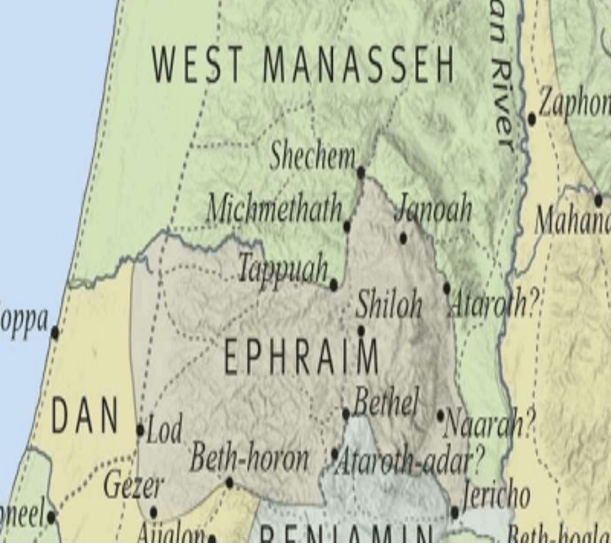
This is complicated. Recall that Joseph’s descendants were divided in- to two tribes: one for his son Ephraim and another for his son Manasseh. Also remember that half of Manasseh opted for land on the eastern side of the Jordan River. The map on the left focuses on West Manasseh and Ephraim. Verses 1-3 describe their combined lands. The southeastern corner of the border starts at Jericho and runs west past Bethel, Ataroth-addar, lower Beth-horon and Gezer. The text says this southern border continues to the sea, which is true as it becomes West Manasseh’s border.
Starting with verse four the text only describes Ephraim’s borders. In this passage we see some deviation from what the map above (and most published maps) represents. Here is a summary of the text: The western border goes from Ataroth-addar to Beth-horon up to Michmethath on the north. Then the northern border goes eastward to Janaoh. The eastern border goes from there to Ataroth and finally back to Jericho. It’s the western border that’s perplexing. Perhaps the text means a border that curves around out to the west. The basic truths of the historical events and their application for our lives are not confusing, though. This chapter concludes by stating that Ephraim didn’t drive out the Canaanites living in Gezer.
JOHN 6 Each chapter of John is dense, packed with enough teaching to meditate on for a long time – a lifetime, I guess, of reading and rereading. But this chapter is exceptionally so! We’ll focus mainly on the theme that permeates the whole chapter: “I am the Bread of Life”. (The first of seven “I am” declarations.) This chapter takes place as the Jewish Passover Festival was near. The nation was preparing for its annual commemoration of the time when God liberated his people and led them through the wilderness to the Promised Land, providing them with manna or “bread from heaven” throughout their journey. This provides the background for Jesus’s works and teaching in our chapter.
We are familiar with the feeding of the 5,000 (the 4th sign). John describes the people’s response like this: “After the people saw the sign Jesus performed, they began to say, ‘Surely this is the Prophet who is to come into the world.’” (v 14) In their excitement, they latched onto a promise given by Moses: “The Lord your God will raise up for you a prophet like me from among you, from your fellow Israelites.” (Deut. 18:15) This must be the one who, like Moses, would deliver them from Rome. In fact, he must be the Messiah, the king! Jesus, understanding the shallowness and worldliness of their understanding of Messiah, slipped away. He would be
READING FOR JANUARY 10, 2025 CONTINUED: JOHN 6, PSALM 139:13-24 King on God’s terms (eternal and Cosmic) and in God’s way and God’s time, and so he patiently followed the course the Father had laid out from the beginning of time.
When the people came to him the following day, the feeding of the 5,000 was foremost in their minds. And they said, “Moses gave us manna; what sign will you do?” Jesus encouraged them not to get stuck focusing on the sign itself – free bread! – but to be curious about what the sign was pointing to. Jesus’s teaching was this: The manna in the wilderness didn’t come from Moses; it was from God. In the same way, God has now sent me to be bread for Israel (and for the whole world), but bread of a different nature: living bread. The manna was bread that sustained life temporarily, but I am bread which will sustain life for eternity for anyone who will eat it. The one who eats my bread will live; the one who will not has no life in them.
Those who heard his teaching on this day, even his closest disciples, struggled to understand it. To be honest, we still struggle with what exactly Jesus meant by “eats my flesh and drinks my blood”. We understand it to be connected with our sacrament of communion, but we sense it is also much more than that. It is helpful to meditate on words in verse 57: Just as . . . I live because of the Father, so the one who feeds on me will live because of me. While on earth, Jesus drew his very life from being immersed in relationship with the Father. We eat Jesus’ flesh by doing the same with him, abiding or remaining in life-giving relationship with him. In what way are you doing this in your everyday life? In your shared life as members of YMC?
Note throughout this chapter the many references that support what John wrote in the prologue: The Word was with God, and the Word was God. He was with God in the beginning. Jesus testified that he has come down from heaven (v 33, 38), he was sent by the Father (v 38, 44), he has seen the Father (v 46), and he is the one who will raise people up on “the last day” (v 40, 44).
Finally, notice again how Jesus speaks of eternal life in the present tense (v 47, 54). The one who believes Jesus and the one who eats and drinks of him has eternal life. Jesus understands eternal life to be a quality of life from the heavens, the new life from God, an inner life like Jesus had, that is given in the present when someone believes and continues into the future beyond death and into the resurrection.
PSALM 139:13-24 David continues to extol the staggering capabilities of God. Although he speaks from the perspective of his own personal interaction with God, this same level of Divine knowledge and involvement is true of every person who ever existed. David says God specifically created him while he was in the womb of his mother." David adds that his body is amazingly put together. Current science continues to identify its immense complexity. He goes on to suggest that even in his prenatal state, all his days were ordained for him. This last thought might give some support that God determined his life choices beforehand, or it could be read in other senses that are less Calvinistic. No matter how it is read, the next claim about the infinite number of God’s thoughts directed personally toward him is totally mind boggling. Do we ever think no one cares about us? David says God’s thoughts towards each one of us are more than the sands in existence. Yet, David says in the face of this awesome God there are those who actively oppose Him. Social media is loaded with them, in fact. Let’s use spiritual resources, not personal attacks, to battle the powers behind these deluded people (Eph. 6). Are we bold enough to invite such a God to search our hearts for any wickedness? We should be if we truly desire not to be hurtful to God and others, and desire to follow God’s way of living, which is by far the best way.