READING FOR JANUARY 13, 2025: JOSHUA 17, JOHN, PSALM 140 JOSHUA 17 LAND ALLOTTED TO THE HALF TRIBE OF MANASSEH
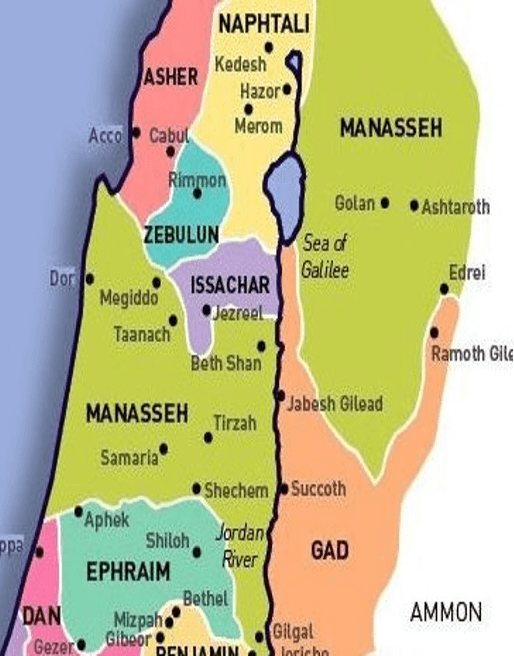
Manasseh was a son of Joseph. His descendants were allotted territory as a half tribe, as were Ephraim’s. Manasseh’s initial allotment was only on the east side of the Jordan River and the Sea of Galilee. The southern part of this territory was known before as Gilead and the northern part as Bashan. The kings of these eastern areas were defeated by Moses, before the nation crossed the Jordan. A complicating factor is one descendant of Manasseh only had daughters. These women approached the nation’s leaders to claim a promise made by Moses to give them land. This claim was approved, and land was awarded to them west of the Jordan. Verses 11-17 describe the boundaries of this generous additional allotment. The southern border includes the area east of Shechem, then going west along the brook of Kanah all the way to the sea. The border to the west is the Great Sea. This reached all the way to Asher’s tribal territory to the north. The northern boundary went from that point east, running along the borders of Zebulun and Issachar to the Jordan, east of Beth-shan.
That problem solved; another arose. Ephraim and Manasseh asked why they weren’t given yet more land. Joshua told them they should instead clear out the forest land for more space. They in turn replied that the Canaanites living in the area of Jezreel and Beth Shan had too many chariots. Joshua told them they could do it. Before judging them too harshly, ask if we ever come up with excuses for not making inroads against evil and unbelief?
JOHN 7 Chapter 7 takes place in Jerusalem during the Feast of Tabernacles, a fall feast that begins five days after the Day of Atonement, a stark contrast to that solemn season of repentance. It was a time of rejoicing, feasting, and dancing often referred to as “The Season of Our Joy”, a 7-day celebration followed by a day of rest. Its roots were in Leviticus 23 and in Deuteronomy 14, where Moses instructed:
Be sure to set aside a tenth of all that your fields produce each year. Eat the tithe of your grain, new wine and oil, and the firstborn of your herds and flocks in the presence of the LORD your God at the place he will choose as a dwelling for his Name, so that you may learn to revere the LORD your God always. . . Then you and your household shall eat there in the presence of the LORD your God and rejoice. (Deut 14:22-26)
The holiday is a time for the Jews to rejoice in God’s bounty – his deliverance out of bondage in Egypt, his provision of food and water in the desert then, and a plentiful harvest now (the festival coincides with the end of the harvest season). Ultimately, though, Sukkot celebrates Israel’s trust in God and reliance on their relationship with Him. (Do you find it surprising that God would take joy in his people gathering for a giant
READING FOR JANUARY 13, 2025: JOHN 7, PSALM 140 week-long party? It was his idea!!) Part of the festivities was to remember the days in the wilderness after leaving the slavery of Egypt by living in booths/tents/tabernacles during the feast, simple structures made with branches. By the time Jesus came, some 1500 years after Moses, the hills outside of Jerusalem would have been covered with these booths, as every Jew who could would gather to celebrate God’s presence and provision during the Exodus so long ago. Two elaborate ceremonies had developed to celebrate and remember God’s presence and provision in the Exodus and to look toward his messianic deliverance in the future. These ceremonies create the backdrop for Jesus’ teaching and declarations in John 7 & 8.
The Water Ceremony: Celebrating God’s Provision
Every day of the feast, the high priest in all his regalia would lead a parade through the streets of Jerusalem to the pool of Siloam where he would fill a gold pitcher, march back to the temple, approach the altar in front of the temple, march around it one time, and then climb the ramp and pour out the water before the Lord. While he was doing this, the crowd would wave palm branches and sing from the Psalms. And they would shout from Isaiah 12:3, “With joy you will draw water from the wells of salvation!” The seventh day of the feast was the greatest day. On that day, the priest marched back with his water and circled the altar seven times. Then the crowd would draw silent as the moment arrived and the priest poured out the last water offering.
The Water Ceremony served as a reminder to Israel that God had provided water for them in the desert wilderness of the Exodus and that they could trust him to provide for them in their day. It also served as a prophetic reminder, looking forward to the longed for day when God would pour out his Spirit: For I will pour water on the thirsty land and streams on the dry ground; I will pour out my Spirit on your offspring, and my blessing on your descendants. (Isaiah 44:3)
And today we read that it was on that last day of the feast – perhaps at that climactic moment of silence – that Jesus cried loudly, “If anyone is thirsty, let him come to me and drink. Whoever believes in me. . . streams of living water will flow from within him.” By this he meant the Spirit. . .” Jesus declared himself to be the fulfillment of this festival. He is our provision! All that the world has needed in the past and all we will need in the future, are given to us in him. With joy we will draw water from Jesus, the eternal well of salvation!
PSALM 140 Is David paranoid or a realist? He really believes there are people who spend their time thinking up ways they can harm him (vs.2-3). David actually was often opposed by enemies, even by his own son. What about those of us today who in trust in Jesus as our Lord and Savior. How could anyone so dislike us? Jesus warns otherwise: “You will be hated by all because of My name” (Matt. 10:22). Yet David also could be considered an ultimate optimist because, as he says at the end (vs. 13), he dwelt in God’s presence. Those who choose not to dwell in God’s presence are truly the ones whose view on reality is distorted and whose life is “cast into the fire” (vs.10). Jesus agrees: “If anyone does not remain in Me, he is thrown away like a branch and dries up; and they gather them and throw them into the fire, and they are burned” (John 15:6).