READING FOR JANUARY 15, 2024: JOSHUA 19, JOHN 9, PSALM 142 JOSHUA 19 Joshua completes the land allotment process.
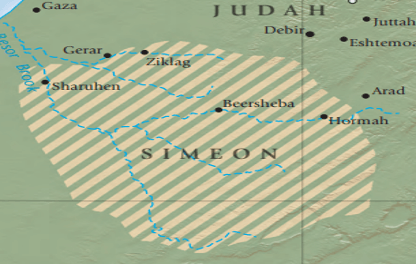
The next land allotment went to the tribe of Simeon. As can been seen on the map, it is completely surrounded by the land allotted to Judah, a larger tribe. In fact, the text states Simeon’s cities were selected out of southern Judah because it was decided by this time that Judah had too much land (vs 9). In reading the text, there is no mention made of borders. Thus, only cities mentioned in the text were likely given to Simeon within the overall territory of Judah. This would explain the striped pattern used by the editor for Simeon; all other tribal territories are shown in block colors.
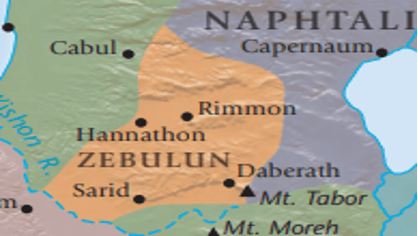
Zebulun’s allotment was next. It is roughly the same latitude as the Sea of Galilee. The text describes its southern border as Sarid in the west then going east to Daberath before turning north. The northern border circles around before bending toward Hannathon. Thus, the tribal territory is surrounded by Napthali, Asher, West Manasseh, and Issachar. In Deut. 33, Moses blesses Zebulun with riches of the sea and mountains. Although landlocked, the Kishon River in the west provides access to the Great Sea; its mountainous region is southeast.
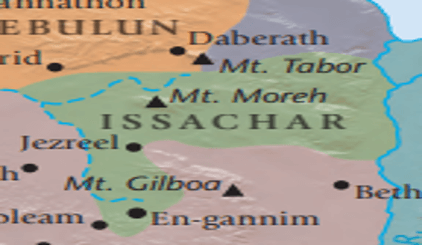
Today this writer witnessed a conversation about the city of Columbus. The speaker had family in Columbus, Ohio while the listener’s daughter lives in Columbus, Ohio. Slapstick confusion reigned. Good thing no one from Georgia was there. Beth-shemesh was a border town in Issachar (Joshua 19:21) that no longer exists. We learn in Joshua (19:38) that Naphtali also had a Beth-shemesh, which also no longer exists. To increase our enjoyment, the most famous Beth-shemsh was in Judah (Joshua 15:10), which for a while was home to the ark.
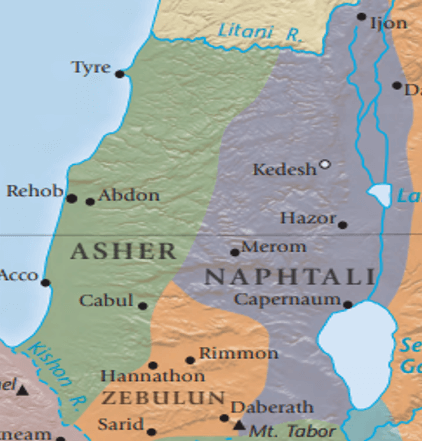
Asher and Naphtali were the next two to receive their allot- ments. They are both bord-- ered on the north by the Litani River. Asher’s western border is the Great Sea, with its coast- al city of Tyre mentioned in the text as its only fortified city. Asher’s eastern border is with neighbor Napthali. Napthali’s eastern most area includes the Jordan River and the Sea of Galilee. Hazor was perhaps its major fortified city, although Capernaum is now best known because it was Jesus’s home.
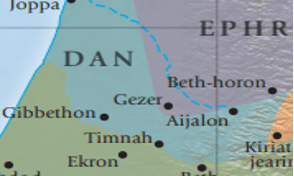
Dan was the last to receive its allotment. It began well: “Dan went up and fought with Leshem and captured it. Then they struck it with the edge of the sword and took possession” (vs 47). In Judges 18, however, the tribe relocated to the far north.
READING FOR JANUARY 15, 2025 CONTINUED: JOHN 9, PSALM 143 JOHN 9 Blindness and sight permeate this whole chapter. It begins with Jesus encountering a man born blind and ends with Jesus lamenting the spiritual blindness of the Pharisees. The first exchange sets the stage: Disciples: Why was this man born without sight? Whose sin is responsible – his or his parents? Jesus:Neither. His blindness was not the result of anyone’s sin. Something bigger is going on here. Let go of your old assumptions and formulas and watch the light of new creation break into this old dark world as I “do the works of him who sent me.” (v 4) Remember that I said (in chapter 8) that I am the light of the world? Let me demonstrate it for you in this way. Watch and believe. (my paraphrase).
At this, Jesus, in a manner reminiscent of creation in Genesis 2, recreated the man’s eyes and gave him sight. Then we follow two different paths for the rest of the chapter. First, the man literally moves from darkness to light as his physical blindness is healed and he can see for the first time. (Hallelujah!) All he knew at the time was that a man people had been talking about, a man called Jesus healed him. Then as the Pharisees questioned him, the man began to realize this Jesus must be a prophet, for what ordinary man could have performed this miracle? By the time the Pharisees brought the man back in later to question him further, he was “seeing” more clearly. This time he declared that Jesus was a godly person who had come from God to do God’s will on earth (v 31-33). Finally, the man encounters Jesus again (Jesus had been looking for him, it seems), and this time he bows down to Jesus and professes faith in him as the Son of Man. (Glory Hallelujah!) Unfortunately, the religious leaders took a different path. When they first heard of the healing, some rejected immediately it because it was performed on the Sabbath. Therefore, in their minds, they could dismiss Jesus as not of God, “for he does not keep the Sabbath” (v 16). (Others, though, did remain curious, “How can a sinner perform such signs?” (v 16) We will learn in a later chapter that some of them came to believe.) Next they tried to deny that the man had actually been blind. If they could dismiss the “sign”, they could dismiss what the sign was pointing to. When that didn’t work they relied on intimidation and bullying – counting on the fact that the man and his parents would retract their claims under threat of being put out of the synagogue. Finally failing to silence him, they threw him out.
Thus, the one who was blind came to see clearly. And the ones who claimed to see clearly demonstrated that they were actually blind. The Pharisees were determined not to believe, so they did everything they could do to dismiss the sign and remained in darkness. The once-blind man looked at the sign and lifted his eyes to what the sign was pointing to: Jesus who healed him was the promised Messiah, the One from God who came to reveal the Father and to save the world. And he stepped from darkness into light. John crafts this chapter with great skill to show both the brilliance of Jesus’ teaching (combining this healing with his declara- tion of being the Light of the World) and the inevitable decision every person must make when they encounter Jesus (to follow him into the light or to reject him and remain in darkness). For as John wrote in his prologue: “The true light that gives light to everyone was coming into the world. He was in the world, and though the world was made through him, the world did not recognize him. He came to that which was his own, but his own did not receive him. Yet to all who receive him, to those who believed in his name, he gave the right to become children of God.” (John 1:9-12) PSALM 142 What circumstances cause us to cry out for help from God? According to the Cleveland Clinic, “isolation and lack of support can trigger depression.” Here we find David is hiding in a cave saying, “no one cares for my soul.” Yet he also knows intellectually that God is aware of him (vs 3) and is his refuge (vs 5). David finally states his belief even as he doesn’t really feel it: “The righteous will surround me, for You will look after me.” Pray to God, restating what we know to be true, even when we “feel” our situation is hopeless.