READING FOR JANUARY 16, 2025: JOSHUA 20, JOHN 10, PSALM 143 JOSHUA 20 Sanctuary cities have been a hot topic in Indiana in recent years. According to the Center for Immigration Studies, there are four sanctuary counties in our state. Our state’s attorney general has threatened legal action against them. Where did this concept come from? It came from the cities of refuge in the Bible. Israel’s six cities of refuge are below:
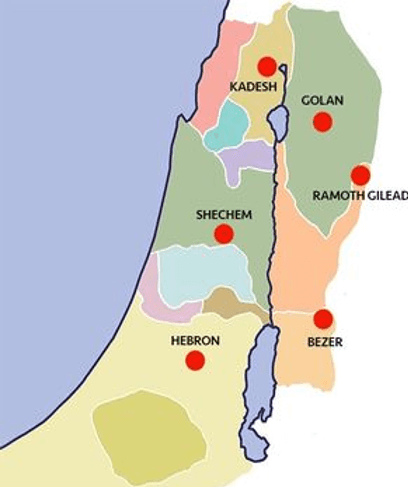
Kadesh, Shechem, and Hebron are west of the Jordan River; Golan, Ramoth Gilead, and Bezer are to the east. Those who believed they accidently caused the death of another could flee to these cities. The elders at the city gates would initially determine if the individual fleeing warranted protection. If so, the individual would be admitted and protected from any avenger until he stands trial and until the death of the high priest. Then he could safely return to his home. The great hymn “How Firm a Foundation” beautifully uses this concept to point us to Jesus: How firm a foundation, O saints of the Lord,
Is laid for your faith in his excellent Word!
What more can he say than to you he has said
Who unto the Savior for refuge have fled?
JOHN 10 There is a passage in Ezekiel 34 where God issues a rebuke to those who were supposed to be leading Israel, caring for their well-being and guiding them in righteous living, but who were serving their own interests instead. Following the rebuke is a beautiful passage where God prophesies a coming day when Israel will once again have a good shepherd – one who will look after the sheep, searching out the lost, rescuing those in danger, binding up the injured, strengthening the weak, etc. (You can read this in Ezekiel 34:1-24.)
The puzzling thing about this passage is that first Ezekiel names that coming good shepherd as God himself, but later in the same passage he names David (meaning the coming Messiah/King from the lineage of David) as the good shepherd. Which is it? Is God the shepherd or is the Messiah the shepherd? Ezekiel doesn’t clarify. He only speaks of it as a certainly coming reality.
Now, as we come to this chapter, it makes sense; it all fits together in Jesus. As the chapter opens, Jesus is continuing his critique of the Pharisees from the end of chapter 9, where he called them blind and now indicates that they are serving as self-serving “hired hands,” with their own interests in mind rather than the well-being of the sheep. And then he asserts himself as the good shepherd. He is claiming to be the one spoken of by Ezekiel all those centuries ago. Ah! So the Messiah is the true king of Israel. But then he makes this outrageous claim: I and the Father are one. (v 30) And now the prophesy makes sense: In Jesus, and in Jesus alone, the Messiah/King from the line of David and God himself is Israel’s true Shepherd.
A few quick thoughts:
- In this chapter we have two of the “I am” statements of Jesus: I am the gate for the sheep and I am the good shepherd.
READING FOR JANUARY 16, 2025 CONTINUED: JOHN 10, PSALM 143
- In Hebrew Scriptures, the ideal king is described as a shepherd (likely because of the shepherd David who became a king after God’s own heart). In their culture, the relationship of care and trust between shepherd and sheep, was the image of a good kingship. Think of the image we have today of leaders and rulers. When we serve in a leadership capacity in any realm of our life, how might we learn from the shepherd image? Take time to read Ezekiel 34 and Psalm 23 and meditate on this question.
- Even as Jesus spoke of being the good shepherd, he began hinting at – for the first time in John – where this vocation would lead him: The good shepherd lays down his life for the sheep; I lay down my life for the sheep. The image of a good shepherd is a peaceful one to us, with images of the shepherd walking with the lost little lamb in his arms as he tenderly brings him back to the fold. Though this is true, Jesus’ claim at the time was much more provocative than that. It was a claim of power, of rule, of authority and went toe to toe with all other claims of such. Jesus was not naïve to where his claim would lead. He was fully aware of the path ahead, but as the true and righteous shepherd of his people he was prepared to lay down his life to save them.
- Note also that Jesus has “other sheep that are not of this sheep pen. I must bring them also. They too will listen to my voice, and there will be one flock and one shepherd.” Jesus didn’t set out only to deliver the present flock (Israel); he was going to bring into the fold other sheep. (Us!) The God of Israel was never interested in only Israel. His relationship with Israel was always for the sake of the whole world. Let’s pause and thank God for his good and beautiful plan to deliver us and ask Him how he might help us to look beyond our own “fold” of YMC and bring in others not yet part of his flock.
- Finally, when you find yourself in need of God’s care, remember this passage and the earlier Hebrew writings in Ezekiel 34 and Psalm 23. Meditate on these Scriptures; read them regularly; remember that you are in the care of the true and the very good Shepherd.
PSALM 143 This Psalm uses the Hebraic poetic device of parallelism: each verse first making a statement then repeating it using similar wording. As opposed to the Lord’s Prayer that begins with affirming God’s holiness, this prayer asks for a response based upon God’s attributes of faithfulness and righteousness. How wise to affirm God’s attributes in our prayers. Just by verbalizing them it changes our outlook. In verse 2, David brings up our unrighteousness before such a righteous God. Paul later powerfully builds upon this truth:“There is no one righteous, not even one” (Rom. 3:11). In verse 3, David doesn’t describe a particular physical danger, but rather persecution by an enemy against his soul. Consider how much more eternally dangerous an attack on our soul can be than one against our bodies. Thus, David commits to setting his mind on God’s past faithfulness to stave off this attack. We have a much better past event to consider: “For our sake He made Him to be sin who knew no sin, so that in Him we might become the righteousness of God” (2 Corinthians 5:21). Notice how David evokes the cities of refuge concept (Joshua 20) by seeking spiritual refuge from his enemies: “Save me, Lord, from my enemies; I take refuge in You” (vs. 9). David concludes by committing to obey God’s will (i.e., the Bible), to follow the Spirit’s leading, and to submit to God’s Lordship. This little Psalm points to the Gospel, the power of God’s word, and the guiding role of the Holy Spirit.