
READING FOR JANUARY 23, 2025: JUDGES 1, JOHN 15, PSALM 146 JUDGES 1 Removing the *Caananite Inhabitants from the Land: An Incomplete Obedience Israel is moving into uncharted territory with no one designated person to lead them. They start well by asking God who should first go up against the *Canaanites still residing in the land. God says Judah. Judah then invites Simeon to join them. (Simeon’s cities were in Judah.)
A B C D E F G H I J K L M N O P *(Note: Canaanites are the indigenous people in the land.)
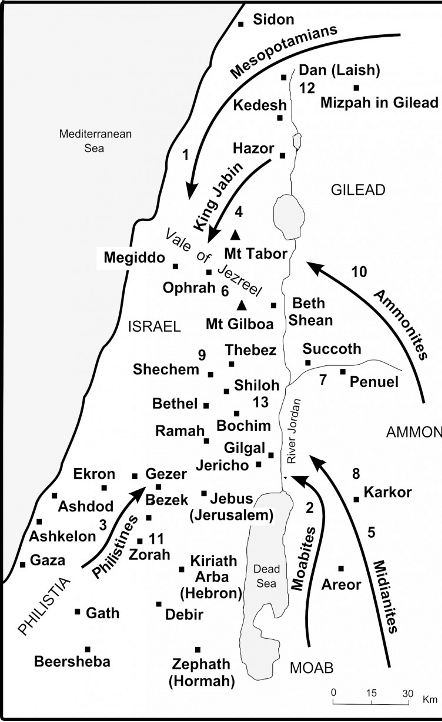
| Perhaps the greatest failure is the Amorites driving Dan into the hill country.(Adapted from Journey through the Bible) | 1 2 3 4 5 6 7 8 9 10 | Vs. 1-7 The tribes of Judah and Simeon capture King Adoni-Bezek at Bezek (F8). This king had previously cut off the toes and thumbs of 70 other kings. This now happened to him as a kind of repayment.Vs. 8-10 Judah mounts an attack on Jebus/Jerusalem (H8). They capture it and set it on fire. They then attack Kiriath Arba/Hebron (H9).Vs. 1:11-15 Othniel, Caleb's nephew, conquers Debir (G9) and is awarded Caleb’s daughter, Achsah. She asks Caleb for springs nearby. She has Caleb’s style. Vs. 16-19 The tribes of Judah and Simeon conquer Zephath (H10) which is re-named Hormah meaning “destruction.” They take Gaza (B9), Ashkelon (C8) and Ekron (D8), “but they could not drive out the inhabit-- ants in the valley, because they had iron chariots.” Vs. 20-26 Caleb takes Hebron (H9) and drives out the sons of Alak (gigantic people), but Benjamin allows many Jebusites to remain in Jerusalem. The tribes of Ephraim and Manasseh conquer Bethel (H7).Vs. 27-28 Manasseh fails to drive out the *Canaanites fully from Beth-shean (K5), Taanach, Dor, Ibleam, and Megiddo (G4). Vs. 29-30 Ephraim does not drive *Canaanites from Gezer (F8), nor does Zebulun drive them from Kitron and Nahalol. Vs.31-32 Asher fails to drive out all those living in Acco, Sidon (I1), Ahlab, Achzib, Helbah, Aphik, and Rehob. Naphtali fails at Beth-shemesh and Beth-nath. |
JOHN 15 I read that, if left alone, a grape vine will get straggly and tangly and grow in on itself, getting in the way of its own light along the way. The neglected vine produces a lot of superfluous growth and ends up producing many poor grapes rather than fewer luscious ones. Grape vines need help to grow in the right direction and to be productive. They need vinedressers to cut out the parts of the plant growing inward and getting tangled up and to encourage the shoots that are growing outward toward the light. They need the care of a gardener if they are to become what they were intended to be: filled with lovely, mature, delicious, nourishing grapes.
Aren’t we like that? If left to our own ideas and instincts, won’t we also get straggly and tangly and grow in on ourselves? Won’t we get in the way of the light that seeks to help us grow? Won’t our own efforts leave us
READING FOR JANUARY 23, 2025 CONTINUED: JOHN 15, PSALM 146 producing only poor fruit? That’s what had happened to the nation of Israel. In Jewish tradition Israel was often pictured as a vine (Ps 80; Isaiah 5) – a vine that had been planted by God himself but which had refused to yield to the gardener’s care and as a result had gone wild and been ravaged until it produced only wild grapes instead of properly cultivated ones.
And now Jesus identified himself as the true vine, meaning that he is the true Israel. He is the one in whom God’s eternal purposes were now resting. And his followers would be members along with him of God’s true people if they would simply remain in him. What an opportunity! The best invitation we will ever receive!
Branches that decide to go it alone (if a branch could so decide. . .), that try living on their own, separated from the life-giving vine, soon wither and die – good for nothing but the fire. But branches that remain in the vine and submit to the gardener’s pruning live and bear fruit, fulfilling the purpose for which they were created. The branch does not need to concentrate on bearing fruit – it only needs to remain attached to the vine receiving its life flow – and fruit emerges. So, Jesus told his disciples to remain in me. (Other translations use the term abide in me, remain joined to me, live in me, continue in me) What does this really mean practically for our everyday lives? To remain in him we must cultivate a life of connectedness with Jesus:
“This connectedness is crucial to the life of a Christian. The Bible uses metaphors to help us see the reality of our relationship to the Lord: We are like trees that flourish because they are growing by the side of a stream, drinking up the life-giving water (Psalm 1; John 1:1-3). We are like the branches of a grape vine, heavy with fruit (John 15:1-5). We depend on the Spirit of God to produce good things in us, as we walk with Him (Galatians 5:16-17, 22-25).. . . This is why Jesus said, "Whoever abides in me and I in him, he it is that bears much fruit, for apart from me you can do nothing" (John 15:5). A branch cannot bear fruit by itself—it needs the vine (John 15:4). To abide in Christ means to depend on Him for that power, not only for the salvation of others but for one's own salvation and spiritual growth. Like branches that do not bear fruit without the vine, without Him we can do nothing(John 15:4).” (https://www.compellingtruth.org/abide-in-Christ.html)
How do we remain in him? By setting our minds on him. By arranging our days with to turn our attention back to God and his goodness, learning (with God’s help) to become increasingly aware of God’s presence with us. (Practices like these readings, memorizing Scripture, setting alarms on our phones to remind us to pause and pray, fasting, gathering with fellow Jesus-followers are helpful). Like David, “set the Lord always before me.” (Ps 16:8) All of this sets the tone for our days and leads us to loving action, for whatever occupies our mind forms our character
What “fruit” will we bear? Lives marked by the fruit of the Spirit (Gal 5:22), by “all goodness, righteousness, and truth” (Eph 5:9), that bring glory to God (15:8) and are filled with joy (15:11), and that help the world believe (17:21)
PSALM 146 Here is yet another Psalm highlighting praise to God. Since this is such a recurrent topic in the Psalms, perhaps it suggests we don’t give adequate time and attention to doing it. The Psalmist states praising God is an essential activity that we can still do no matter how old we are. Since the end is coming soon for this earthly life, we should get busy doing it. Much of this Psalm expresses the truth that only the God of creation, Israel, and the Bible is worth our ultimate praise and allegiance. Politicians, writers, entertainers and even spiritual leaders might be good folks but can become false idols that let us down if we place our ultimate hope in them. “Blessed is he whose help is the God of Jacob, whose hope is in the Lord his God” (vs. 5).
