
READING FOR JANUARY 28, 2025: JUDGES 4, JOHN 18, PSALM 148:1-6 JUDGES 4 GOD USES A KENITE WOMAN FOR ISRAEL TO DEFEAT THE CANAANITES
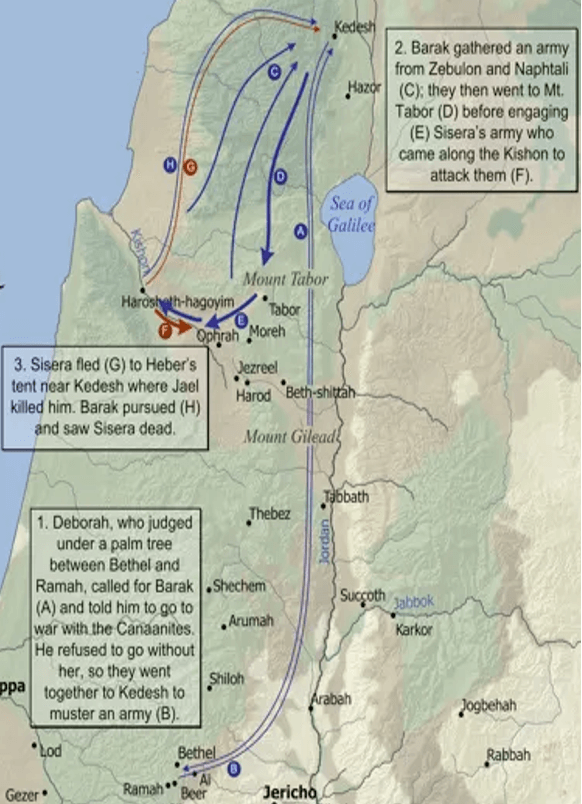
Map from Headwaters Christian Resources
Box 1 Action-The cycle begins again with Israel’s disobedience. This time God gave them over to King Jabin of Canaan, who reigned from Hazor in the far north. His army commander Sisera, lived in Haroheth-hagoyoim, which is above Box 3. Next in the cycle is always Israel crying to God for help. They were very scared because Sisera had 900 iron chariots. The judge of Israel then was the prophetess Deborah. She worked from under a palm tree between Bethel and Ramah in the map’s south. She told Barak to attack the Canaanites at Mt. Tabor. Barak lived in Kadesh, the extreme north. He would only go if she went also—conditional obedience. She agreed but said a woman would get the credit. Box 2 Action-Barak gathered 10,000 men at Kadesh from the tribes Zebulun and Naphtali and went to Mt. Tabor. Sisera’s men and chariots came from Harosheth-hagoyim. The Lord defeated the Canaan-- ites. The entire army died, except Sisera.Box 3 Action-Sisera fled on foot pursued by Barak. He hid in a Kenite woman’s tent.The Kenites were at peace with Canaan. While Sisera took a nap, Jael, the Kenite woman, drove a peg through his head. Then Barak arrived, after the fact.
In this episode God used the oppressive Canaanite commander Sisera to discipline Israel for 20 years. We see that God in His persistent mercy once more heard Israel’s cry for help. We also see God working through flawed, fearful people, such as Barak. And we see God using faithful women in leadership and in action to achieve His purposes. Other places where women, such as Deborah, are identified with the gift of prophecy include Exodus 15:20, 2 Kings 22:14, Luke 2:36, and Acts 21:8-9. Guidelines for women prophesying in the church are provided in 1 Cor. 11:5: “Every woman who has her head uncovered while praying or prophesying disgraces her head.”
JOHN 18 If you have a red-letter Bible in which the words of Jesus appear in red, you will notice that the previous four chapters are almost entirely red. John records Jesus’ teaching his disciples and praying to his Fathers. Chapter 18 returns us to the narrative of the story. There are four scenes in this chapter.
In the Garden: In the midst of the confusion of darkness and “torches, lanterns and weapons,” Jesus appears to be the only one who is in perfect peace. There are at least two reasons for this. First, the chapter begins with this sentence, “When he had finished praying…” The real struggle for Jesus over. Although he would soon
READING FOR JANUARY 28, 2025 CONTINUED: JOHN 18, PSALM 148:1-6 be bound, and beaten, he had finished praying. In his prayers, he had made the decision to drink the cup the Father was giving him. He says in the garden, “Shall I not drink the cup the Father has given me?” (v11) The second reason for his peace is stated in verse 4, “Jesus, knowing all that was going to happen to him…” No one else in the garden knew what would happen. Judas isn’t sure how Jesus will respond to his betrayal. (Matthew says he called Judas “friend” even with the kiss of betrayal.) Those sent to arrest Jesus had no assurance they would arrest the right man for they didn’t even know what he looked like. (Jesus identifies himself and willingly surrenders to them.) Peter hopes to keep Jesus from being arrested and lashes out with a sword. (Jesus tells him to put it away.) Malchus loses an ear. (All the gospel writers mention this, but only Luke tells us that Jesus immediately touched his ear and healed him.)
Before the High Priest: This is actually two scenes. Jesus is first taken to Annas, who is the father-in-law of Caiaphas, the high priest and then he is taken to Caiaphas. The result of these meetings had been settled in another meeting weeks earlier just after Jesus raises Lazarus from the dead:
"What are we accomplishing?" they asked. "Here is this man performing many miraculous signs. If we let him go on like this, everyone will believe in him, and then the Romans will come and take away both our place and our nation." Then one of them, named Caiaphas, who was high priest that year, spoke up, "You know nothing at all! You do not realize that it is better for you that one man die for the people than that the whole nation perish." He did not say this on his own, but as high priest that year he prophesied that Jesus would die for the Jewish nation, and not only for that nation but also for the scattered children of God, to bring them together and make them one. So, from that day on they plotted to take his life.” John 11:47-53
This was their chance, and they were going to make the most of it. They would see Jesus dead!
In the Courtyard: Here Peter denies knowing Jesus on three separate occasions. We will discover in chapter 21 that Jesus does not hold this against Peter and welcomes him with open arms.
Before Pilate: Unlike the high priest, who seemed to know that Jesus really was sent from God, Pilate was ignorant of Jesus and his claims. But after questioning Jesus, Pilate did not want to condemn him, for he could see that Jesus was innocent. Pilate tried to set Jesus free. (19:12) He tried to convince the crowd to ask for Jesus’ release, but the crowd, stirred by the religious leaders asked for another prisoner named Barabbas. (It is worth noting that the name Barabbas literally means the Son of the Father.)
The chapter ends with Jesus facing crucifixion. But he is still at peace, for he had finished praying. He knew who he was and where he had come from and where he was going. And he knew that no one was taking his life from him, but that he was willingly laying it down in love.
PSALM 148:1-6 The first verses of this chapter list those entities above us who are directed to praise the Lord. Some groups we can easily imagine having this capacity, such as angels and other spirit beings. Some are inanimate, such as the sun, moon, and stars. We usually interpret such statements as poetic metaphors, that the splendor of their existence brings God praise. Yet, all these entities alike exist because God “commanded and they were created.” All alike continue because God “established them forever and ever.” Let’s not totally foreclose on the idea that, at least in God’s fully realized Kingdom, somehow all alike could also praise the Lord. Remember Jesus: “I tell you, if these [disciples] stop speaking, the stones will cry out!” (Luke 19:40).