
READING FOR JANUARY 6, 2025: JOSHUA 12, JOHN 2 PSALM 136 JOSHUA 12 COMPLETE LIST AND LOCATION OF KINGS DEFEATED BY ISRAEL
A B C D E F G H I J K L M N
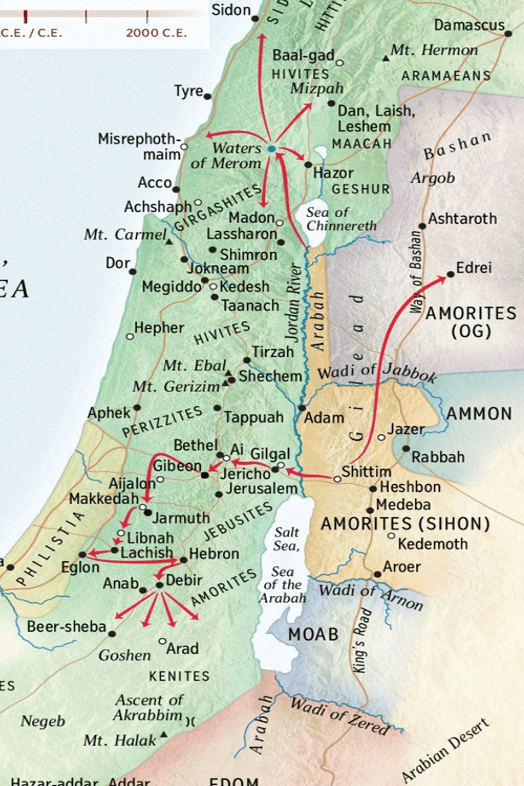
| Defeated kings of cities not on this map: Gezer, Geder, Hormah, and Adullam. Victories by Moses were on the east side of the Jordan River. This land was given to the tribes of Reuben, Gad, and half the tribe of Manasseh. Victories by Joshua were on the west side. | 1 2 3 4 5 6 7 8 9 10 11 12 13 14 | DEFEATED BY MOSES (2 Kings):Sihon, King of Amorites—L 10Og, King of Bashan—N 5 DEFEATED BY JOSHUA (31 Kings):King of Jericho—I 9King of Ai—H 9King of Jerusalem—G 9King of Hebron—F 10King of Jarmuth—E 9King of Lachish—D 10King of Eglon—C 10 King of Debir—E 11King of Arad—F 12King of Libnah—D 10King Makkedah—E 9King of Bethel—G 9King of Tappuah—G 8King of Hepher—D 6King of Aphek—D 8King of Lasharon—I 5 King of Madon—I 4King of Hazor—J 4King of Shimron—G 5King of Achshaph—F 4King of Taanach—G 6King of Megiddo—F 5King of Kedesh—G 5King of Jokneam—F 5King of Dor—D 5King of Gilgal—I 9King of Tirzah—H 7 |
JOHN 2 As we move today into the main body of John, he leads us on the first steps of a divine treasure hunt: a series of seven clues (miraculous acts, which John calls signs); seven declarations by Jesus concerning his identity; a crescendo of confessions by his followers of who they understand Jesus to be; deliberate fulfillment of the Jewish religious systems and rituals, one after another; and Jesus speaking of time progressing from “my hour has not yet come” of this first miracle to “the hour has come” of his arrest and crucifixion. We will also see as we go along that every individual and group who encountered Jesus were faced with a decision. As John wrote in the prologue: The world did not recognize him. He came to that which was his own, but his own did not receive him. Yet to all who did receive him, to those who believed in his name, he gave the right to become children of God. (John 1:10-12)
READING FOR JANUARY 6 CONTINUED: JOHN 2, PSALM 136 At first, they genuinely didn’t know who he was, but as he slowly revealed himself they would either receive him and believe him – and therefore follow and obey him – or they would reject him and take increasingly drastic measures to stop him. It seemed no one was indifferent to Jesus; he left no room for indifference.
At the wedding of Cana we are shown the first of the signs that John includes in his gospel: Jesus turning water into wine. Jesus is surely moved by compassion for the wedding parties, but he is also revealing in this seemingly small act a glimpse of the glory of God at work in and through him. As he told Nathanael, those who watch with even a little bit of faith will see heaven open and the angels coming and going in Jesus. This is the first signpost, and John specifically tells us that at this sign the disciples believed. Their belief was shallow at this point, an immature belief (a little faith, as Jesus will say later), but it was a beginning.
Another interesting detail of this story is that Jesus produced this wine in jars used for ceremonial washing. Wine was not made nor stored in jars like this. Why might he have chosen them to be filled with water which he turned into new wine? Perhaps it symbolized the fulfillment of the Old Testament ceremonial bathing for purification. Rather than water that cleans only the outside of a person, Jesus was bringing forth a new wine – the wine of his blood, the wine of the gospel – to cleanse the hearts of those who receive it.
The next scene of Jesus at the Temple brings many questions. An unknown prophet coming into town and turning the Temple upside down like he owned the place?? Shocking!! We can glean three things from it:
- The Temple was the place Israel’s God had promised to live in the midst of his people, like Jacob’s Ladder a place where heaven and earth met. And Jesus is judging it; the Temple had become corrupt and was not fulfilling its purpose. (The corruption will become increasingly obvious as we continue in the gospel.)
- This took place as Passover neared and Jesus made reference to his eventual crucifixion. John wants us to see that what Jesus did here was a hint of his coming fulfillment of the Passover.
- Jesus spoke and acted as if he had authority over the Temple. It’s impossible for us to understand the gravity of this for the Jewish leaders – indeed for all Jewish people. Again, we are seeing a glimpse here of what we will understand more as we go on. Who is this man who speaks with such authority? A devil or one sent by God?
“In the two vivid scenes of chapter 2, John has introduced us to almost all the major themes of the gospel story, and has given us food for thought about where it’s all going. But, as so often, he ends with a hint as to how people should respond: If you see the signs Jesus is doing, then trust him. Believe in him.” (N.T. Wright, “John for Everyone”)
PSALM 136 This Psalm recalls Psalm 118 in that there are repeated calls for various groups to respond with the words “His mercy endures (hasdow) forever.” This word “hasdow” is now used in Psalm 136, although the phrase here is shouted in response 26 times instead of just five. Note that while King James Version translates it “mercy endures,” the NASB uses “faithfulness endures,” and the NIV uses “love endures.” Obviously, scholars see this Hebrew expression as having the range to accommodate these related English meanings. The reasons for shouting this mantra include the following: God’s goodness; being the ultimate God and Lord; His wonders; His wisdom in creation; His victory over Israel’s enemies; the heritage He bequeathed to Israel; His remembrance of Israel during hard times; His redemption of Israel; and his provisions for all living creatures. Having trouble finding reasons for which to praise God? This chapter alone provides enough to keep us busy for the rest of our lives.