READING FOR JANUARY 7, 2025: JOSHUA 13, JOHN 3, PSALM 137 JOSHUA 13 Unfinished business for Israel and perhaps for us:
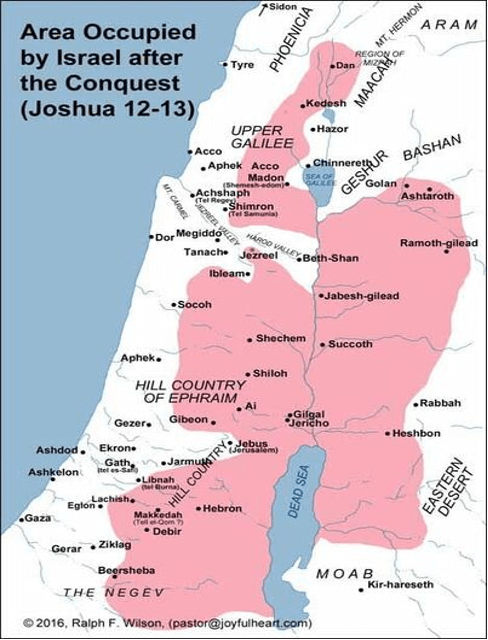
The King James Version has a pointed way of stating Johua’s age after he defeated the 31 kings of Caanan: “old and stricken in years.” The NASB uses the more polite “advanced in years,” but doesn’t the KJV wording ring true at times? Despite Joshua’s astounding success and old age, the work wasn’t finished. Remember these enemy kings often allied together to converge at common locations to battle Israel. While Israel defeated all these kings, enemy residents still occupied much land in between these victorious battle sites. The light areas on the map at left are areas of enemy occupation. The Lord reaffirmed his promise to drive out the inhabitants of these areas. The land conquered east of the Jordan River by Moses, though, was subdued with the exception of two groups: Geshur and Maacath in the north. It was ready for the Gadites, Reuben-- ites, and the half tribe of Manasseh to settle.
As God had made clear before, Levites wouldn’t be given a tribal region. They, like Christians today, claimed the Lord their God as their inheritance. Let’s seek to pass that greatest of legacies onto our children and grandchildren by praying and working for their salvation.
JOHN 3 In today’s chapter we encounter the most well-known and most beloved verse of Scripture: For God so loved the world that he gave his one and only Son, that whoever believes in him shall not perish but have eternal life. The context is a conversation with a Pharisee who came after dark to talk with Jesus. We see the germination of belief forming in Nicodemus. After hearing of some miracles and of Jesus’s clearing of the Temple, he seems curious enough to come see Jesus but afraid enough to come under cover of darkness. He recognized that Jesus had an authority that must come from God, but he wasn’t willing to risk his reputation or standing by being seen with him. Jesus was willing to work with that. He must have recognized Nicodemus’s desire for God and his budding belief, because we see in other encounters that Jesus simply refused to get pulled into theological conversations with Jewish leaders who had hardened their hearts and refused to humbly listen. But moved by Nicodemus’s humble seeking, Jesus took time for this deep conversation.
Nicodemus approached Jesus as Rabbi, meaning Teacher, apparently to discover new information. But Jesus told him that people don’t need only new information; they need a new heart and a new life: Very truly I tell you, no one can see the kingdom of God unless they are born again. (v 3:3) Jesus knows that humans are caught in a web of sin and selfishness that they cannot escape, which leads to death, but that God desires life for them instead, for this is why he has come. Some important things to notice in this conversation are:
READING FOR JANUARY 7, 2025 CONTINUED: JOHN 3, PSALM 137
- The gift of new life is offered because of God’s love for the world he made, his abundantly generous love. This is how God loves – he gives. The generous love of God led to him giving his Son. – v 16
- The gift of new life is offered to everyone. Whoever believes – vs 16, 18, 21
- Jesus always speaks of eternal life in the present tense. For Jesus, eternal life is a new life from abovethat is given when a person believes and that will continue after their physical death and into eternity. Throughout his gospel, John uses the term eternal life to describe “a new quality of life, one that is infused with God’s eternal love, beginning now and lasting into the future”. (Bible Project Guide to the Book of John, www. bibleproject.com)
Two more quick thoughts about the rest of the chapter that reveal themes of the whole book of John:
- Jesus came as Light (vs 19-21), which represents revelation (light allows reality to be seen as it is). He revealed the Father to us, making him known in a way we couldn’t know him otherwise. As each person received the revelation of God they were faced with a decision – to come into the light or to remain in darkness.
- Verse 36 literally translates as “The one believing in the Son has life eternal; the one however not obey- ing the Son will not see life. . .” We will see John (and Jesus) never separated believing from obeying.
We leave Nicodemus here for a time and will run into him later in the book. As we leave him here on this dark night we know that Jesus has shown him some light; we don’t know yet what Nicodemus will do in response. Will he draw nearer the light or will he choose to remain in darkness? Will he believe and, therefore, follow and obey or will he not? Jesus seems content to give him freedom and time to decide. He does the same for us. What will we do with the free will and the time God has given us? Will we use it to draw near to Jesus and live increasingly in the light of his teaching? And for those who are not yet following Jesus, will we do the same? Will we lovingly and patiently share truth, giving them the time and space they may need to seek and meditate and decide how they will respond?
PSALM 137 This shocking Psalm is both a tragically beautiful lament and a raw imprecation or curse upon Babylon. Most of us cannot fully enter into the deep feelings of the Psalmist who had experienced being forced from his home and subject to the whims of heartless captors. Perhaps the closest we can come is the death of a child, end of a marriage, firing from a job, or life-threatening illness. The Psalmist sits by the rivers of Babylon sadly recalling Zion—that one of kind city of God. He isn’t able to fake songs of joy or make music, even when his captors perhaps mockingly demand it. Yet, he commits to never forgetting Jerusalem, perhaps remembering God’s prophetic word: “For this is what the Lord says: ‘When seventy years have been com-- pleted for Babylon, I will visit you and fulfill My good word to you, to bring you back to this place”’ (Jer. 29:10).
This resoluteness is a sign of trust in God’s word, which gives hope for the future. This hope is available to us whenever we trust God’s word. Apparently the Edomites, descendants of Esau, were cheering on the Babylonians when they carried off Israel. Whether or not as a result of this curse, Edom did disappear from history around 70 A.D. Babylon also fell, being defeated by the Persians in 539 BC. No matter how sad we become, though, in our current time after the cross, resurrection, and indwelling of the Holy Spirit, it is very difficult to justify our asking God to dash the children of our tormentors against the rock. We now, thanks to Jesus, have the opportunity to love and pray for our enemies. This is spiritual warfare in Jesus’s name.