READING FOR JANUARY 9, 2025: JOSHUA 15, JOHN 5, PSALM 139:1-12 JOSHUA 15 The Land Allotted to the Tribe of Judah
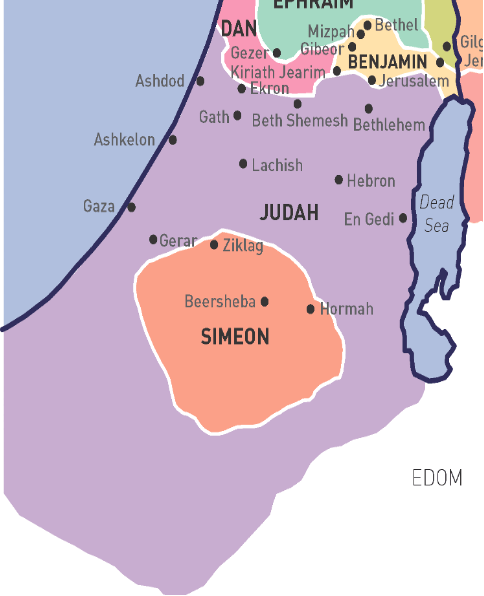
The lottery for the tribe of Judah resulted in the territory shown on the map at left. Notice the southern border starts at the lower end of the Dead (Salt) Sea. It goes southwest next to Edom (Esau’s descendants) and even-- tually curves back up to the Great (Mediterranean) Sea. The eastern border is the Dead (Salt) Sea going north to near the mouth of the Jordan River. The northern border starts near the mouth of the Jordan, runs through the slopes south of Jerusalem and south of the border town of Kiriath Jearim. It proceeds just north of Ekron and ends at the Great Sea, which serves as its western border. As mentioned in chapter 14, Caleb was given Hebron. He immediately defeated three sons of Anak there. He then challenged his tribesmen that anyone who captured Debir (located between Hebron and Ziklag) could marry his daughter. Othniel was the brave winner. Caleb’s daughter, Achsah, was as assertive as Caleb by asking for and receiving additional property rights to springs in the Negev desert. The rest of the chapter lists all the cities that were given to Judah.
The last verse states Judah failed to drive out all the Jebusites residing in Jerusalem. This verse also poses an interpretive problem: Joshua 15 lists Jerusalem in Judah, but Joshua 18:28 says it’s in Benjamin. Here’s a solution suggested by Defending Inerrancy: “Both are true. Some scholars also point to a Jewish tradition that held the altars and sanctuary were in Benjamin, while the courts of the temple were in Judah. Be that as it may, the city was actually within the limits of Benjamin’s territory but was also on the border of Judah’s land. So, it may properly be described as being part of both.”
JOHN 5 Chapter 5 begins with the third of Jesus’s signs recorded by John. It’s interesting to note that of all the people there seeking a healing from the waters, Jesus singled out this one man and approached him for a divine encounter. Why only one? Why this one? We aren’t told, but we do hear from Jesus that he does the work and the will of his Father (4:34), so we trust in God’s purpose for this healing of this man on this day.
The pool had offered the hope of a miraculous healing, but it seemed sporadic and unpredictable and completely unattainable to this man – and most of those who waited. Then Jesus came along – the one John has been telling us is the true Son of the true God. With a question and a command, Jesus did what the pool had not been able to do. We don’t know anything about the man’s faith or of his previous knowledge or his opinion of Jesus, but when Jesus told him to “Get up!” he did, and he was healed.
And what was the reaction of the Jewish leaders? Rather than rejoice in the man’s healing or respond with curiosity about the kingdom of God coming to earth in a new way through this man Jesus, they immediately began to oppose and persecute him, the sharpest opposition so far. As the signs keep coming and Jesus’
READING FOR JANUARY 9, 2025 CONTINUED: JOHN 5, PSALM 139:1-12 following increases, we will see the opposition becoming fiercer and the cost of following Jesus growing. Through the rest of the chapter Jesus speaks of his identity, his authority, the testimony to his claims, and the hearts of the Jewish leaders.
Identity: Jesus clearly understands his identity as the Son of God (Yahweh; Creator; God of Abraham, Isaac, and Jacob; God of Moses; God of Israel; etc.). And he has such confidence in God’s goodness and generosity and such love for him, that he refers to him as his Father. He speaks of watching and listening to his Father and joining him in all he does. He understands that over time he will share in his Father’s honor. All who love and honor the Father will come to love and honor him.
Authority: Jesus declares that the Father has given him authority over things of heaven and earth. He has demonstrated authority over the elements in turning water into wine and over physical life in restoring health to the official’s son and the lame man. And he speaks in today’s reading of having authority over the life that comes after this life. The Father has given him authority over judgment and eternal life. Note that Jesus says he exercises this authority in obedience and honor to his Father from whom it comes.
Testimony to His Claims: What evidence is there that his claims are true? They seem outlandish – and even blasphemous to faithful Jews. He reminds them that John the Baptist has testified to his identity and authority. He tells them to keep watching what he does, for his deeds will offer plenty of testimony that what he says is true. Finally, he says the Father himself has testified about him in the Scriptures. (Remember in Luke 24 the conversation on the road to Emmaus, after his resurrection, when “beginning with Moses and with all the prophets, He explained to them the things concerning Himself in all the Scriptures”.)
Hearts of Jewish Leaders: Jesus demonstrated a deep understanding of human hearts, particularly here the hearts of the leaders. He could see that, though they claimed to believe Moses and love God, they really didn’t. In fact they did not really know God at all, for if they knew and loved God, they would have received Jesus and believed his word. He knew they were really more interested in seeking glory from one another.
Let’s close with these words of Jesus: “Very truly I tell you, whoever hears my word and believes him who sent me has eternal life and will not be judged but has crossed over from death to life.” (5:24)
PSALM 139:1-12 This writer recalls talking with a friend long ago in college who mocked the idea that a God could hear and respond to everyone who prayed to Him throughout the world. Now we are learning every day of heretofore unbelievable informational tasks performed by Artificial Intelligence. Such a multi-tasking God no longer seems as implausible. Yet, consider how amazing His omniscience is. He knows everyone’s visible behaviors, everyone’s thoughts, everyone’s life directions, and everyone’s personal tendencies. Not only does He know what we have said, but He knows what we will say in the future. Anything that can be known about us is known by Him, much more than we can know about ourselves. We will never be able to comprehend this fully until we see Him in heaven: “For now we see in a mirror dimly but then face to face; now I know in part, but then I will know fully, just as I also have been fully known” (1 Cor. 13:12). This is the God whose word some believe couldn’t possibly be applicable in today’s culture. Hmm.