
READING FOR MARCH 5, 2025: 1 SAMUEL 5, MATTHEW 23, PSALM 17:1-7 1 SAMUEL 5 When is a victory not a victory? Ask a Philistine or his local equivalent.
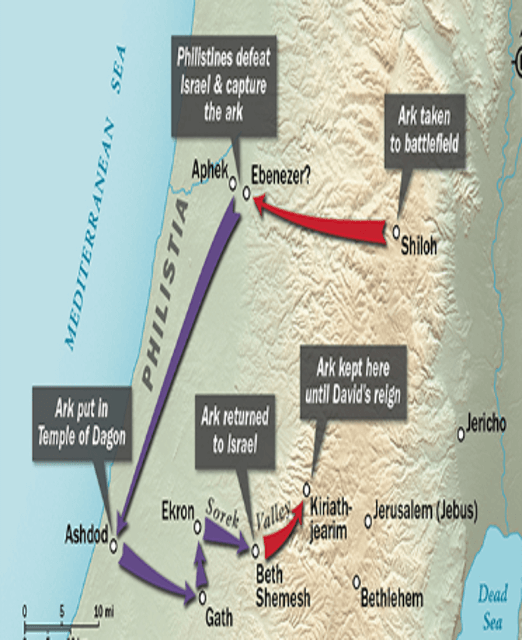
The map at left shows the journey of the ark of the covenant after its capture by the Philistines. It went from Ebenezer in Ephraim south to Ashdod on the coast where it was placed in the house of Dagon. Perhaps the Philistines thought they could maintain their worship of Dagon and add some of the benefits of Israel’s God. Our God doesn’t work that way: “You shall not worship any other god, because the Lord, whose name is Jealous, is a jealous God” (Ex. 34:14). Jesus is the only way—not other faiths or philosophies. After one night next to the ark, Dagon fell on his face. After the second, he fell again breaking off his head and hands. Rather than to accept this evidence of God’s superiority and worship Him, the Philistines sought to protect themselves and their manmade god, Dagon. This is exactly what happens today when we refuse to sub- mit to God’s will and follow manmade gods/ways of our cultural norms. In order to escape the conse-- quences of housing the ark but not obey the God it represents, they sent the ark to Gath. Here the Lord brought tumors on all the men. So, they sent the ark to Ekron, who immediately sent it back to Israel.
Hear and obey the words of Jesus: “You shall love the Lord your God with all your heart, and with all your soul, and with all your mind, and with all your strength” (Mark 12:30). Don’t mix and match with other faiths or with worldviews that contradict the Bible.
MATTHEW 23 This chapter, all words of Jesus, falls into three distinct sections: 1) a warning to the disciples and the crowd about the scribes and Pharisees, 2) a blunt recitation of seven “woes” directed at the scribes, Pharisees, and all hypocrites (which could include us), and 3) weeping over Jerusalem but with a last-ditch offer to them. Warning. This begins with unusual guidance to do what the Jewish leadership says, but don’t imitate their deeds. The late Art Holmes, philosophy professor at Wheaton College, wrote a book entitled All Truth Is God’s Truth. Its point was that all truth is ultimately from God, even if its immediate source is flawed or evil. The Apostle Paul made this same point in Philippians 1:15-18. Jesus then lists some of the Pharisees’ specific ungodly characteristics: piles on needless rules without any support; makes religious displays to be noticed; loves places of public prominence; enjoys being called by honorific titles such as teacher, father, and leader. On this last point Jesus takes a more egalitarian view. Let’s all consider ourselves equally brothers (and sisters) in Christ. Let’s strive to serve each other. Let’s never exalt ourselves but
READINGS FOR MARCH 6, 2024 CONTINUED: MATTHEW 23, PSALM 17:1-7 intentionally humble ourselves. This represents true Biblical “egalitarianism” more so than how that word is often used today.
Woes. We sometimes hear of people rejecting Jesus because they perceive the church is hypocritical. Here we see that no one could oppose hypocrisy more than Jesus does. If anything, Jesus is harsher here than John the Baptist was earlier. He directs seven woes right at the Pharisee, scribes, and hypocrites for doing the following: 1) blocking others from the kingdom (which in turn also blocks themselves), 2) profiting from poor widows (think aggressive appeals for money), 3) mission trips without a Gospel motivation and result, 4) concern for money rather than true worship, 5) focusing on minor nonessentials while neglecting the foundational Gospel message, 6) preoccupation with external appearance rather than purity of the inner person, and 7) boasting about how well they would have treated God’s prophets, even as they would later reject God’s messengers sent to them. Jesus said they will be guilty of murdering all the Old Testament prophets. When we reject God’s Word today, does our guilt extend to the murder of Jesus and all His prophets (Heb. 6:6)?
Weeping. Here is one of the key passages indicating humanity has free will. God’s perfect will is that all of us will be saved. Because we are made in His image, God’s permissive will allows us to reject Him, as Adam and Eve did much to their great loss. This causes God sorrow even while He still hopes we will welcome Him “who comes in the Name of the Lord” (vs.39).
PSALM 17:1-7 It appears that David really thought about this prayer before he prayed it (vs.1). David, as we have seen, often expresses his raw emotions to God. Here he seems to have processed his thoughts more before offering God his requests. Maybe, that would be a good plan to follow during normal times when we are not experiencing great emotional turmoil. Consider the words from James, the half-brother of Jesus: “You ask and do not receive because you ask with wrong motives, so that you could spend it on your pleasure” (James 4:3). How about 1 John 5:14? “This is the confidence which we have before Him, that, if we ask anything according to His will, He hears us.” Remember we are speaking to the creator God who alone possesses all the attributes we discussed when studying Job 12. David affirmed that God is aware of his past actions (vs.4-5), motivations (vs. 3a), and intentions (vs. 3b). He also states his desire for God’s lovingkindness and overall belief that God saves those who take refuge in him. All these statements precede David’s specific requests. Maybe these sorts of affirmations are appropriate or even necessary to include before making our requests. Remember that the beginning of the prayer Jesus taught us 1) affirms the close fatherly relationship we enjoy with God; 2) affirms God’s position in heaven of total authority; 3) affirms the complete holiness of God’s character; 4) affirms our desire for the coming of God’s Kingdom; and 5) and affirms our desire for God’s will. All this occurs before we ask for our daily needs. It is always wise to remember with whom we are speaking before asking for what we desire.