
READING FOR MAY 21, 2025: 1 CHRONICLES 19, MARK 5, PSALM 44:17-26
1 CHRONCILES 19
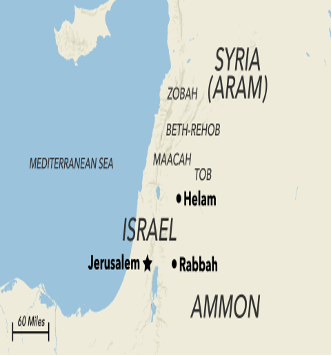
One of David’s many good traits was that he never forgot a kindness bestowed to him. Even after the kind person died, he desired to repay the kindness to that person’s family. In this case David wished to pay back the kindness of the just deceased King of Ammon by sending his servants to offer condo- lences to his son Hanun. One danger in life is to suspect the worst of intentions from others. Hanun’s commanders convinced him that this was just a trick to spy out the land. So Hanun humiliated David’s servants by shaving their beards and cutting off their garments at the waist. Even today we see certain leaders needlessly humiliate others on social media. It might temporarily make someone feel tough, but it likely will cause suffering for lots of innocent people. In this case, it led to a pointless war. These unwise Ammonites realized they had provoked Israel, so they hired Mesopotamian (i.e., Aramean) soldiers from Aram-maacah, and Zobah. Ammonites also fought, of course.
Joab, David’s commander, saw that the enemies were positioned both in front and behind him. Rather than regretting that situation, he used it to his advantage. He placed his brother in charge of the side facing the Ammonites while he led the forces facing the Arameans. This gave Israel flexibility to maneuver troops to either the Ammonite or Aramean side of the battle, depending which side needed more troops. Joab was wise to consider how a difficult situation could be used to his advantage. As with Joab, when we are fighting the Lord’s battles, being in a difficult spot need not depress us; it just brings more glory to God. First the Arameans fled and then the Ammonites fled. Then Aramean reinforcements were brought from the Euphrates River in the far north But David, himself, called forth an Israelite army from throughout Israel and gathered at Helam (according to 2 Sam. 10) for a huge battle. David’s victory at Helam was total, resulting in peace with King Hadadezer and the Arameans, neutralizing them as a future threat.
MARK 5 We first read this story of exorcism on February 12, 2025 when studying Matthew 8. In the Matthew account there were two demon-possessed men. Mark’s account just focuses on one of these men. We can’t know why the accounts differ, but their differences do not make them contradictory. By looking at both, we receive a fuller picture. In Mark, we learn about the extent of physical strength, constant screaming, and self-harming of this possessed
man. In Matthew 8 it says people avoided these men. Likely, we would do the same. Jesus,
however, commanded the unclean spirit to leave and asked its name. The demons, named
READING FOR MAY 21, 2025 CONTINUED: MARK 5, PSALM 44:17
Legion signifying many, made a request to Jesus, which He granted. Might this mean that demons are ultimately limited in their actions by what God permits? That was certainly the case in the book of Job. Consider 1 Cor. 10:13: “God is faithful, so He will not allow you to be tempted beyond what you are able, but with the temptation will provide the way of escape also, so that you will be able to endure it.” If we really rely on God, then Satan cannot defeat us. In this account we learn that the demons entered a herd of 2,000 pigs that then ran off a cliff into the sea. Try to picture that scene. Who said the Bible is boring? When the town tragically asked Jesus to leave, He did. Jesus never pushed faith in Him on anyone. Perhaps that should inform our methods of sharing the Gospel. We can, as Jesus told the formerly possessed man, just go to our people and tell what the Lord has done for us.
The rest of the chapter deals with two intertwined healing storylines: the hemorrhaging woman and synagogue official’s dying daughter. Stop to imagine how many requests for healing come to God simultaneously. Millions? Yet, even in Jesus’s human body He was able to address both of these requests with compassion and unhurried attention. This woman had a chronic condition of 12 years that drained all her finances. Yet, she still had a positive belief in what Jesus could do. Notice Jesus told the woman that her faith made her well. After learning the official’s daughter had died, Jesus told the father not to be afraid but to believe. Jesus does not always promise a specific clinical result from our faith, but He does say our faith can make us well and unafraid. In this case, the woman’s bleeding stopped, and the daughter sprang to life. This may not be our experience, but we can be unafraid and well with our soul.
PSALM 44:17 The lament of this Psalm continues with the extra information that Israel did not violate their end of the Mosaic Covenant (Deut. 28) by disobeying God’s commands. Yet, Israel is not experienced the promised blessings of God from this covenant at that moment. This seeming nonresponsive God adds to their pain, but, and a big but it is, does not cause them to “deviate from [God’s] way” (vs.18). They remain persistent in prayer and confident in His power, even as they are perplexed by His actions. We might pray this prayer today as some of us struggle yet remain faithful in our obedience, as did Job. Paul quotes from vs. 22 when he writes in Rom. 8:36, “For Your sake we are killed all day long; We were regarded as sheep to be slaughtered.” Yet with the advantage of living after the cross and resurrection, he adds: “But in all these things we overwhelmingly conquer through Him who loved us. For I am convinced that neither death, nor life, nor angels, nor principalities, nor things present, nor things to come, nor powers, nor height, nor depth, nor any other created thing will be able to separate us from the love of God that is in Christ Jesus our Lord” (Rom. 8:37-39).