READING FOR MAY 27, 2025: 1 CHRONICLES 20, MARK 9, PSALM 46:8-11 1 CHRONICLES 20 Retelling some great victories by Israel
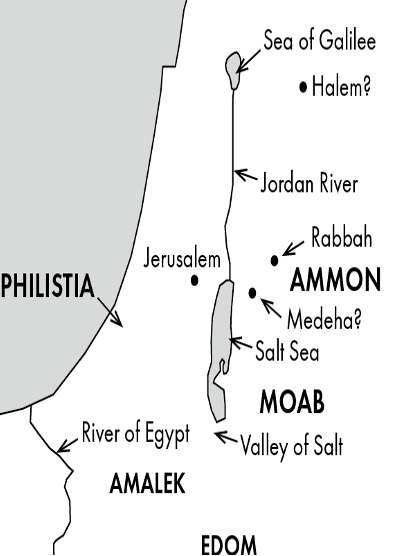
Verse one begins almost exactly as does 2 Sam. 11:1, describing David not leading his forces in Rabbah against Ammon. He unfortunately stayed home. But then it skips the entire drama about what David did while this took place, which was to commit adultery with Bathsheba. It seems that Ezra was not interesting in retelling the great moral failure of David, Israel’s national hero, to the people returning from exile. Today we also need discernment to determine what Biblical passages are appropriate to be voiced to address the situation at hand. The Chronicler then picks up the story found in 2 Sam. 12: 26 regarding Joab’s victory at Rabbah, David acquiring its wealth, Israel utilizing its popula- tion for forced labor, and the conquest of other Ammonite cites. Starting in verse five, the Chronicler again skips many details from David’s personal travails. The last four verses of this chapter jump all the way to 2 Samuel 21:18 to remind the exiles of Israel’s victory over the Philistines in the cities of Gezer and Gath in Philistia. These Philistines were descendants of giants, including Goliath. One even had twelve fingers and twelve toes. With the incredible tasks ahead of the returning exiles to rebuild Jerusalem and the temple, no wonder the Chronicler believed these stories of God’s empowerment needed to be emphasized.
MARK 9 This is Mark’s version of the Transfiguration. The verse before the Transfiguration in the other two accounts (Matthew and Luke) is essentially the same as Mark 9:1: “And Jesus was saying to them, ‘Truly I say to you, there are some of those who are standing here who will not taste death until they see the kingdom of God after it has come with power.’” The very next verse is the first verse of the Transfiguration story in all three accounts: “Six days later, Jesus took with Him Peter and James and John, and brought them up on a high mountain by themselves. And He was transfigured before them” (9:2). The proximity of the two statements and the fact they are connected by the temporal phrase “six days later,” suggests the Transfiguration is the fulfillment of the prophecy about seeing “the kingdom of God.” There are those who hold to another meaning of this prophecy, though, such as Pentecost.
READING FOR MAY 27, 2025 CONTINUED: MARK 9, PSALM 46:8-11 On the way down the mountain, Jesus told them not to tell others about this until “the Son of Man rose from the dead.” Many of us are puzzled as to why Jesus kept referring himself as the Son of Man, perhaps thinking it is a reference to His human nature. While that might also be true, this expression was very familiar to Jews of that day as a quotation from Daniel 7:13-14 referring to the promised king coming down from heaven: “I kept looking in the night visions, and behold, with the clouds of heaven One like a Son of Man was coming, and He came up to the Ancient of Days and was presented before Him. And to Him was given dominion, Glory and a kingdom, that all the peoples, nations and men of every language Might serve Him. His dominion is an everlasting dominion which will not pass away; and His kingdom is one Which will not be destroyed.”
Mark’s account of the demon-possessed boy differs from Matthew’s in that it includes more dialogue between Jesus and the father. Jesus is a bit taken aback by the father’s request to heal the boy if He could. Jesus stresses that all things are possible with sufficient belief. The father’s response was honest and heartfelt: “I do believe; help my unbelief.” This could be an appropriate request for all Christians. Jesus then implied that the disciples failed to heal the boy because of insufficient prayer. This begs the question: What victories over Satan have we failed to win due to our not engaging in prayer? Let’s pray for our Church with this in mind.
in verses 30-32, Jesus temporarily shut down His public ministry to engage in some intense instruction with His disciples. What is this central doctrine He wanted the disciples to understand and that He wants us to understand? JESUS’S DEATH AND RESURRECTION. Isn’t it ironic that after Jesus tells them about His ultimate sacrifice, His disciples started arguing about which one of them is the greatest? What should we do instead? Serve everyone and especially care for little children. Jesus then warns not to cause these children to stumble, saying those who do would be better off not to have been born. Then He extends this warning to anyone who stumbles: You will be thrown into hell (vs. 47). These words are from Jesus!
PSALM 46:8-11 Notice that verses 7 and 11 are the same: “The Lord of armies is with us;
The God of Jacob is our stronghold.” This literary device, known as an inclusio, brackets material in between this repeated statement that describes the statement. Thus, the Psalmist invites the covenant people of God to examine God’s works that prove God is with them. The reader should notice God’s judgment on the earth, likely meaning against Israel’s enemies, and God’s enforcement of peace. He neutralizes the enemies’ instruments of war and tells those who strive against Him to stop and realize He is in charge. Then He points to a time when all nations will exult Him as sovereign, even if they failed to do so before Judgment Day:“At the name of Jesus every knee will bow, of those who are in heaven and on earth and under the earth, and that every tongue will confess that Jesus Christ is Lord, to the glory of God the Father” (Phil. 2:10-11).