
READING FOR OCTOBER 14, 2025: 2 CHRONICLES 13, ACTS 27, PSALM 107:1-16 2 CHRONICLES 13 The reign of Abijah (called Abijam in 1 Kings) lasted three years, making his time as king one of the shortest in Judah’s history. Yet, one extremely consequential event was the war that took between Judah and Israel during Jeroboam’s reign in Israel. A battle bet- ween them involved 1,200,000 valiant men with Israel’s forces being twice as large as Judah’s. This is such a large number of soldiers for two kingdoms having limited populations. Does it seem sad that so many lives were lost in one battle, 500,000 men from Israel? Remember the pain caused to America during the Viet Nam War when 50,000 men were killed from our much larger country. Let’s obey 1 Tim. 2:1-4: First of all, then, I urge that requests, prayers, intercession, and thanksgiving be made in behalf of all people, for kings and all who are in authority, so that we may lead a tranquil and quiet life in all godliness and dignity. This is good and accep table in the sight of God our Savior, who wants all people to be saved and to come to the knowledge of the truth.”
Before the battle started, King Abjhah ascended Mount Zemaraim and reminded all of Israel of God’s covenant with the house of David and how Jeroboam deviated from it. He proclaimed Judah’s faithfulness to that covenant (not so sure this was entirely true) and thus God’s con- tinued presence with them that day. He tried to convince Israel not to attack Judah. Having been warned, Jeroboam promptly started the attack, both from the front and rear of Judah’s forces. In response, all Judah cried out to the Lord and the priests blew their trumpets. Guess who prevailed that day? “God defeated Jeroboam and all Israel before Abijah and Judah” (vs.15). Jero- boam never recovered his health after this defeat and soon died. In contrast, Abijah became powerful. As often happens with power and a great victory, he did not entirely follow God’s guidance. He took 14 wives. We all are vulnerable to a form of pride after a great success.
Acts 27 After appealing to Caesar, Paul begins the long journey to Rome. It is an arduous journey across the Mediterranean Sea (see map).
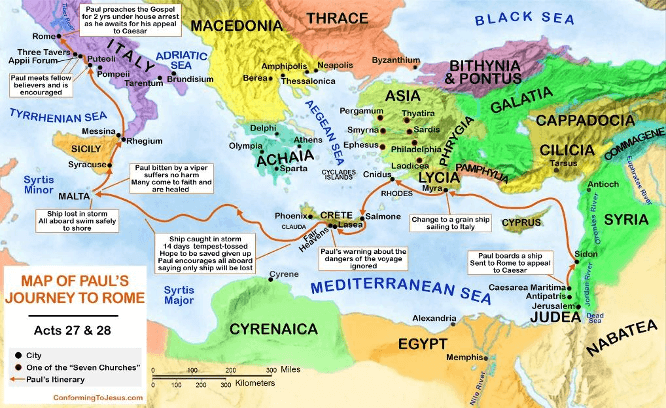
READINGS FOR OCTOBER 14, 2025 CONTINUED: ACTS 27, PSALM 107:1-16
The trip was a dangerous journey in good weather in the middle of summer. The fact that they are sailing in late September or early October is downright dangerous. The Romans considered sailing after September 15thdoubtful and after November 15th suicidal.
Two times, Paul calms the crew and passengers amidst the storm. Twice he tells them that God has told Paul that all who were on board would survive the trip. The key was to stick together and ride out the storm until the could get ashore. It was a faith journey. In a storm, the sails are usually not deployed as it is feared they will rip under the strain. In a hurricane, the strength of the wind can damage the mast of the ship if the sail is deployed. The ship was at the mercy of the winds and was being taken wherever the winds pushed them.
Are we the calm amid a storm? Do we use our faith in God to assist others as they journey through life and its troubles? Do we encourage them to continue to find strength to persevere? Do we encourage them to let God hold them? Paul has an unlikely ally on the journey. The Roman centurion, Julius. Throughout the jour- ney, Julius ensures that Paul has his needs provided. And Paul communicates to Julius what to do to keep the people on board safe. Are there people who may be unlikely allies in your ministry? People who may not fit the mold of our society? Yet, they’re perfect to assist in furthering the impact of Christ’s work through you.
Psalm 107:1-16 Psalm 107 is another salvation history hymn. It calls Israel to praise God for his unfailing love. Psalm 106 was most likely written during the time of the Babylonian exile. However, Psalm 107 was almost without question written after the return of the people of Israel from the Babylonian exile. It reminds us that God hears the prayers and saves those who need God.
This section has two groups of people that God has saved. The first group has wandered into the desert where they are unable to find sufficient water and food for their needs. The Israelites have a lasting history of their ancestors foraging in the desert for 40 years on their journey from Egypt to the Promised Land. In addition, to the east of Israel lies the vast Arabian desert. They were familiar with the struggles for survival in the harsh climate.
The second group of people were in prison. Because of their misdeeds they were forced to do hard labor and to suffer under the hands of foreign oppressors. The psalmist tells us that they struggled to the point of breaking. The concept of darkness (V. 10) may have both a literal and metaphorical meaning. Prisons in ancient times (and really until recent history in the west) were miserable places. They were dark, damp, and dreary. There was little regard for the prisoners well-being.
Metaphorically, darkness is spoken of in the Bible as the absence of God. To be in darkness, is to be without God. As it says in 1 John, “This is the message we have heard from him and declare to you: God is light; in him there is no darkness at all. (1:5, NIV)” To be in the presence of God means that darkness can no longer exist.
In both situations, as soon as the people cry out to God, they are saved. God satisfied their hunger and thirst (V. 9) and broke down the chains that imprisoned them (V. 16). The psalmist calls the people to give praise for God’s unfailing love. God reached in and saved them from their distress.
When we pray to God, we can be assured of being saved. God will walk with us in times of trouble. God will give us the assistance we need in the situation (God gave those who hungered food and those who were in chains their freedom). We are called to give praise because God loves us through all times and places.