
READINGS FOR OCTOBER 15, 2024: NUMBERS 23, ACTS 27, PSALM 107:1-16
Numbers 23
The seer, Balaam, and the Moabite king, Balak, stand upon Bamoth Baal and look out over the Israelite encampment. Balaam tells Balak to build seven altars and sacrifice a bull and a ram on each altar.
The number seven is a Biblical number that means fullness or completeness. The world was created in seven days (six days of work and a day of rest (Genesis). The greatest blessing to a Jewish family in antiquity was a house full of seven sons (Ruth 4:15).
God gives Balaam messages to speak to King Balak. Balaam give them to Balak in a series of seven messages (which will be in the next two chapters). Again, it is a number that means fullness or completeness.
The first message is that Balaam cannot curse the people of Israel. He cannot curse a people that God has blessed.
Balaam take King Balak to the top of Pisgah in the field of Zophim to show him more of the Israelite camp. The second message lifts up the strengths of the people of Israel. Balak is upset. He wants Balaam to do something to stop the power of the Israelites. However, Balaam can only say the words that God has given to him.
Acts 27
After appealing to Caesar, Paul begins the long journey to Rome. It is an arduous journey across the Mediterranean Sea (see map).
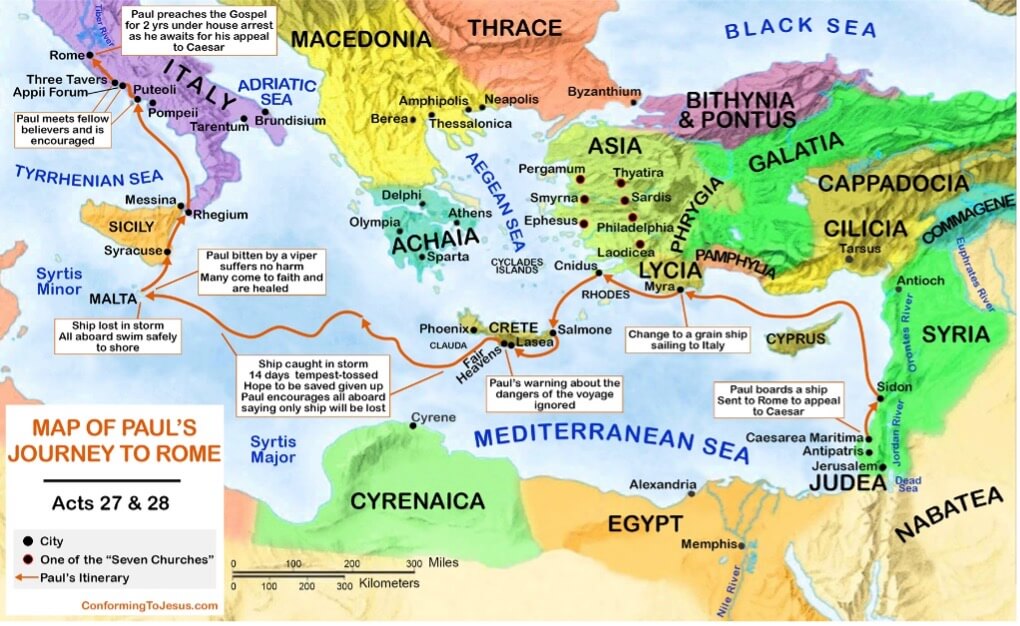
The trip was a dangerous journey in good weather in the middle of summer. The fact that they are sailing in late September or early October is downright dangerous. The Romans considered sailing after September 15th doubtful and after November 15th suicidal.
Two times, Paul calms the crew and passengers amidst the storm. Twice he tells them that God has told Paul that all who were on board would survive the trip. The key was to stick together and ride out the storm until the could get ashore.
It was a faith journey. In a storm, the sails are usually not deployed as it is feared they will rip under the strain. In a hurricane, the strength of the wind can damage the mast of the
READINGS FOR OCTOBER 15, 2024 CONTINUED: NUMBERS 23, ACTS 27, PSALM 107:1-16
ship if the sail is deployed. The ship was at the mercy of the winds and was being taken wherever the winds pushed them.
Are we the calm amid a storm? Do we use our faith in God to assist others as they journey through life and its troubles? Do we encourage them to continue to find strength to persevere? Do we encourage them to let God hold them?
Paul has an unlikely ally on the journey. The Roman centurion, Julius. Throughout the journey, Julius ensures that Paul has his needs provided. And Paul communicates to Julius what to do to keep the people on board safe. Are there people who may be unlikely allies in your ministry? People who may not fit the mold of our society? And yet, they are the perfect person to assist in furthering the impact of Christ’s work through you.
Psalm 107:1-16
Psalm 107 is another salvation history hymn. It calls Israel to praise God for his unfailing love. Psalm 106 was most likely written during the time of the Babylonian exile. However, Psalm 107 was almost without question written after the return of the people of Israel from the Babylonian exile. It reminds us that God hears the prayers and saves those who need God.
This section has two groups of people that God has saved. The first group has wandered into the desert where they are unable to find sufficient water and food for their needs. The Israelites have a lasting history of their ancestors foraging in the desert for 40 years on their journey from Egypt to the Promised Land. In addition, to the east of Israel lies the vast Arabian desert. They were familiar with the struggles for survival in the harsh climate.
The second group of people were in prison. Because of their misdeeds they were forced to do hard labor and to suffer under the hands of foreign oppressors. The psalmist tells us that they struggled to the point of breaking.
The concept of darkness (V. 10) may have both a literal and metaphorical meaning. Prisons in ancient times (and really until recent history in the west) were miserable places. They were dark, damp, and dreary. There was little regard for the prisoners well-being.
Metaphorically, darkness is spoken of in the Bible as the absence of God. To be in darkness, is to be without God. As it says in 1 John, “This is the message we have heard from him and declare to you: God is light; in him there is no darkness at all. (1:5, NIV)” To be in the presence of God means that darkness can no longer exist.
In both situations, as soon as the people cry out to God, they are saved. God satisfied their hunger and thirst (V. 9) and broke down the chains that imprisoned them (V. 16). The psalmist calls the people to give praise for God’s unfailing love. God reached in and saved them from their distress.
When we pray to God, we can be assured of being saved. God will walk with us in times of trouble. God will give us the assistance we need in the situation (God gave those who hungered food and those who were in chains their freedom). We are called to give praise because God loves us through all times and places.
