READING FOR OCTOBER 3, 2025: 1 KINGS 12, 1 JOHN 3, PSALM 119:81-88 1 KINGS 12 The Big Split
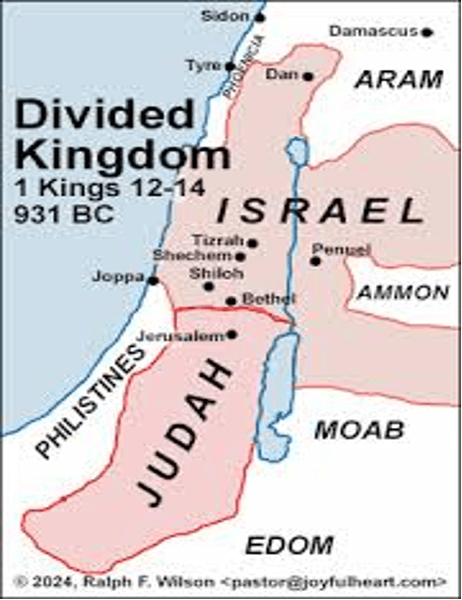
In 1 Kings 11 the prophet Ahijah informed Jeroboam, a man from the tribe of Ephraim, that, due to the sins of Sol- omon, 10 tribes will be given to him to rule as the north- ern kingdom of Israel. He was also told if he obeys God’s commands, God will build him “an enduring house.” In this chapter we see how this prophecy unfolds. Solo- mon’s son Rehoboam went to Shechem expecting to be crowned as Solomon’s successor. That was also the intent of all of Israel who gathered there. Jeroboam and others approached this king-elect and suggested he lighten the load that Solomon had given the people. This was also the thought of the elders. Rehoboam didn’t like that idea, so he sought advice from his younger friends. They gave him the advice he wanted. Have we even kept seeking advice until we find what we were looking for at the outset? This is called “confirmation bias.” We all do it at times. Rehoboam did not communicate his decision to the people with the needed amount of empathy. Shockingly and stupidly, he said, “My father disciplined you with whips, but I will discipline you with scorpions!”
In ways that are beyond our understanding, God used Rehoboam’s own stupidity to fulfill His plan: “It was a turn of events from the Lord, in order to establish His word which the Lord spoke through Ahijah the Shilonite to Jeroboam the son of Nebat” (vs.15). This is the mind-boggling way God uses our free will to achieve His sovereign plan for the universe. We can only stand in awe!
When Rehoboam sent his man to begin the forced labor, the people stoned him to death and Rehoboam beat a quick retreat back to Jerusalem. All of sudden he doesn’t act so tough. The 10 northern tribes promptly made Jeroboam their king, which is a rather fateful decision because it removes these tribes from the Davidic Covenant and its fulfillment in Jesus. Meanwhile back in Jerusalem, Rehoboam started planning to win back the 10 northern tribes, but a man of God told him to drop it. For once Rehoboam listened to this good advice.
Amazingly, Jeroboam found a way to muck up the good deal that God offered him. Without a word from the Lord, but using his own comparably puny brain, he imagined if his people went to Jerusalem to offer sacrifices then they might fall under the sway of (the rather stupid) Rehoboam and kill him, meaning Jeroboam. Thus, he placed a golden calf at Dan (way north) and one at Bethel (way south) where the people could worship and offer sacrifices. It had all the trappings of the real thing with altars, priests and an annual festival. We could call it Jeroboamism. Aren’t we tempted to make our own objects of worship and construct our own set of truths? Christianity means worshipping a holy God. Holy literally means set apart or totally other. We only know Him by His self-revelation, not through our own creativity. We obey His words as He Himself has revealed them in His Word, not what we would like for Him to say or how our tiny snapshot of our present-day culture (a version of Jeroboamism) finds appealing. Are we ready for a God like that?
READING FOR OCTOBER 3, 2025 CONTINUED: ACTS 20, PSALM 105:7-15 ACTS 20 If space allowed, a nice map could be inserted here to track Paul’s progress. To sum up, he sailed to Troas where he spoke to a gathering on a Sunday. As he spoke past midnight, a young man sitting in a windowsill sank into sleep and fell three stories. He was pronounced dead, but Paul embraced him back to life and finished his message through daybreak. Long sermons are nothing new. Paul’s group sailed to Miletus and called the church elders over for a meeting. (Note that in verse 28 he also called elders overseers and shepherds. These words are used interchangeably.) He reminded them of the prior plots against him by the Jews but also his teaching in public places and houses. This was his teaching: repentance toward God and faith in Jesus. This must be our primary teaching as well. Once again, Paul indicates he knows what the Holy Spirit wants him to do: return to Jerusalem. The Spirit also revealed that prison awaits him there. Paul’s awareness of the Holy Spirit’s communication to him is acute.
Paul’s rather valedictory talk to them expressed that his greatest desire wasn’t longevity, but finishing the course of his ministry. How are we doing on that count? Are we still on course to finish? Since Paul was on course, he could honestly say he was “innocent of the blood of all men.” When we share the Gospel with those God puts in our path, we can say the same. What if we haven’t shared the Gospel with them? Are we then somehow guilty of their blood?Paul then reminded them to be on guard for themselves and the flock. As mentioned when Num.16 was discussed, the threat to their faith could come from outside or inside the church: “From among your own selves men will arise, speaking perverse things to draw away the disciples after them.”.
PSALM 105:7-15 These verses provide a poetic history of God’s relationship with His chosen people from Abraham until their time in Egypt. Wouldn’t it be interesting to do a poetic review looking back on different periods of our lives or our church’s history and how God was faithful to meet those specific situations. Probably some of us with a literary bent could do this. First is the powerful observation in verse seven that their Lord is also the judge of the entire earth. Yes, He had this intimate relationship with Israel, but He is the universal judge—not one religion among legitimate beliefs. He made a covenant with Israel’s forefathers (vs. 8-9) that was good then, is good now, and will be good forever, through its fulfillment in Jesus. This promise of a homeland was forged when Israel was only a single family moving among different lands. Throughout these early years of migration, God did not allow His people to be oppressed or His prophets to be harmed. When God makes a promise, it will take place. Count on it. “I am coming again and will take you to Myself, so that where I am, there you also will be” (John 14:3).