
READING FOR OCTOBER 7, 2025: 1 KINGS 14, ACTS 22, PSALM 105:26-36 1 KINGS 14 Next generation of kings for the divided kingdoms of Judah and Israel
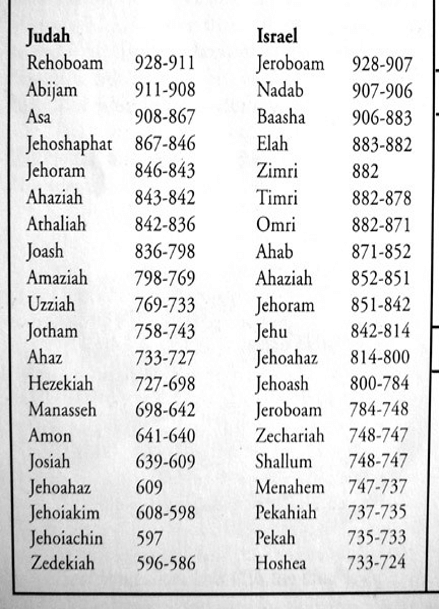
As we bounce back and forth between the histories of Judah and Israel, there might be value in keeping in mind the bigger picture. As the chart at left shows, the nations had the same number of kings, but the length of reign for the kings of Judah was usually considerably longer. As this chapter, opens Jeroboam sends his wife to a prophet of God to find out what will happen to their ailing son Abijah. She disguised herself from the prophet who had bad eyesight already. Because God gave the prophet advanced word, rather humorously he answered the door by asking her why she was disguised. Then without her even asking, He told her that due to Jeroboam’s idolatry, all the males in their house will be wiped out. God said, “You have gone and made for yourself other gods and cast metal images to provoke Me to anger” (vs. 9). There is nothing in the Bible to suggest God feels different- ly now when we serve other entities as our ultimate focus other than the God of the Bible. Although Jeroboam’s son Nadab succeeded him for a few years, Jeroboam’s line was then eliminated forever, as was prophesized.
Meanwhile, how is Rehoboam leading Judah? “And the people of Judah did evil in the sight of the Lord, and they provoked Him to jealousy with their sins which they committed” (vs. 22)...They committed all the same abominations of the nations which the Lord dispossessed before the sons of Israel”(vs. 24). This isn’t surprising because Rehoboam’s mother was from one of these nations: Ammon. So, the disobedience of Solomon created problems for future generations. Our walk with the Lord not only impacts us, but also our children, grandchildren, and great-grandchildren.
Does God love Judah enough to discipline them, or will He let them just continue on this pathway away from Him forever? Consider what the writer of the Hebrews tells us: “God deals with you as with sons; for what son is there whom his father does not discipline? But if you are without disci- pline, of which all have become partakers, then you are illegitimate children and not sons.” (Heb. 12:7-8). Yes, God does not change! In verse 25 we learn that Shishak the king of Egypt marches against Jerusalem and removes the treasures from the Temple and the palace. Also, Rehoboam and Jeroboam, our two disobedient kings, continue to war against each other throughout their reigns. Finally, Rehoboam dies and is succeeded by his son Abijam.
ACTS 22 Paul spoke to the Jewish mob in Hebrew, which seemed to surprise and quiet them. He gave some background information about himself, including that he was a student of Gamaliel, whose wisdom we ran into in Acts 5:34. Paul also mentioned that he himself was a former persecutor of Christians, even pursuing them to their death. Thus, his opening remarks were entirely given over to identifying with his hostile
READING FOR OCTOBER 7 2025 CONTINUED: ACTS 22, PSALM 105:26-36 audience. (Perhaps this is good communication practice.) Then he proceeded to give a factual and unadorned account of his encounter with Jesus on the road to Damascus. An interesting detail Paul provides of the encounter is that Jesus considers those who persecute His followers as persecuting Him. Jesus connects completely with his followers, especially their pain.
Paul spoke of Ananias with appreciation for his being a devout Christian while also respected by the Jews. It’s possible to love Jesus while having a good relationship with nonbelievers. All of us, even Paul, need an Ananias to guide us, especially when starting our Christian walk. Do we have such a person in our lives and are we that key guide for someone else? Consider this carefully. What adjustments might be necessary to find such people and be such people. In Paul’s account, Ananias prayed over him and gave him marching orders: Be a witness for Jesus to all people. Then Ananias gave him a little tough love: He told him to get up and get going. What was Paul’s operational definition of getting going? It included praying in the Temple. Nothing of Godly value happens without prayer. While he was praying, he saw another vision of Jesus. Remember Peter’s vision while he was praying on the housetop (Acts 10:9-17)? Might be a pattern here. As Paul continued his account, the moment he spoke the word “Gentiles” to the crowd they asked for his execution.“Lord, may we never hate any group of individuals so that the very name of that group causes us to be unloving, let alone murderous.”
The commander immediately ordered that Paul undergo extreme interrogation to find out the cause of their anger. (By the way, dishonesty, threats, and torture are still interrogation techniques used today, but can’t be reconciled with Christian values as listed in Gal. 5:22-23.) Just before they began the torture, Paul asked if it was lawful to treat a Roman citizen this way. This set off a minor panic and led to Paul’s immediate release. What criterion should cause us to never consider mistreating someone physically or verbally? “With it [the tongue] we bless the Lord and Father, and with it we curse people made in God’s image. From the same mouth come blessing and cursing. These things should not be so” (James 3:9-10). Don’t mistreat anyone.
PSALM 105:26-36 This is a ten-verse whirlwind account of the ten plagues of Egypt. For those Baroque fans among you, here is a wondrously jumpy rendition of “The Land Brought Forth Frogs” by George Handel: https://www.youtube.com/watch?v=av_f0hb0pjk Speaking of “wondrously,” the Psalmist said Moses and Aaron performed wondrous acts among their enemies. Of course they were damaging, painful, and eventually deadly, but still, they call for wonder. Do we find our Lord wonderful? Think of the Hebrew people. Enslaved for hundreds of years, mistreated by their oppressors, and without a voice to give hope for the future. Yet, they were liberated in a manner that was unforeseeable.
Now, fast forward thousands of years later to another liberation: Lincoln’s visit to Richmond after the South’s surrender: "Such wild, indescribable ecstatic joy I never witnessed," Charles Coffin described the scene in the Boston Journal. As Lincoln walked from the river toward the state Capitol, he was surrounded by "a surging mass of men, women and children, black, white and yellow, running, shouting, and dancing. Yesterday morning most of the thousands who crowded the streets and hindered our advance were slaves. Now they were free and beheld him who had given them their liberty." Now let’s behold Him who liberated us from much greater oppression to a much great future: “For He rescued us from the domain of darkness and transferred us to the kingdom of His beloved Son, in whom we have redemption, the forgiveness of sins” (Col 1:13-14).