READING FOR OCTOBER 9, 2025: 2 CHRONICLES 11, ACTS 24, PSALM 106:1-12 2 CHRONICLES 11 Judah back on track, for now.
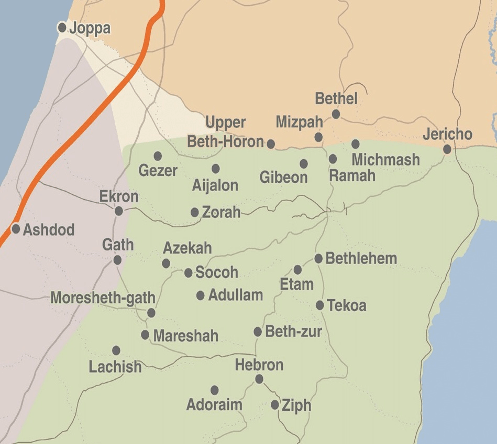
With the Southern Kingdom reduced down to the area occupied by Benjamin and Judah, we find Rehoboam focusing on strengthening the defenses in some of the remaining cities: “Rehoboam lived in Jerusalem and built cities for defense in Judah. He built up Bethlehem, Etam, Tekoa, Beth-zur, Soco, Adullam, Gath, Mareshah, Ziph, Adoraim, Lachish, Azekah, Zorah, Aijalon, and Hebron, which are fortified cities in Judah and Benjamin.” (vs. 5-10). At least Rehoboam is taking seriously the defense of Judah. As can been seen on the map, this is a significant build up for a such a small area. The nation is further strengthened by the emigration from the Northern Kingdom of Levites and all who refused the worship the false gods of Jeroboam.
This enabled Rehoboam to get back on track, temporarily at least, after his rocky start: “They strengthened the kingdom of Judah and supported Rehoboam the son of Solomon for three years, for they walked in the way of David and Solomon for three years” (vs. 17). One difference between a leader of God’s people and a secular entity, such as a country like the USA, is that the personal life of the leader is as important as her/his public life. Thus, we too often see pastors fail because they have not been faithful to their family commitments, even if they are effective in public.
The King of Judah also needs to live according to God’s expectations or else the entire nation will suffer the consequences. Although Rehoboam had far fewer wives and concubines than his father did, that’s not the standard to really demonstrate he is fully devoted to God. He acted wisely, though, in certain matters, such as distributing some of his 28 sons in all the fortified cities. This no doubt kept the sons too busy to plot against each other, gave them administrative experience, and sent a message throughout the Kingdom that the King took these cities seriously. It’s easy to be too focused on headquarters—in this case Jerusalem.
Acts 24
Paul has been brought to Herod’s palace in Caesarea to face trial against the charges of the religious leaders. The High Priest, Ananias, a lawyer, Tertullus, and some others come to present their charges to the Roman governor, Felix. The charges against Paul are vague and nothing concrete is given for their request to have him punished.
When Paul is given his chance to speak, he defends his position. He explains that he did not do anything against the law of Rome. Verse 16 can be seen as a motto that we could all strive to attain:
READING FOR OCTOBER 9, 2025 CONTINUED ACTS 24, PSALM 106:1-12
“So I strive always to keep my conscience clear before God and man.” (NIV)
We should strive to be truthful in all things.
For some reason, Felix waits to rule on Paul’s case. He frequently invites Paul into conversation. After two years, Felix is recalled to Rome. We know from historical sources that he was called to Rome to respond to accusations about his governing. His “shady” dealings might explain why he became afraid when Paul “talked about righteousness, self-control, and the judgement to come” (V25, NIV).
The gospel can sound accusatory. When you begin to talk about what it means to follow Christ, people who are living sinful lives may think you are pointing out their faults. It may just be their conscience. When you are confronted with the truth, it is hard to live a lie.
Psalm 106:1-12
Psalm 106 is a salvation history hymn. It stresses Israel’s history of rebellion and a prayer for God to once again save them from their enemies. The hymn begins and ends with a call to praise God (“Praise the LORD” in Hebrew is “Hallelujah”).
Verses 1-5 is an introduction to the hymn. The psalmist gives praise to God. The psalm gives thanks for the way God blesses those who act justly. Then, it asks for God’s favor and blessing. The psalmist reminds God of the requirements for blessing and then asks that the psalmist be able to receive them (be righteous and just).
Verse 6 sets the stage for the rest of the psalm. The people of Israel have again sinned. They have rejected the will and law of God. They are again in need of rescuing.
Our section for today concerns the crossing of the Red Sea. God saved the people of Israel by drying up the Red Sea, allowing them to cross over, and then drowning the Egyptians as they attempted to follow. The saving act of God brought the Israelites to praise God for the blessings. The rest of the psalm will detail how short that praise lasted.
How easy is it for us to praise God when we have been blessed? How often do we forget to praise God when times are good? How often to we turn to God when we are facing struggles and then ignore God when the trouble passes?