READING FOR SEPTEMBER 26, 2025: 1 KINGS 10, ACTS 15, PSALM 103:15-22 1 KINGS 10 This chapter records the Queen of Sheba’s visit to Solomon. Where is Sheba?
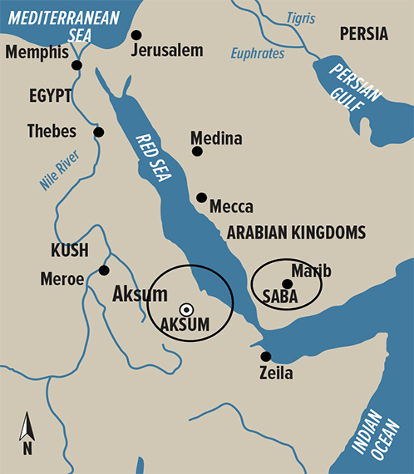
“There is a well-documented Kingdom of Sheba (Saba) that existed in Biblical times. It is documented both historically and archaeologically—and it was not in Ethiopia, but rather in southern Arabia--modern-day Yemen” (Source: Biblical Archeology Society website). The text states Solomon’s fame had spread that far, and the Queen visited to test his knowledge. She apparently traveled the length of Arabia in a caravan of camels. Those who have seen the movie “Laurence of Arabia” would have the idea. Wouldn’t it be great today if there were leaders whose knowledge was so great that other leaders would travel great distance for the purpose of exploring the leaders’ wisdom? The Queen brought a load of expensive gifts. Even today in some eastern cultures, such as Japan, it’s imperative for visit- ors to bring thoughtful, if not expensive, gifts for their hosts.
Solomon received a perfect score on the Queen’s test. In addition, she was overwhelmed by the “house that he had built, and the food of his table, the seating of his servants, the service of his waiters and their attire, his cupbearers, and his burnt offerings which he offered at the house of the Lord” (vs.4-5).
As King Hiram of Tyre said previously, she stated that Solomon’s men and servants who could benefit from his wisdom on a continual basis were blessed. She blessed the Lord, whom she called Solomon’s God, for placing him on the throne. Interestingly, she did not call Solomon’s God the Lord and creator of all. This leads one to believe she considered His God a local deity—not necessarily the one true God. After an exchange of gifts between them, she returned home. We do not find in any biblical record that there was any romantic relationship between the Queen and Solomon, although stories about this pop up all the time.
One numerical detail in this chapter grabs our attention: “The weight of gold that came to Solomon in one year was 666 talents of gold” (vs. 14). That precise number appears only one other time in the Bible: ”No one will be able to buy or to sell, except the one who has the mark, either the name of the beast or the number of his name. Here is wisdom. Let him who has understanding calculate the number of the beast, for the number is that of a man; and his number is six hundred and sixty-six.” (Rev. 13:17-18). This writer does not know the significance of this for Solomon but would not be surprised if it turns out to be meaningful. Let’s see what happens at the end of time. The rest of the chapter details the enormous wealth generated during the height of Solomon’s reign. One other detail is clearly concerning, though: ”Now Solomon gathered chariots and horsemen; and he had 1,400 chariots and twelve thousand horsemen” (vs. 26). This is clear violation of Deut. 17:16: “He [the king of Israel] is not to acquire many horses for himself.”
READING FOR SEPTEMBER 26, 2025 CONTINUED: ACTS 15, PSALM 103:15-22 ACTS 15 The church dispute described in Acts 15 began when some the Judean Christians came to Antioch to teach that Gentile believers in Jesus need to be circumcised before being saved and baptized (15:1). Such a requirement went against the core of Paul’s understanding of the Gospel (see entire Book of Galatians). The church at Antioch appealed to Jerusalem for direction from the elders and apostles on the matter (15:2). This “Jerusalem Council” becomes a model for resolving disputes in churches and denominations. Let’s learn from it.
After extended debate, a turning point occurred with the testimony of Peter (15:7), whose undisputed credibility was first established by Jesus (Matthew 16:17-19). He referenced his encounter at Joppa with an angel, who sent him to share the Gospel with the house of the Roman Centurion Cornelius at Caesarea (15:7). Peter reported that the Holy Spirit, by endowing these Gentiles with spiritual gifts (15:8), confirmed the central truth that it is by grace though faith in Jesus that all are saved—not through the works of the Law (15:9-11). Paul and Barnabas followed Peter’s testimony by recounting the signs and wonders of God had done outside of the Judean bubble among the Gentiles (15:12). James, who apparently was the presiding officer of the proceedings, identified these Gentile conversions as the fulfillment of the prophets’ writings (5:13-18). Having given this clinching rationale via Scripture, he ruled against requiring circumcision before salvation and baptism (15:19). After safeguarding the core of the Gospel, James then displayed remarkable wisdom and charity by adding three stipulations that were especially meaningful to the Christians on the losing side of the debate (5:20-21). These stipulations, were either already supported by all or posed no theological or practical problems for the Gentile believers, and helped foster healing between the factions:
- Abstain from things contaminated by idols.
- Abstain from fornication.
- Abstain from what is strangled and from blood.
This entire decision was reduced to writing and sent to the church at Antioch (15:23-29). When it was read by them, “they rejoiced because of its encouragement” (15:31). Wouldn’t it be great if every report summarizing the actions of a general conference or annual convention were greeted with rejoicing? PSALMS 103:15-22 Here’s a comparison between two extremes: 1) a person’s earthly life is over in a flash and then soon forgotten; 2) God’s mercy and justice are everlasting towards those who have faith in Him. Continuing to describe God, He reigns in the heavenly domain, which means He’s in charge of everything. The mighty angels, who exist to do His will, need to praise and obey Him. In fact, all of creation needs to praise Him. Let’s take some comfort that, despite appearances, when we praise God, we are part of the vast majority in the Universe.