READING FOR SEPTEMBER 30, 2025: 2 CHRONICLES 9, ACTS 17, PSALM 104:10-23 2 CHRONICLES 9 This chapter is Ezra’s take on Queen Sheba’s visit to Solomon also found in 1 Kings 10. Remember this account was written hundreds of years after the events described. Ezra was clarifying this history for those exiles who were returning to Israel after their 70-year stay in Babylon. Also, recall God sent them into Babylon due to their repeated sins against God over hundreds of years. Thus, Ezra is reminding the people of their former greatness before experiencing God’s punishment. Ezra states that “King Solomon became greater than all the kings of the earth in wealth and wisdom” (vs 22). This must have been almost impossible for the returning exiles to believe as they encountered their totally devastated homeland.
This chapter stays very close to the text of 1 Kings 10, which we looked at on September 26. Perhaps we could focus on the few different details. For example, this version gives us more details about trading practices in antiquity: “King Solomon gave the queen of Sheba her every desire, whatever she requested, besides gifts equal to what she had brought to the king” (vs. 12). From what is written here, it appears that trading between countries took place at the highest level of national government. Also, it appears that the normal practice was to trade equal values of goods. In this case, they did this, but Solomon went to an extra level of generosity with the Queen. This method of reciprocal trading would guarantee there would be no trade imbalance between countries because all trading could be centrally controlled. Also, there would be no such tax as tariffs involved. Today, trading usually occurs between independent companies. Thus, the national leaders cannot control the balance unless they place a trade embargo on certain countries for political reasons or levy tariffs to protect domestic companies. Classical economists such as Adam Smith suggest that freer trade generates more economic growth.
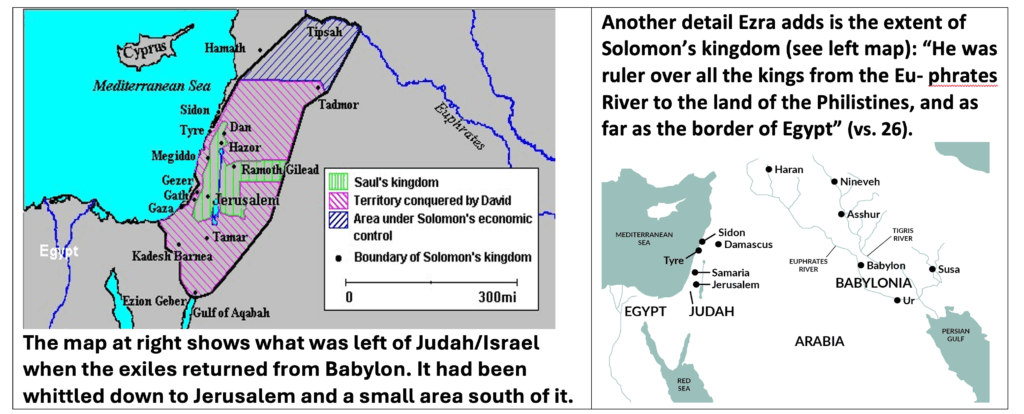
Interestingly, one item Ezra leaves out totally is God’s anger with Solomon. Any thoughts why?
READING FOR SEPTEMBER 30, 2025: ACTS 17, PSALM 104:10-23 ACTS 17 After getting out of prison in Philippi, Paul and Silas decided they needed to take it easy. No, that’s what we would do! They pressed on to Thessalonica. Once again, they first went to the synagogue. Notice that for three Sabbaths Paul “reasoned with them from the scriptures.” For those who have any appreciation for the Bible at all, reasoning with them from the Bible is a best way to persuade them of God’s truth. For those for whom the Bible is outdated or too narrow, it may not be as effective.
Paul gave evidence from the scriptures that “Christ had to suffer and rise from the dead.” The evidence for this truth still needs to be given to today’s churches! Here is a comment from a popular author while he still self-identified as a Jesus follower: “Jesus did NOT have to die on the cross. In other words, God did not require Jesus to be crucified to fulfill some mystical prophecy.” Not surprisingly, but sadly, this man no longer believes in the divinity of Jesus and follows “the notion of Divine Unity.” Do we know the Biblical evidence Paul referenced?
Paul did indeed persuade some to be Christians, including God-fearing Greeks who apparently attended the Synagogue services and others called “leading woman.” We already met Lydia, who was a businesswoman from Philippi. Now we meet leading woman and in verse 12 “prominent Greek women.” The common view that women were always treated like property in the New Testament is not supported by the Biblical evidence. Once again, jealousy prevented the Jews from coming to faith and prompted them to falsely claim that Paul was undermining Roman rule. Thus, Paul and Silas slipped out of town out at night.
The evangelistic team now arrives at Berea. The Bereans were given perhaps the greatest compliment of any city in the Bible and one to which our church should aspire: “They received the word with great eagerness, ex- amining the Scriptures daily to see whether these things were so” (vs.11). Please take that approach for any comments written in these studies! As President Reagan used to say, “verify.” Although many believed in Je- sus, still-angry Jews from Thessalonica came to Berea to cause trouble, forcing the team to leave.
This brought Paul to likely the intellectual capital of the world: Athens. Because Paul got to Athens before Silas and Timothy, he used the time to walk around. The fact that many gods were worshipped there disturbed him, as we should be disturbed by those who don’t practice Christianity. Jesus is more than just one religion among many, but He’s the universal truth. Paul again reasoned in the synagogue, but he also matched wits the Greek philosophers. Even with the Stoics and Epicureans he preached Jesus and the resurrection, but he did not use the Bible. When Paul was walking around Athens alone, he noticed an altar with this inscription: “TO AN UN- KNOWN GOD.” Paul used that as a bridge to sharing the truth of the one true God who was not idol made by human hands, but the creator of all things. He even used Greek poetry to describe Him: “For we also are His descendants.” He then pointed to the resurrected Christ, as we all must when witnessing. Some believed; oth- ers did not. Can we take contemporary non-Christian material to point others to Jesus? It’s possible!
PSALM 104:10-23 Here is an interpretation that won’t be shared by everyone. As implied above about the Bereans, verify it. These verses say God supports animal habitats and replenishes the earth in such a way to foster agriculture. He plants cedar and juniper trees which maintain wildlife. He goes out of his way to help endangered species such as lions and forest animals survive. Might it be that when we as a fallen human race selfishly work against the sustainability of the natural environment, we are dishonoring God? Just asking.