
READING FOR SEPTEMBER 6, 2024: LEVITICUS 23, LUKE 24, PSALM 92 LEVITICUS 23 Summary of Seven Feasts (Chart from Firm Foundation-New Zealand).
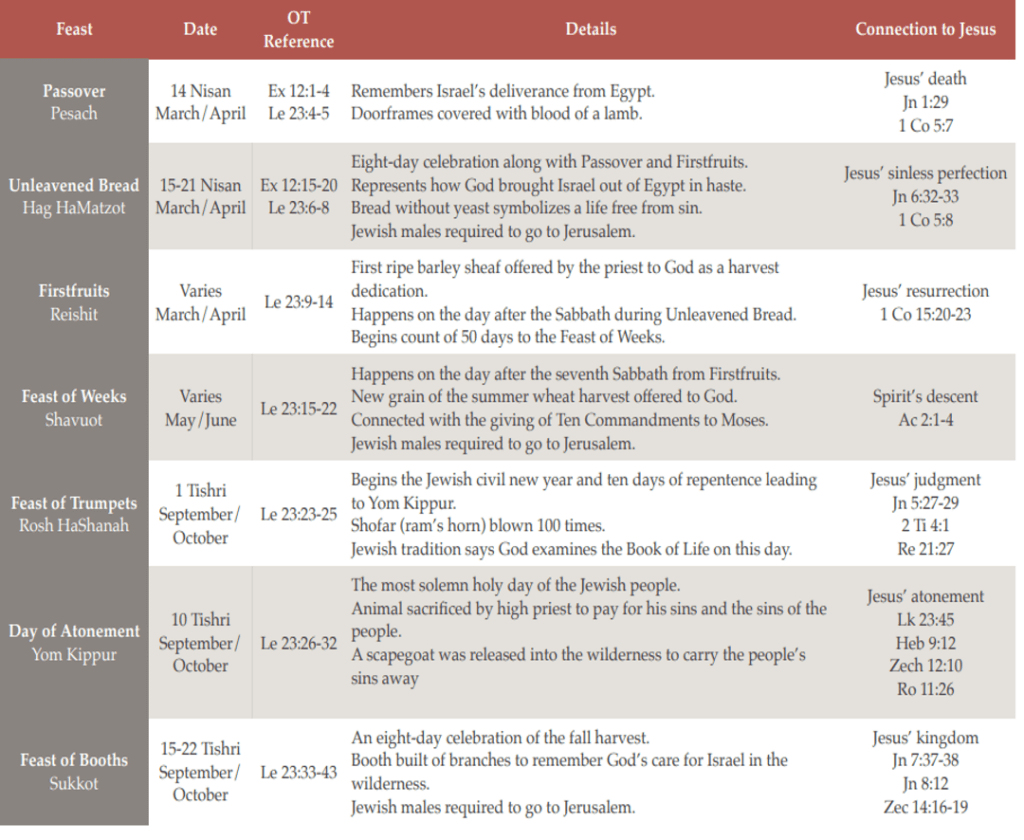
These feasts were commanded to be observed exactly as directed by God in Leviticus 23. They were essential to help Israel remember how God freed them from captivity, blessed them in harvest, dealt with their sins, and guided them in the wilderness. Jesus fulfilled all the requirements connected with these feasts by His death and resurrection. It would be wrong to require them today: “Do you wish to be enslaved by them all over again? You are observing special days and months and seasons and years! I fear for you, that somehow I have wasted my efforts on you” (Gal.4:9-11). Yet, it is important to study them to understand the great price Jesus paid to fulfill all these requirements. In fact, some churches have found that their study of the book of John especially has been enriched by reenacting these feasts occasionally on a voluntary basis.
READING FOR SEPTEMBER 6, 2024 CONTINUED: LUKE 24, PSALM 92 LUKE 24
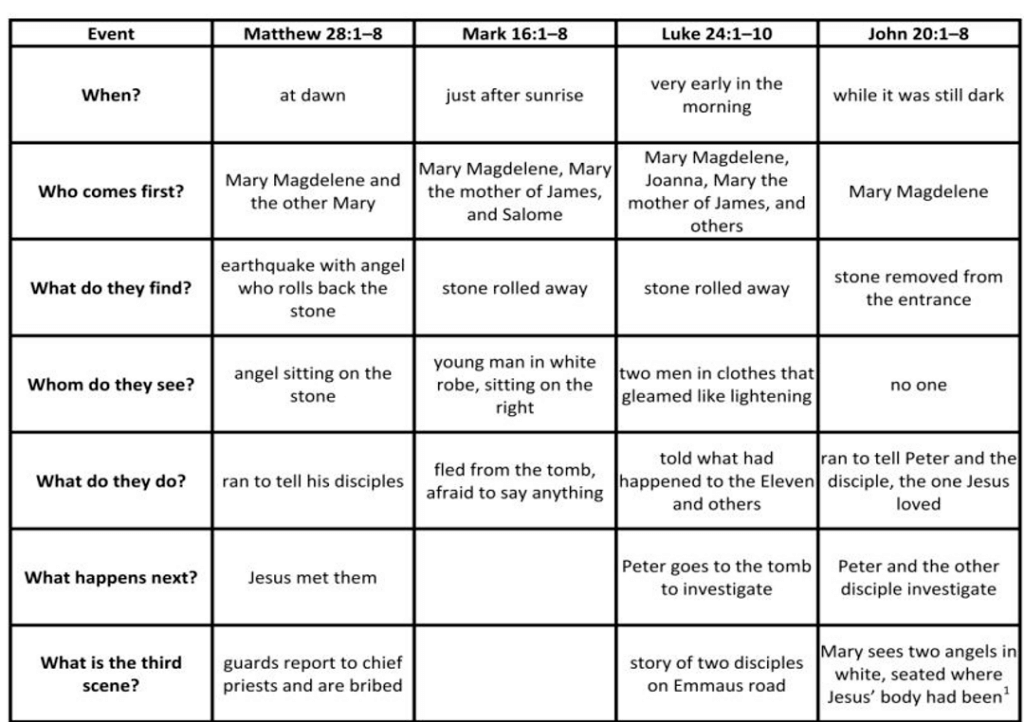
What to do with differences among the gospel writers about the resurrection? We have often referred to Bart Ehrman in these study guides because he is possibly the most prominent biblical skeptic in academic circles today. One of his major points has been the differences found in the resurrection accounts. The chart above was put together by four major biblical scholars of the twentieth century who were also practicing Christians. They are not at all hiding these differences, nor should we. The comments below are from Dr. Ehrman‘s Blog. Following that will be a little more from these Christian scholars. “What does one do with the fact that the women apparently meet different persons at the tomb? In Mark it is one man, in Luke it is two men, and in Matthew it is one angel. The way this discrepancy is sometimes reconciled, by readers who can’t believe there could be a genuine discrepancy in the text, is by saying that the women actually met two angels at the tomb. Matthew mentions only one of them, but never denies there was a second one; moreover, the angels were in human guise, so Luke claims they were two men; Mark also mistakes the angels as men but mentions only one, not two, without denying there were two. And so, the problem is easily solved! But it is solved in a very curious way indeed.”
READING FOR SEPTEMBER 6, 2024 CONTINUED: LUKE 24, PSALM 92 The quotation below is from Hard Sayings of the Bible by Kaiser, Davids, Bruce, and Baruch: “Finally, when we try to put the stories together, we miss the point of the authors. The church accepted into its canon four separate Gospels, viewing each as inspired by God. It did not put into the canon a harmony of these Gospels (although such existed). The fact is that each writer is trying to bring out his unique perspective and theological insights by the details he includes or leaves out... Matthew wants to underline the miraculous and also explain a rumor that the body of Jesus was stolen. Luke stresses the fulfillment of the words of Jesus and yet the disbelief of the apostles. John, by focusing on a single character and her intimate discussion with Jesus, points out that in the resurrection and ascension of Jesus the promises of John 13–16 are fulfilled. Jesus cannot be held, for it is better for him to go to the one who is not only his Father but is now also our Father. It is when we look at the resurrection through such eyes, informed by the perspective of each Gospel writer, that we see not simply a miracle, nor even the fact of the resurrection, but the message the church has believed that God wanted to communicate in and through the resurrection of Jesus Christ.”
Other significant insights from Luke’s accounts:
- The angels said this in Verses 6-8: “Remember how he told you, while he was still with you in Galilee: “The Son of Man must be delivered over to the hands of sinners, be crucified and on the third day be raised again.” Here are Jesus’s words from verse 26: “Did not the Messiah have to suffer these things and then enter his glory?” On the other hand, here is a recent comment from a Baptist minister: “It was not God’s intent that Jesus die. God’s intent was that people listen to Jesus, follow Jesus, be changed by Jesus. That was God’s intent.” Apparently. the pastor, like the disciples, missed this when Jesus taught it three times before in Luke. What would the pastor make of Leviticus?
- What does Jesus do when he wants to prove a point on the Road to Emmaus? “Beginning with Moses and all the Prophets, He explained to them what was said in all the Scriptures concerning himself” (vs. 27). It’s good to have opinions, but why not refer to God’s word to discern truth?
- What does Jesus do to prove a point when meeting other disciples? “Then he opened their minds so they could understand the Scriptures. He told them, ‘This is what is written: The Messiah will suffer and rise from the dead on the third day, and repentance for the forgiveness of sins will be preached in his name to all nations, beginning at Jerusalem.”’ (vs. 45-47). BASE BELIEFS ON THE BIBLE.
PSALM 92 Verses 1-4 say it’s good to sing thanks and praises to God’s for His attributes day and night accompanied by instruments. The reason is God has made us joyful for what He’s done for us. Let’s assume this is true. Set our stopwatches for 60 seconds and thank God for the joy He has brought to our lives ......................................................................Time’s up. Verses 5-9 say, however, wickedness is temporarily flourishing due to the of lack of under- standing of God’s ways. Get out our stopwatches setting them for 60 seconds. Pray for God to scatter this evil that we are witnessing..........................................................................Time’s up. Verses 10-15 say we can receive fresh anointing to perceive these evils more accurately. As people of faith, God will plant and grow us with His people. We can bear fruit for Him and tell of His goodness to others into our old age. We can if He is our Rock. Let’s Rock!
